Which of the following is NOT a characteristic of a double-stranded DNA helix. Question 22 options:...
Which of the following is NOT a characteristic of a double-stranded DNA helix.
Question 22 options:
|
The width of the helix is 20 Angstroms. |
|
|
Bases are separated by 10 Angstroms. |
|
|
The length of one helical turn is 34 Angstroms. |
|
|
All these statements are true. |
Homework Answers
Which of the following is not a characteristic of a double stranded DNA helix
THE CORRECT ANSWER IS D) ALL THESE STATEMENTS ARE TRUE
Dimensions of DNA
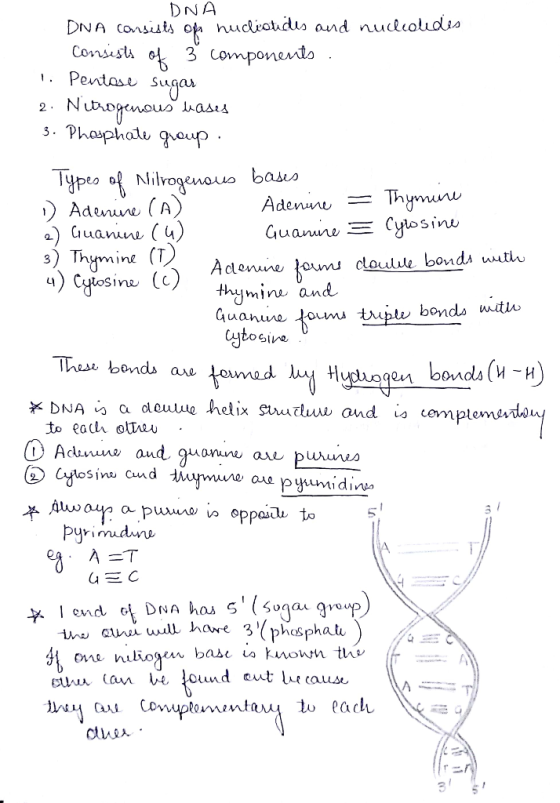
The diameter aur width of DNA molecule is 2nm or 20 angstroms. When DNA molecule makes 1 complete 360 degree turn, it covers a distance of 3.4nm or 34 angstroms. There are 10base pairs in 10 angstroms.
Add Answer to:
Which of the following is NOT a characteristic of a
double-stranded DNA helix.
Question 22 options:...
On a planet other than earth, an organism has DNA with a left handed double helix...
On a planet other than earth, an organism has DNA with a left handed double helix with a rise of 0.61 A and a helical pitch of 9.76 A. When the DNA wraps around a histone 181 bases of DNA surround the histone and each nucleosome is separated by 121 bases of DNA. How many bases are found in a single pitch ( one turn of DNA ) ?
Draw the DNA double helix as proposed by Watson and Crick in their famous 1953 paper....
Draw the DNA double helix as proposed by Watson and Crick in their famous 1953 paper. On this drawing, indicate the locations of the following: the ribose-phosphodiester backbone the base pairs the 5' and 3' ends of the two strands the number of base pairs in one complete turn of the helix the length of 1 complete turn of the double helix (in Angstroms or nanometers)
Select the phrases that accurately describe properties of the most common form of the DNA double helix
Select the phrases that accurately describe properties of the most common form of the DNA double helix. There is more than one correct answer. Select all that apply. DNA contains equal amounts of adenine and thymine, and equal amounts of cytosine and guanine. A helical turn consists of about 10 nucleotides. Base pairs have a spacing of 20 A. The phosphodiester bonds between nucleotide residues run in opposite directions in the two strands. The nitrogenous bases are exposed to the solvent, whereas the sugar-phosphate backbone of...
6a. Dissociation of the double stranded DNA helix into single coils is referred to as DNA...
6a. Dissociation of the double stranded DNA helix into single coils is referred to as DNA melting. In this process, two strands of a DNA molecule can be separated by heat without breaking any covalent bonds. Every unique DNA molecule “melts” at a different temperature. Determine the order of the DNA sequences listed below according to relative melting temperatures (lowest Tm to highest Tm). Assume that they all begin as stable double-stranded DNA molecules. [3 pts] A. CTGAATCA B. CAGTGTCT...
Which of the following statements is true regarding the discovery of the double helix? Choose 1...
 Which of the following statements is true regarding the discovery of the double helix? Choose 1 answer: (A) It was discovered that double-stranded DNA is a parallel molecule. Rosalind Franklin's x-ray crystallography provided Watson and Crick with important data that helped determine the structure of DNA. The experiments that led to the discovery of the double helix ultimately disproved Chargaff's rules regarding nitrogenous bases. James Watson, Francis Crick, Maurice Wilkins, and Rosalind Franklin were awarded the Nobel Prize in Medicine...
Sketch the diffraction pattern you would expect to see for the following DNA molecules: (a) DNA...
Sketch the diffraction pattern you would expect to see for the following DNA molecules: (a) DNA isolated from humans, (b) Martian DNA, which is a double stranded DNA molecule with a 1⁄4 offset and 8 bases per turn, and (c) Jovian DNA, which is single stranded DNA molecule with 6 bases per turn. You only need to sketch the diffraction above the direct x-ray beam (i.e. the top half of the X due to the helix). Your sketch should extend...
QUESTION 11 Which is true of the structure the DNA double helix? A. The sugar-phosphate backbone...
QUESTION 11 Which is true of the structure the DNA double helix? A. The sugar-phosphate backbone faces outward. B. The nitrogen-containing bases face inward and form hydrogen bonds to one another. C. Adenine (A) bonds to Thymine (T). D. Adenine (A) bonds the Cytosine (C).
What is the angle of the turns of DNA? What length in Å (Angstrom) would be...
 What is the angle of the turns of DNA?
What length in Å (Angstrom) would be DNA with 23 chromosomes in
the sex cells?
If p = 34 Å how many angstroms would you estimate is the
length of the hydrogen bond?
Interpretation of crystallograph 17h 01/p IP sin = n2/20 - tilt of helix (angle from perpendicular to long axis) - 3.4 A (Distance between bases) P = 34 Å (Distance for one complete turn of helix; Repeat unit...
What is the angle of the turns of DNA?
What length in Å (Angstrom) would be DNA with 23 chromosomes in
the sex cells?
If p = 34 Å how many angstroms would you estimate is the
length of the hydrogen bond?
Interpretation of crystallograph 17h 01/p IP sin = n2/20 - tilt of helix (angle from perpendicular to long axis) - 3.4 A (Distance between bases) P = 34 Å (Distance for one complete turn of helix; Repeat unit...
In a test tube, a strand of double-stranded DNA can be separated into two single-stranded DNA...
 In a test tube, a strand of double-stranded DNA can be separated into two single-stranded DNA molecules by applying energy such as heat. Sequences for two different dsDNA molecules are shown below (dsDNA 1 and dsDNA 2). Which one of these two would require less energy to be separated? Explain your reason. Note: Both dsDNA are 20 base pairs long. The sequence for only one of the strands in each dsDNA are shown dsDNA 1: GCGCACGGACGGCCCGCACC dsDNA 2: TATTAGTATACTAATAAGTT
QUESTION 34 The nucleotide sequence of one DNA strand of a DNA double helix is 5-GGATTTTTGTCCACAATCA-3'...
 QUESTION 34 The nucleotide sequence of one DNA strand of a DNA double helix is 5-GGATTTTTGTCCACAATCA-3' What is the sequence of the complementary strand? A. 5-CCTAAAAACAGGTGTTAGT-3 B.3.CCUAAAAACAGGUGUUAGU-5 C.3-CCTAAAAACAGGTGTTAGT-5 D. None of these QUESTION 35 In the DNA of the spinach chloroplast, 31% of the nitrogenous bases are adenine (A). What are the percentages of the other bases? A. 25% G, 25% C, 19% T B. 19% G, 19% C, 31% T C.31% G, 19% C, 19% T D.31% G, 31%...
 Which of the following statements is true regarding the discovery of the double helix? Choose 1 answer: (A) It was discovered that double-stranded DNA is a parallel molecule. Rosalind Franklin's x-ray crystallography provided Watson and Crick with important data that helped determine the structure of DNA. The experiments that led to the discovery of the double helix ultimately disproved Chargaff's rules regarding nitrogenous bases. James Watson, Francis Crick, Maurice Wilkins, and Rosalind Franklin were awarded the Nobel Prize in Medicine...
 What is the angle of the turns of DNA?
What length in Å (Angstrom) would be DNA with 23 chromosomes in
the sex cells?
If p = 34 Å how many angstroms would you estimate is the
length of the hydrogen bond?
Interpretation of crystallograph 17h 01/p IP sin = n2/20 - tilt of helix (angle from perpendicular to long axis) - 3.4 A (Distance between bases) P = 34 Å (Distance for one complete turn of helix; Repeat unit...
What is the angle of the turns of DNA?
What length in Å (Angstrom) would be DNA with 23 chromosomes in
the sex cells?
If p = 34 Å how many angstroms would you estimate is the
length of the hydrogen bond?
Interpretation of crystallograph 17h 01/p IP sin = n2/20 - tilt of helix (angle from perpendicular to long axis) - 3.4 A (Distance between bases) P = 34 Å (Distance for one complete turn of helix; Repeat unit...
 In a test tube, a strand of double-stranded DNA can be separated into two single-stranded DNA molecules by applying energy such as heat. Sequences for two different dsDNA molecules are shown below (dsDNA 1 and dsDNA 2). Which one of these two would require less energy to be separated? Explain your reason. Note: Both dsDNA are 20 base pairs long. The sequence for only one of the strands in each dsDNA are shown dsDNA 1: GCGCACGGACGGCCCGCACC dsDNA 2: TATTAGTATACTAATAAGTT
 QUESTION 34 The nucleotide sequence of one DNA strand of a DNA double helix is 5-GGATTTTTGTCCACAATCA-3' What is the sequence of the complementary strand? A. 5-CCTAAAAACAGGTGTTAGT-3 B.3.CCUAAAAACAGGUGUUAGU-5 C.3-CCTAAAAACAGGTGTTAGT-5 D. None of these QUESTION 35 In the DNA of the spinach chloroplast, 31% of the nitrogenous bases are adenine (A). What are the percentages of the other bases? A. 25% G, 25% C, 19% T B. 19% G, 19% C, 31% T C.31% G, 19% C, 19% T D.31% G, 31%...
Most questions answered within 3 hours.
-
Where is the error in this code sequence?
String s1 = "Hello";
String s2 = "ello";...
asked 11 months ago -
Financial data for Joel de Paris, Inc., for last year
follow:
Joel de Paris, Inc.
Balance...
asked 11 months ago -
Consider this reaction:
Al2(SO4)3 (aq)+ BaCl3
(aq) Al2Cl6 (aq)- +
3BaSO4(s) . What is the...
asked 11 months ago -
Suppose that Savneet is considering increasing her
recent random sample from 20 car rentals to 40...
asked 11 months ago -
Trucks arrive at an unloading terminal at an average rate of 120
per hour.
Trucks arrive...
asked 11 months ago -
Why are methanol and ethanol completely soluble in water while
octanol is not very little soluble....
asked 11 months ago -
A facilities manager at a university reads in a research report
that the mean amount of...
asked 11 months ago -
When the CuSO4 is rehydrated by adding water to the anhydrous
compound, is this an endothermic...
asked 11 months ago -
A ray of sunlight is passing from diamond into crown glass; the
angle of incidence is...
asked 11 months ago -
A block of mass 0.249 kg is placed on top of a light, vertical
spring of...
asked 11 months ago -
how do the kidneys compensate in the presences of acidosis
a) trigger hyperventilate
b) reserve acid...
asked 11 months ago -
Question 501 pts
The rental rate of capital to the firm increases. Which of the
following...
asked 11 months ago