Match each cell component with its function. _____ mitochondriona. synthesis of polypeptide chains _____ chloroplastb. initial...
Match each cell component with its function. _____ mitochondriona. synthesis of polypeptide chains _____ chloroplastb. initial modification of new polypeptide chains _____ ribosomec. final modification of proteins; sorting, shipping tasks _____ rough ERd. photosynthesis _____ Golgi bodye. formation of many ATP
Homework Answers
ANSWER :
Matching the cellular components with their function :-
1. Mitochondria --- formation of many ATPs
2. Chloroplast --- photosynthesis
3. Ribosome --- synthesis of polypeptide chains
4. Rough endoplasmic reticulum --- initial modification of the new polypeptide chains
5. Golgi body --- final modification of proteins; sorting, shipping tasks
Add Answer to:
Match each cell component with its function. _____
mitochondriona. synthesis of polypeptide chains _____ chloroplastb.
initial...
Match the organelle with its function. 14 01:04:36 A. Instructions for protein synthesis and cell reproduction...
 Match the organelle with its function. 14 01:04:36 A. Instructions for protein synthesis and cell reproduction contains genetic information B. Intracellular compartment forms transport vesicles, participates in lipid synthesis and synthesis of membrane or secreted proteins lekto rach Click to select) C. Packages proteins for export from cell; forms secretory vesicle Click to select D. Digest wom-out organelles and cell debris: digest material taken up by endocytosis cick to select E. "Power plants of the cell; sites of oxidative metabolism...
Match the component to its function during in vitro DNA synthesis. This question has multiple parts;...
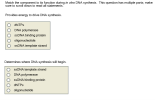 Match the component to its function during in vitro DNA synthesis. This question has multiple parts; make sure to scroll down to read all statements Provides energy to drive DNA synthesis. O dNTPs O DNA polymerase O sSDNA binding protein O oligonucleotide O sSDNA template strand Determines where DNA synthesis will begin. O SSDNA template strand O DNA polymerase O ssDNA binding protein O dNTPs O oligonucletide
Match each type of immune system cell to its function or description. (Use each description once)....
Match each type of immune system cell to its function or description. (Use each description once). Helper T-cell Detects pathogens and releases chemokines as part of the inflammatory response Participates in activation of B-cells if it has receptors for the same antigens Has receptors that are specific to particular antigen structures and releases antibodies as part of the humoral response Releases histamine as part of the inflammatory response Secretes proteins that cause infected cells to undergo apoptosis White blood cell...
Match the prokaryotic cell structure with its function(s) or its role(s) in disease by placing the letter(s) on the bla...
Match the prokaryotic cell structure with its function(s) or its role(s) in disease by placing the letter(s) on the blank line. Note: Each structure may have more than one function/role associated with it. However, each function/role will be used only one time. (1/4 pt. each correct answer; -1/4 pt. each incorrect answer) Prokaryotic Cell Structure Function or Role in Disease Peptidoglycan Site of protein synthesis (a.k.a., translation) Flagellum (flagella); Axial fibrils (a.k.a, endoflagella, periplasmic flagella) Reception and processing of electrochemical...
Match the functions listed on the left to the subcellular organelles responsible for those functions listed...
Match the functions listed on the left to the subcellular organelles responsible for those functions listed on the right. Question 6 options: 12345678910 sub-cellular organellse actually responsible for the packaging of cellular proteins that must be contained within membrane-bound vesicle. Proteins 'packaged' by these organelles would include hydrolytic digestive enzymes that are used within the cell but must be sequestered away from other parts of the cell so they don't digest the cell itself, or enzymes like catalases and dismutases...
Match the reproductive system cell with its description or function. Notochord Formation of internal organs during...
Match the reproductive system cell with its description or function. Notochord Formation of internal organs during development Germ layer that forms the lining of the digestive and respiratory systems Rod-shaped mesodermal structure that forms following gastrulation and releases signaling molecules Infolding of the blastula to form the three germinal tissue layers Hollow ball of cells that results from cleavage Rapid series of cell divisions without cell growth following fertilization A ball of mesoderm that eventually produces muscle and bone tissue...
please answer all that you can 1. You have genetically engineered green fluorescent protein (GFP) containing...
please answer all that you can 1. You have genetically engineered green fluorescent protein (GFP) containing a KDEL sequence (GFP-KDEL). When GFP-KDEL is expressed in normal human fibroblasts and examined using fluorescence microscopy, the fluorescence appears diffuse across the cytoplasm. How would you explain this observations given that KDEL is supposed to be an ER-specific sorting sequence? A. This engineered GFP would not have a hydrophobic signal sequence to get it into the RER in the first place. B. The...
Name: Match each microscope component with its description or function. 1. Objective _2. Ocular __3. Condenser...
 Name: Match each microscope component with its description or function. 1. Objective _2. Ocular __3. Condenser 4. Diaphragm a. gathers light rays and focuses on object b. eyepiece c. magnifying element located on nosepiece d. disk with an opening that adjusts amount of light that contacts specimen Match each reagent of the Gram stain with its description or purpose. __5. Crystal violet ___6. Gram's iodine ___7. Acid alcohol 8. Safanin a. Secondary or counterstain b. Mordant C. Primary stain d....
9 ) When viewed with an electron microscope, what gives the rough Endoplasmic Reticulum its rough...
9 ) When viewed with an electron microscope, what gives the rough Endoplasmic Reticulum its rough appearance? A) The nucleus B) Mitochondria C) Nucleosomes D) Ribosomes E)sugars 10 ) Which statement below describes the function of smooth endoplasmic reticulum? A) Packing and sorting of newly synthesized macromolecules B) Protein Synthesis C) Cellular Respiration D) Detoxification and hydrolysis of polysaccharide E) Photosynthesis 11 ) If a cell is in a hypotonic environment that means…….. Protein synthesis The solute concentration inside...
SHORT ANSWER. Write the word or phrase that best completes each statement or answers the question....
 SHORT ANSWER. Write the word or phrase that best completes each statement or answers the question. 00 OA Figure 2.1 Using Figure 2.1, match the following: 1) Tertiary (protein) structure, 2) Monosaccharide 3) Nucleotide 4) Lipid 5) Functional protein 6) Polymer 7) Polysaccharide TRUE FALSE. Write T if the statement is true and F if the statement is false, 8) Final preparation for cell division is made during the cell life cycle subphase called G2. SHORT ANSWER. Write the word...
 Match the organelle with its function. 14 01:04:36 A. Instructions for protein synthesis and cell reproduction contains genetic information B. Intracellular compartment forms transport vesicles, participates in lipid synthesis and synthesis of membrane or secreted proteins lekto rach Click to select) C. Packages proteins for export from cell; forms secretory vesicle Click to select D. Digest wom-out organelles and cell debris: digest material taken up by endocytosis cick to select E. "Power plants of the cell; sites of oxidative metabolism...
 Match the component to its function during in vitro DNA synthesis. This question has multiple parts; make sure to scroll down to read all statements Provides energy to drive DNA synthesis. O dNTPs O DNA polymerase O sSDNA binding protein O oligonucleotide O sSDNA template strand Determines where DNA synthesis will begin. O SSDNA template strand O DNA polymerase O ssDNA binding protein O dNTPs O oligonucletide
 Name: Match each microscope component with its description or function. 1. Objective _2. Ocular __3. Condenser 4. Diaphragm a. gathers light rays and focuses on object b. eyepiece c. magnifying element located on nosepiece d. disk with an opening that adjusts amount of light that contacts specimen Match each reagent of the Gram stain with its description or purpose. __5. Crystal violet ___6. Gram's iodine ___7. Acid alcohol 8. Safanin a. Secondary or counterstain b. Mordant C. Primary stain d....
 SHORT ANSWER. Write the word or phrase that best completes each statement or answers the question. 00 OA Figure 2.1 Using Figure 2.1, match the following: 1) Tertiary (protein) structure, 2) Monosaccharide 3) Nucleotide 4) Lipid 5) Functional protein 6) Polymer 7) Polysaccharide TRUE FALSE. Write T if the statement is true and F if the statement is false, 8) Final preparation for cell division is made during the cell life cycle subphase called G2. SHORT ANSWER. Write the word...
Most questions answered within 3 hours.
-
Where is the error in this code sequence?
String s1 = "Hello";
String s2 = "ello";...
asked 10 months ago -
Financial data for Joel de Paris, Inc., for last year
follow:
Joel de Paris, Inc.
Balance...
asked 10 months ago -
Consider this reaction:
Al2(SO4)3 (aq)+ BaCl3
(aq) Al2Cl6 (aq)- +
3BaSO4(s) . What is the...
asked 10 months ago -
Suppose that Savneet is considering increasing her
recent random sample from 20 car rentals to 40...
asked 10 months ago -
Trucks arrive at an unloading terminal at an average rate of 120
per hour.
Trucks arrive...
asked 10 months ago -
Why are methanol and ethanol completely soluble in water while
octanol is not very little soluble....
asked 10 months ago -
A facilities manager at a university reads in a research report
that the mean amount of...
asked 10 months ago -
When the CuSO4 is rehydrated by adding water to the anhydrous
compound, is this an endothermic...
asked 10 months ago -
A ray of sunlight is passing from diamond into crown glass; the
angle of incidence is...
asked 10 months ago -
A block of mass 0.249 kg is placed on top of a light, vertical
spring of...
asked 10 months ago -
how do the kidneys compensate in the presences of acidosis
a) trigger hyperventilate
b) reserve acid...
asked 10 months ago -
Question 501 pts
The rental rate of capital to the firm increases. Which of the
following...
asked 10 months ago