1. If a restriction enzyme cuts a circular plasmid twice, how many fragments would you see...
1. If a restriction enzyme cuts a circular plasmid twice, how many fragments would you see on the gel?
2. How would you estimate the total number of base pairs in a plasmid by looking at the DNA fragments of the digested plasmid on a gel?
3. If a linear 1kb DNA fragment has a restriction site that is located 50 bp from one end of the plasmid, what would you expect to see if the digested and undigested DNA samples were run on a 1% agarose TAE gel?
Homework Answers
1)
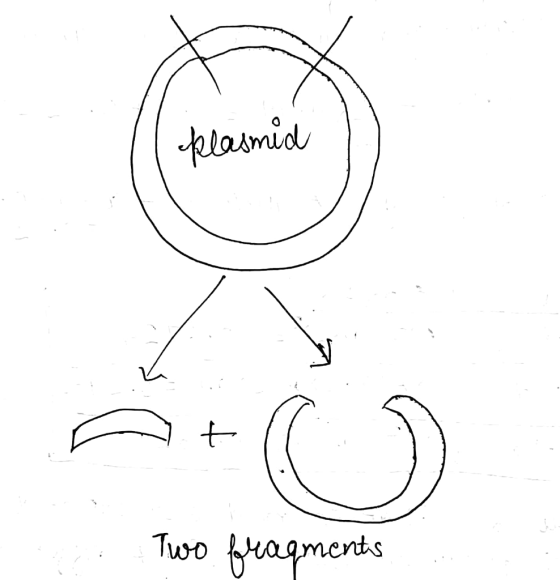
If a restriction enzyme cut a plasmid two times,then two fragments are obtained.
Look in the image for diagrammaric representation:
2)
We also load a DNA ladder in the well of gel electrophoresis. We also load our digested sample in the gel. Then look for the corresponding band fragments. And compare it with the DNA ladder. In this way, the molecular weight of fragments are obtained.
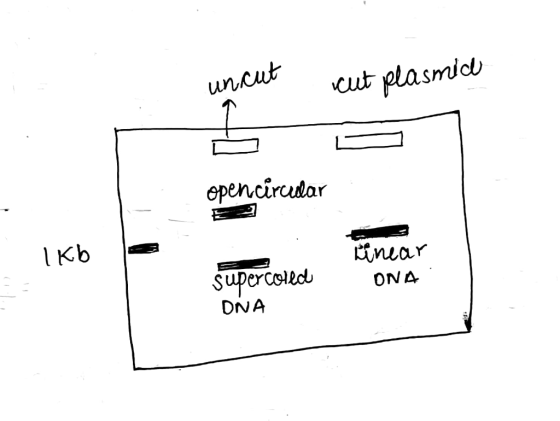
3) There is found one restriction site in the plasmid. That's why the digested plasmid have linear DNA.
The uncut plasmid have two forms open circular DNA and supercoiled DNA. The following pattern is observed in the gel.
Supercoiled DNA runs faster than open curcular DNA because of less friction.
Please rate.
Add Answer to:
1. If a restriction enzyme cuts a circular plasmid twice, how
many fragments would you see...
Sketch the predicted migration pattern on an agarose gel of the following DNA samples: (1) Undigested...
Sketch the predicted migration pattern on an agarose gel of the following DNA samples: (1) Undigested pET15b plasmid; (2) pET15b digested with the EagI restriction enzyme; (3) pET15b digested with NdeI and AhdI (see pET15b vector map for location of these enzyme cutting sites). Include in your sketch a DNA base-pair ladder from 0 to 10,000 bp with 1000 bp increments. Label each band in the DNA ladder with the known size (in base-pairs), and estimate the size of the...
1) If a restriction enzyme cuts a circular DNA into five fragments, how many restriction sites...
1) If a restriction enzyme cuts a circular DNA into five fragments, how many restriction sites are there in the DNA? 2) How many molecules of DNA will be present after 6 cycles of PCR, if you started with one double-stranded DNA molecule? CELL BIOLOGY QUESTIONS!! SHOW WORK PLEASE
1. A circular plasmid has two PmeI restriction sites. A PmeI restriction enzyme will cut this...
1. A circular plasmid has two PmeI restriction sites. A PmeI restriction enzyme will cut this plasmid into two fragments. A. True B. False 2.In general, restriction enzymes that recognize four nucleotides have higher probability to produce more DNA fragments than those enzymes that recognize six nucleotides. A. true B. false 3. Which of the following sequences are palindromes? A. 5' TGGCCA 3' B. 5' GAAAAG 3' C. 5' CGATGG 3' D. 5' GACGAC 3' 4. Below are the possible...
A restriction digest of a circular plasmid is conducted using two different restriction enzymes. Restriction enzyme...
A restriction digest of a circular plasmid is conducted using two different restriction enzymes. Restriction enzyme 1 cuts the plasmid in one place while restriction enzyme 2 cuts in two places. All restriction sites are at least 1kB apart from each other. Based on this information, the resulting gel should have _____ bands for the enzyme 1 reaction, _____ bands for the enzyme 2 reaction, and _____ bands for the reaction that contains both enzymes A 1; 2; 3 B...
In your previous prac session you digested your POTC-A plasmid DNA with 3 enzyme mixes (AB...
 In your previous prac session you digested your POTC-A plasmid DNA with 3 enzyme mixes (AB and C). One mix contained the restriction endonuclease Kpnl alone, another contained both del and Not and another contained Sphi and Nhe, but you don't know which was which yet. The sites where these enzymes cut POTC-A are indicated on the plasmid map at the top of the page. Calculate the sizes of the DNA fragments that you would expect to see on your...
The figure below shows a restriction map of a segment of a DNA molecule. Eco refers...
 The figure below shows a restriction map of a segment of a DNA molecule. Eco refers to locations where the restriction endonuclease EcoRI cuts the DNA, and Pst refers to locations where the restriction enzyme Pst cuts the DNA. Potential restriction sites are numbered 1-6. Distances between restriction sites are shown on the bottom scale in base pairs (bp). The thick line represents the part of the molecule that has homology with a probe. Eco Pst Eco Pst Eco Pst...
Now determine the sizes of the fragments generated after digesting the r-plasmid with each of the...
 Now determine the sizes of the fragments generated after digesting the r-plasmid with each of the restriction enzymes or combination of restriction enzymes. r-plasmid digested with Pstl r-plasmid digested with EcoRI r-plasmid digested with both Pstl and EcoRI Question 8. (3 pts.) Use this information to determine the relative placement of these restriction sites in the r-plasmid, and then draw restriction site maps of the vector and the r-plasmid on the following circular chromosome templates. The map should show the...
can someone explain throughly on how to find a-c??? thanks!!! The following question will provide practice in interpreting and analyzing gel results. 5. You obtained the DNA electrophoresis gel be...
 can
someone explain throughly on how to find a-c??? thanks!!!
The following question will provide practice in interpreting and analyzing gel results. 5. You obtained the DNA electrophoresis gel below. Three samples of lambda phage DNA were digested with 3 different restriction enzymes and the digested DNA was applied to the gel in lane 4 and the bands were visualized. The Hind Ill digest was used as a molecular weight standard marker and produced 6 DNA fragments of known size:...
can
someone explain throughly on how to find a-c??? thanks!!!
The following question will provide practice in interpreting and analyzing gel results. 5. You obtained the DNA electrophoresis gel below. Three samples of lambda phage DNA were digested with 3 different restriction enzymes and the digested DNA was applied to the gel in lane 4 and the bands were visualized. The Hind Ill digest was used as a molecular weight standard marker and produced 6 DNA fragments of known size:...
Suppose you are going to do a restriction digest with a plasmid, using the restriction enzyme...
Suppose you are going to do a restriction digest with a plasmid, using the restriction enzyme Eco R1. A map of the plasmid is shown here. The entire plasmid is 6000 bp, and there are Eco R1 restriction sites at 1500 bp, 2000 bp, and 4000 bp. You’re going to run the entire volume of the digest on a gel, and you want to cut just enough DNA to have 50 ng in the smallest band on your gel. Starting...
Prac result Nhel Kpn I 1569 1601 Kpni 1030 2295 / 2310 Not I 988 ОТС-д...
 Prac result
Nhel Kpn I 1569 1601 Kpni 1030 2295 / 2310 Not I 988 ОТС-д Sphi 2559 Nde I 484 POTC-A 6401 bp Hygro Amp Nde1 3369 pUC Ori 5260 4587 Amp: Ampicillin resistance gene 5405 - 6265 Hygro: Hygromycin resistance gene Choose the gel image with correct bands in lanes 1 to 5 to indicate the approximate positions where you expect to see these predicted DNA fragments. (1 mark) Lane 1: POTC (undigested / uncut) Lane 2: POTC-A...
Prac result
Nhel Kpn I 1569 1601 Kpni 1030 2295 / 2310 Not I 988 ОТС-д Sphi 2559 Nde I 484 POTC-A 6401 bp Hygro Amp Nde1 3369 pUC Ori 5260 4587 Amp: Ampicillin resistance gene 5405 - 6265 Hygro: Hygromycin resistance gene Choose the gel image with correct bands in lanes 1 to 5 to indicate the approximate positions where you expect to see these predicted DNA fragments. (1 mark) Lane 1: POTC (undigested / uncut) Lane 2: POTC-A...
 In your previous prac session you digested your POTC-A plasmid DNA with 3 enzyme mixes (AB and C). One mix contained the restriction endonuclease Kpnl alone, another contained both del and Not and another contained Sphi and Nhe, but you don't know which was which yet. The sites where these enzymes cut POTC-A are indicated on the plasmid map at the top of the page. Calculate the sizes of the DNA fragments that you would expect to see on your...
 The figure below shows a restriction map of a segment of a DNA molecule. Eco refers to locations where the restriction endonuclease EcoRI cuts the DNA, and Pst refers to locations where the restriction enzyme Pst cuts the DNA. Potential restriction sites are numbered 1-6. Distances between restriction sites are shown on the bottom scale in base pairs (bp). The thick line represents the part of the molecule that has homology with a probe. Eco Pst Eco Pst Eco Pst...
 Now determine the sizes of the fragments generated after digesting the r-plasmid with each of the restriction enzymes or combination of restriction enzymes. r-plasmid digested with Pstl r-plasmid digested with EcoRI r-plasmid digested with both Pstl and EcoRI Question 8. (3 pts.) Use this information to determine the relative placement of these restriction sites in the r-plasmid, and then draw restriction site maps of the vector and the r-plasmid on the following circular chromosome templates. The map should show the...
 can
someone explain throughly on how to find a-c??? thanks!!!
The following question will provide practice in interpreting and analyzing gel results. 5. You obtained the DNA electrophoresis gel below. Three samples of lambda phage DNA were digested with 3 different restriction enzymes and the digested DNA was applied to the gel in lane 4 and the bands were visualized. The Hind Ill digest was used as a molecular weight standard marker and produced 6 DNA fragments of known size:...
can
someone explain throughly on how to find a-c??? thanks!!!
The following question will provide practice in interpreting and analyzing gel results. 5. You obtained the DNA electrophoresis gel below. Three samples of lambda phage DNA were digested with 3 different restriction enzymes and the digested DNA was applied to the gel in lane 4 and the bands were visualized. The Hind Ill digest was used as a molecular weight standard marker and produced 6 DNA fragments of known size:...
 Prac result
Nhel Kpn I 1569 1601 Kpni 1030 2295 / 2310 Not I 988 ОТС-д Sphi 2559 Nde I 484 POTC-A 6401 bp Hygro Amp Nde1 3369 pUC Ori 5260 4587 Amp: Ampicillin resistance gene 5405 - 6265 Hygro: Hygromycin resistance gene Choose the gel image with correct bands in lanes 1 to 5 to indicate the approximate positions where you expect to see these predicted DNA fragments. (1 mark) Lane 1: POTC (undigested / uncut) Lane 2: POTC-A...
Prac result
Nhel Kpn I 1569 1601 Kpni 1030 2295 / 2310 Not I 988 ОТС-д Sphi 2559 Nde I 484 POTC-A 6401 bp Hygro Amp Nde1 3369 pUC Ori 5260 4587 Amp: Ampicillin resistance gene 5405 - 6265 Hygro: Hygromycin resistance gene Choose the gel image with correct bands in lanes 1 to 5 to indicate the approximate positions where you expect to see these predicted DNA fragments. (1 mark) Lane 1: POTC (undigested / uncut) Lane 2: POTC-A...
Most questions answered within 3 hours.
-
Where is the error in this code sequence?
String s1 = "Hello";
String s2 = "ello";...
asked 10 months ago -
Financial data for Joel de Paris, Inc., for last year
follow:
Joel de Paris, Inc.
Balance...
asked 10 months ago -
Consider this reaction:
Al2(SO4)3 (aq)+ BaCl3
(aq) Al2Cl6 (aq)- +
3BaSO4(s) . What is the...
asked 10 months ago -
Suppose that Savneet is considering increasing her
recent random sample from 20 car rentals to 40...
asked 10 months ago -
Trucks arrive at an unloading terminal at an average rate of 120
per hour.
Trucks arrive...
asked 10 months ago -
Why are methanol and ethanol completely soluble in water while
octanol is not very little soluble....
asked 10 months ago -
A facilities manager at a university reads in a research report
that the mean amount of...
asked 10 months ago -
When the CuSO4 is rehydrated by adding water to the anhydrous
compound, is this an endothermic...
asked 10 months ago -
A ray of sunlight is passing from diamond into crown glass; the
angle of incidence is...
asked 10 months ago -
A block of mass 0.249 kg is placed on top of a light, vertical
spring of...
asked 10 months ago -
how do the kidneys compensate in the presences of acidosis
a) trigger hyperventilate
b) reserve acid...
asked 10 months ago -
Question 501 pts
The rental rate of capital to the firm increases. Which of the
following...
asked 10 months ago