

Homework Answers
Add Answer to:
The figure below shows a restriction map of a segment of a DNA molecule. Eco refers...
9. On Worksheet 16.IIIB is a restriction map of bacteriophage lambda. You digest some lambda DNA...
 9. On Worksheet 16.IIIB is a restriction map of bacteriophage lambda. You digest some lambda DNA with the enzymes BamHI and HindIII separately and then load the fragments into an agarose gel and perform electrophoresis. Next, you perform a Southern analysis using the 4,878-bp EcoRI lambda fragment as a probe. a. Draw a picture of the electrophoresis gel, using the outline of the stained electrophoresis gel in Worksheet 16.IIIB (the two smallest HindIII fragments will run off the gel.) b....
A 10 kb linear DNA molecule was digested with restriction enzyme EcoRI (E) and two fragments...
A 10 kb linear DNA molecule was digested with restriction enzyme EcoRI (E) and two fragments were produced of sizes 6 kb and 4 kb. The restriction enzyme HaeIII (H) also produced two fragments of sizes 9 kb and 1 kb. When the two enzymes HaeIII and EcoRI were used together, three fragments were produced of sizes 1 kb, 3 kb, and 6 kb. A 4 kb long cloned genomic probe from this region hybridized to the 3 kb and...
For each problem draw each digest listed as well as a final figure with each restriction...
For each problem draw each digest listed as well as a final figure with each restriction site indicated 1. Construct a restriction map of a linear fragment of DNA, using the following data. Your map should indicate the relative positions of the restriction sites along with distances from the ends of the molecule to the restriction sites and between restriction sites: DNA Sizes of Fragments (bp) uncut DNA: 10,000 DNA cut with EcoRI: 8000, 2000 DNA cut with BamHI: 5000,...
Hello, I came across this question and I am confused on where to start. Restriction mapping...
 Hello,
I came across this question and I am confused on where to
start.
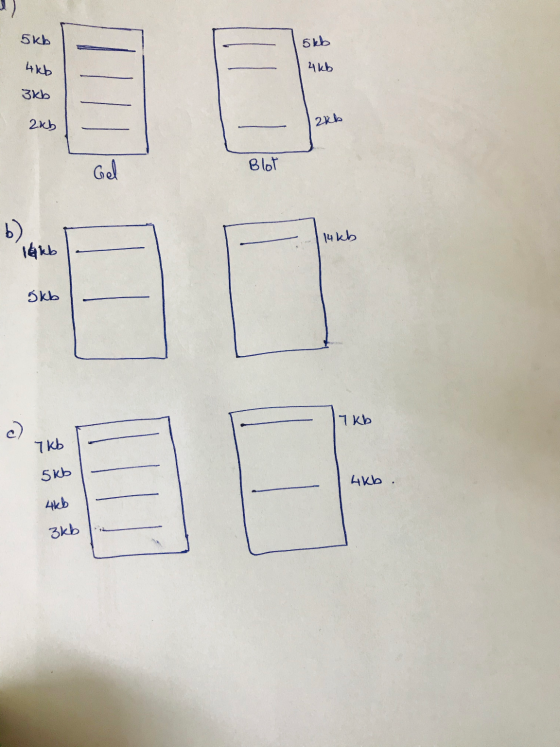
Restriction mapping of a linear piece of DNA reveals the following EcoRI restriction sites. Site 1 Site 2 _2kb 4kb 5kb 1. This piece of DNA is cut by EcoRI the resulting fragments are separated by gel electrophoresis, and the gel is stained. Draw a picture of the bands that will appear in the gel below 2.If a mutation that alters EcoRI site 1 occurs in...
Hello,
I came across this question and I am confused on where to
start.
Restriction mapping of a linear piece of DNA reveals the following EcoRI restriction sites. Site 1 Site 2 _2kb 4kb 5kb 1. This piece of DNA is cut by EcoRI the resulting fragments are separated by gel electrophoresis, and the gel is stained. Draw a picture of the bands that will appear in the gel below 2.If a mutation that alters EcoRI site 1 occurs in...
Questions 9-12 deal with SSR loci in Sam's genome. Remember that SSRs (simple sequence repeats) are...
 Questions 9-12 deal with SSR loci in Sam's genome. Remember that SSRs (simple sequence repeats) are tandem (next to each other) repeats of short sequences (a few bp). Such tandem repeats are located at specific sites scattered throughout the genome. Individuals vary in the number of repeats at each site sites can have up to 100 repeats. Each locus with the same repeats is called an SSR ocus DNA was extracted from Sam's white blood cells and cut with a...
One strand of a DNA sequences is given below. Find the EcoRI sites and indicate the...
 One strand of a DNA sequences is given below. Find the
EcoRI sites and indicate the cutting site with an arrow. Count the
number of bases in each fragment.
CP22: vne strand of a DNA sequence is given below. Find the EcoRI sites and indicate the cutting site with an arrow. Count the number of bases in each fragment. Restriction digest A: ATTGAATTCCGGTTAGCTTTAGAATTCCGCCATATGCGCAATTGGAATTCC Number of bases in each fragment: Now compare the same region of DNA from another individual. Where...
One strand of a DNA sequences is given below. Find the
EcoRI sites and indicate the cutting site with an arrow. Count the
number of bases in each fragment.
CP22: vne strand of a DNA sequence is given below. Find the EcoRI sites and indicate the cutting site with an arrow. Count the number of bases in each fragment. Restriction digest A: ATTGAATTCCGGTTAGCTTTAGAATTCCGCCATATGCGCAATTGGAATTCC Number of bases in each fragment: Now compare the same region of DNA from another individual. Where...
Now determine the sizes of the fragments generated after digesting the r-plasmid with each of the...
 Now determine the sizes of the fragments generated after digesting the r-plasmid with each of the restriction enzymes or combination of restriction enzymes. r-plasmid digested with Pstl r-plasmid digested with EcoRI r-plasmid digested with both Pstl and EcoRI Question 8. (3 pts.) Use this information to determine the relative placement of these restriction sites in the r-plasmid, and then draw restriction site maps of the vector and the r-plasmid on the following circular chromosome templates. The map should show the...
1. You perform a restriction endonuclease assay on an uncharacterized DNA molecule, using Pstl, Sall, and...
 1. You perform a restriction endonuclease assay on an uncharacterized DNA molecule, using Pstl, Sall, and Xhol. When you run the DNA on a 1% agarose gel, you obtain the following information regarding fragment number and length (all lengths are in bp): Pstl (P) 700 200 Sall(s) 600 300 Xhol (X) 500 350 50 Pstl + Sall (P+S) 600 200 100 Pstl + Xhol (P+X) 500 200 150 50 Sall + Xhol (S+X) 500 250 100 50 Solve the following...
. Using the figure of the gel below, draw in the DNA bands in the left...
 . Using the figure of the gel below,
draw in the DNA bands in the left lane that would appear from the
DNA of the person described in the question above. The right lane
contains a molecular weight standard.
the questions are
When circular DNA is sequenced, the
nucleotide base pairs are numbered starting from an fixed position
on the DNA, all the way around, usually in a clockwise
manner. a DNA molecule that is 3133 base pairs long is...
. Using the figure of the gel below,
draw in the DNA bands in the left lane that would appear from the
DNA of the person described in the question above. The right lane
contains a molecular weight standard.
the questions are
When circular DNA is sequenced, the
nucleotide base pairs are numbered starting from an fixed position
on the DNA, all the way around, usually in a clockwise
manner. a DNA molecule that is 3133 base pairs long is...
1. If a restriction enzyme cuts a circular plasmid twice, how many fragments would you see...
1. If a restriction enzyme cuts a circular plasmid twice, how many fragments would you see on the gel? 2. How would you estimate the total number of base pairs in a plasmid by looking at the DNA fragments of the digested plasmid on a gel? 3. If a linear 1kb DNA fragment has a restriction site that is located 50 bp from one end of the plasmid, what would you expect to see if the digested and undigested DNA...
 9. On Worksheet 16.IIIB is a restriction map of bacteriophage lambda. You digest some lambda DNA with the enzymes BamHI and HindIII separately and then load the fragments into an agarose gel and perform electrophoresis. Next, you perform a Southern analysis using the 4,878-bp EcoRI lambda fragment as a probe. a. Draw a picture of the electrophoresis gel, using the outline of the stained electrophoresis gel in Worksheet 16.IIIB (the two smallest HindIII fragments will run off the gel.) b....
 Hello,
I came across this question and I am confused on where to
start.
Restriction mapping of a linear piece of DNA reveals the following EcoRI restriction sites. Site 1 Site 2 _2kb 4kb 5kb 1. This piece of DNA is cut by EcoRI the resulting fragments are separated by gel electrophoresis, and the gel is stained. Draw a picture of the bands that will appear in the gel below 2.If a mutation that alters EcoRI site 1 occurs in...
Hello,
I came across this question and I am confused on where to
start.
Restriction mapping of a linear piece of DNA reveals the following EcoRI restriction sites. Site 1 Site 2 _2kb 4kb 5kb 1. This piece of DNA is cut by EcoRI the resulting fragments are separated by gel electrophoresis, and the gel is stained. Draw a picture of the bands that will appear in the gel below 2.If a mutation that alters EcoRI site 1 occurs in...
 Questions 9-12 deal with SSR loci in Sam's genome. Remember that SSRs (simple sequence repeats) are tandem (next to each other) repeats of short sequences (a few bp). Such tandem repeats are located at specific sites scattered throughout the genome. Individuals vary in the number of repeats at each site sites can have up to 100 repeats. Each locus with the same repeats is called an SSR ocus DNA was extracted from Sam's white blood cells and cut with a...
 One strand of a DNA sequences is given below. Find the
EcoRI sites and indicate the cutting site with an arrow. Count the
number of bases in each fragment.
CP22: vne strand of a DNA sequence is given below. Find the EcoRI sites and indicate the cutting site with an arrow. Count the number of bases in each fragment. Restriction digest A: ATTGAATTCCGGTTAGCTTTAGAATTCCGCCATATGCGCAATTGGAATTCC Number of bases in each fragment: Now compare the same region of DNA from another individual. Where...
One strand of a DNA sequences is given below. Find the
EcoRI sites and indicate the cutting site with an arrow. Count the
number of bases in each fragment.
CP22: vne strand of a DNA sequence is given below. Find the EcoRI sites and indicate the cutting site with an arrow. Count the number of bases in each fragment. Restriction digest A: ATTGAATTCCGGTTAGCTTTAGAATTCCGCCATATGCGCAATTGGAATTCC Number of bases in each fragment: Now compare the same region of DNA from another individual. Where...
 Now determine the sizes of the fragments generated after digesting the r-plasmid with each of the restriction enzymes or combination of restriction enzymes. r-plasmid digested with Pstl r-plasmid digested with EcoRI r-plasmid digested with both Pstl and EcoRI Question 8. (3 pts.) Use this information to determine the relative placement of these restriction sites in the r-plasmid, and then draw restriction site maps of the vector and the r-plasmid on the following circular chromosome templates. The map should show the...
 1. You perform a restriction endonuclease assay on an uncharacterized DNA molecule, using Pstl, Sall, and Xhol. When you run the DNA on a 1% agarose gel, you obtain the following information regarding fragment number and length (all lengths are in bp): Pstl (P) 700 200 Sall(s) 600 300 Xhol (X) 500 350 50 Pstl + Sall (P+S) 600 200 100 Pstl + Xhol (P+X) 500 200 150 50 Sall + Xhol (S+X) 500 250 100 50 Solve the following...
 . Using the figure of the gel below,
draw in the DNA bands in the left lane that would appear from the
DNA of the person described in the question above. The right lane
contains a molecular weight standard.
the questions are
When circular DNA is sequenced, the
nucleotide base pairs are numbered starting from an fixed position
on the DNA, all the way around, usually in a clockwise
manner. a DNA molecule that is 3133 base pairs long is...
. Using the figure of the gel below,
draw in the DNA bands in the left lane that would appear from the
DNA of the person described in the question above. The right lane
contains a molecular weight standard.
the questions are
When circular DNA is sequenced, the
nucleotide base pairs are numbered starting from an fixed position
on the DNA, all the way around, usually in a clockwise
manner. a DNA molecule that is 3133 base pairs long is...
Most questions answered within 3 hours.
-
Where is the error in this code sequence?
String s1 = "Hello";
String s2 = "ello";...
asked 11 months ago -
Financial data for Joel de Paris, Inc., for last year
follow:
Joel de Paris, Inc.
Balance...
asked 11 months ago -
Consider this reaction:
Al2(SO4)3 (aq)+ BaCl3
(aq) Al2Cl6 (aq)- +
3BaSO4(s) . What is the...
asked 11 months ago -
Suppose that Savneet is considering increasing her
recent random sample from 20 car rentals to 40...
asked 11 months ago -
Trucks arrive at an unloading terminal at an average rate of 120
per hour.
Trucks arrive...
asked 11 months ago -
Why are methanol and ethanol completely soluble in water while
octanol is not very little soluble....
asked 11 months ago -
A facilities manager at a university reads in a research report
that the mean amount of...
asked 11 months ago -
When the CuSO4 is rehydrated by adding water to the anhydrous
compound, is this an endothermic...
asked 11 months ago -
A ray of sunlight is passing from diamond into crown glass; the
angle of incidence is...
asked 11 months ago -
A block of mass 0.249 kg is placed on top of a light, vertical
spring of...
asked 11 months ago -
how do the kidneys compensate in the presences of acidosis
a) trigger hyperventilate
b) reserve acid...
asked 11 months ago -
Question 501 pts
The rental rate of capital to the firm increases. Which of the
following...
asked 11 months ago