compare the hydrophobic and hydrophilic properties of phospholipids and nucleic acids. how does this relate to...
Homework Answers
In biological system, the phospholipids often occur with other molecules are in bilayer such as cell membrane. Lipid bilayer occur when hydrophobic tail line up against one another, forming membrane of hydrophilic heads on both sides facing the water. A phospholipids is an amphipathic molecule which means it has both hydrophobic and hydrophilic components a single phospholipid molecules usually has a phosphate group at one end which is called as head and two side by side chains of fatty acid that make up the lipids tail.The hydrophilic heads of phospholipids in a membrane forms a bilayer that faces outwards, contacting the fluid both inside and outside of cell the hydrophobic usually known as water-fearing forms a part of a phospholipids which consist of long, non polar fatty acid tails.
The most important function of phospholipid is form phospholipid bilayer. In that bilayer this phospholipids are arranged such that all hydrophilic heads are pointing outwards and hydrophobic tails are pointing inwards.
In phosphodiestr bonds link successive nucleotides in nucleic acids these successive nucleotides of both DNA and RNA molecules are covalently linked through phosphate groups and hydrophilic forms a backbone of both DNA and RNA.
The hydroxyl group of sugar tends to form hydrogen bond with water . The hydrophilic phosphate heads like water so they get touched from inside and outside of cells and environment remains watery. Then the hydrophobic region in the middle which is free from water.Thus the cell membrane help in structuring the cell and also controls substance to cross.
The hydrophilic head pointed out and hydrophobic tail pointed in when the lipid is in water ,the phospholipid can be flexible and strong. This stable structure with fluidity allows the cell to change shape easily and maintain their structure too.
Add Answer to:
compare the hydrophobic and hydrophilic properties of phospholipids
and nucleic acids. how does this relate to...
1. Draw one string of ten (10) phospholipids. Label the hydrophilic heads and the hydrophobic tails....
 1. Draw one string of ten (10) phospholipids. Label the hydrophilic heads and the hydrophobic tails. (3 points) chrohobia hrudiephilic CH₂-CH-CH 2. What are the basic components of one phospholipid molecule? (3 points) 3. Draw a phospholipid bilayer. Label the hydrophilic heads and the hydrophobic tails. (3 points) 4. Cell membranes are made of phospholipid bilayers. Why is it important for there to be both hydrophilic and hydrophobic components of the membranes that surround all of our cells and organelles?...
Which of the following macronutrients are least hydrophilic? Lipids Carbohydrates Nucleic Acids Proteins
Which of the following macronutrients are least hydrophilic? Lipids Carbohydrates Nucleic Acids Proteins
Hypothesize: How would a hydrophilic drug be loaded into a hydrophobic artificial liposome, and how would...
Hypothesize: How would a hydrophilic drug be loaded into a hydrophobic artificial liposome, and how would lipid composition affect liposome properties and drug delivery?
Hypothesize: How would a hydrophilic drug be loaded into a hydrophobic artificial liposome, and how would...
Hypothesize: How would a hydrophilic drug be loaded into a hydrophobic artificial liposome, and how would lipid composition affect liposome properties and drug delivery?
1. Like phospholipids, lipopolysaccharides have a hydrophilic head and a hydrophobic tail. True or false 2....
1. Like phospholipids, lipopolysaccharides have a hydrophilic head and a hydrophobic tail. True or false 2. The outer membrane of Gram negative bacteria contains lipopolysaccharides T or F 3. Biofilms and pure culture are formed by only one type of microorganism T or F 4. Any given antibiotic will have the same minimum inhibitory concentration (MIC) against any test microorganism. T or F 5. Production of antibiotics by the microorganism is not affected by the culture conditions T or F...
Proteins fold in water with hydrophilic amino acids on the exterior and hydrophobic ones in the...
Proteins fold in water with hydrophilic amino acids on the exterior and hydrophobic ones in the interior. The most common method of measuring amino acid hydrophobicity is partitioning between two immiscible liquid phases. Nozaki and Tanford proposed the first major hydrophobicity scale for nine amino acids. They measured the standard Gibbs free energy change of transfer of an amino acid sidechain from 100% organic phase into water at 25°C. AA(org) ---> AA(aq) IF the value for serine is -0.300 kcal/mol,...
1. Amino acids are considered to be either hydrophobic or hydrophilic as described by the relative...
1. Amino acids are considered to be either hydrophobic or hydrophilic as described by the relative polarity of their side chain. Consider a folded protein in an aqueous environment; where would the hydrophobic amino acids likely be found? -Tucked away in the middle of the folded protein -Randomly distributed throughout the protein -Exposed on the exterior surface of the folded protein 2. All proteins exhibit a primary, secondary, and tertiary structure, but not all proteins exhibit a quaternary structure. Describe...
What is phosphorus used for biologically other than ATP, nucleic acids, and phospholipids? I understand ATP...
What is phosphorus used for biologically other than ATP, nucleic acids, and phospholipids? I understand ATP is converted to ADP and energy for cellular functions is provided by this process, but can't remember where this happens or what role it plays with nucleic acids. I read that phosphorus containing compounds are important in photosynthesis as well, but the article didn't describe what the compounds were. The last question I have is what is phosphorus used for in plants? I know...
QUESTION 13 The properties of phospholipids that affect how tightly they pack together are the A...
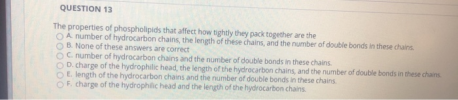 QUESTION 13 The properties of phospholipids that affect how tightly they pack together are the A number of hydrocarbon chains, the length of these chains, and the number of double bonds in these chains. B. None of these answers are correct C. number of hydrocarbon chains and the number of double bonds in these chains. D. charge of the hydrophilic head, the length of the hydrocarbon chains, and the number of double bonds in these chains E length of the...
QUESTION 13 The properties of phospholipids that affect how tightly they pack together are the A...
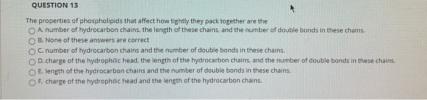 QUESTION 13 The properties of phospholipids that affect how tightly they pack together are the A number of hydrocarbon chains, the length of these chains, and the number of double bonds in these chains. B. None of these answers are correct OC number of hydrocarbon chains and the number of double bonds in these chains. D. charge of the hydrophilic head, the length of the hydrocarbon chains, and the number of double bonds in these chains. E. length of the...
 1. Draw one string of ten (10) phospholipids. Label the hydrophilic heads and the hydrophobic tails. (3 points) chrohobia hrudiephilic CH₂-CH-CH 2. What are the basic components of one phospholipid molecule? (3 points) 3. Draw a phospholipid bilayer. Label the hydrophilic heads and the hydrophobic tails. (3 points) 4. Cell membranes are made of phospholipid bilayers. Why is it important for there to be both hydrophilic and hydrophobic components of the membranes that surround all of our cells and organelles?...
 QUESTION 13 The properties of phospholipids that affect how tightly they pack together are the A number of hydrocarbon chains, the length of these chains, and the number of double bonds in these chains. B. None of these answers are correct C. number of hydrocarbon chains and the number of double bonds in these chains. D. charge of the hydrophilic head, the length of the hydrocarbon chains, and the number of double bonds in these chains E length of the...
 QUESTION 13 The properties of phospholipids that affect how tightly they pack together are the A number of hydrocarbon chains, the length of these chains, and the number of double bonds in these chains. B. None of these answers are correct OC number of hydrocarbon chains and the number of double bonds in these chains. D. charge of the hydrophilic head, the length of the hydrocarbon chains, and the number of double bonds in these chains. E. length of the...
Most questions answered within 3 hours.
-
Where is the error in this code sequence?
String s1 = "Hello";
String s2 = "ello";...
asked 10 months ago -
Financial data for Joel de Paris, Inc., for last year
follow:
Joel de Paris, Inc.
Balance...
asked 10 months ago -
Consider this reaction:
Al2(SO4)3 (aq)+ BaCl3
(aq) Al2Cl6 (aq)- +
3BaSO4(s) . What is the...
asked 10 months ago -
Suppose that Savneet is considering increasing her
recent random sample from 20 car rentals to 40...
asked 10 months ago -
Trucks arrive at an unloading terminal at an average rate of 120
per hour.
Trucks arrive...
asked 10 months ago -
Why are methanol and ethanol completely soluble in water while
octanol is not very little soluble....
asked 10 months ago -
A facilities manager at a university reads in a research report
that the mean amount of...
asked 10 months ago -
When the CuSO4 is rehydrated by adding water to the anhydrous
compound, is this an endothermic...
asked 10 months ago -
A ray of sunlight is passing from diamond into crown glass; the
angle of incidence is...
asked 10 months ago -
A block of mass 0.249 kg is placed on top of a light, vertical
spring of...
asked 10 months ago -
how do the kidneys compensate in the presences of acidosis
a) trigger hyperventilate
b) reserve acid...
asked 10 months ago -
Question 501 pts
The rental rate of capital to the firm increases. Which of the
following...
asked 10 months ago