How do we know that membrane phospholipids regularly intermingle and move laterally, but rarely flip from...
How do we know that membrane phospholipids regularly intermingle and move laterally, but rarely flip from one side of the phospholipid bilayer to the other?
Homework Answers
Answer: One of the features of the fluid mosaic model is the nature of its membrane to allow its movement freely. There are mainly 3 types of movements possible for the membrane to allow, although their frequency can be different, let’s understand one by one:
- The rotational movement which allows the interaction with its neighbor via rotation.
- Lateral where the phosphates move along with its leaflet.
- Flip-Flop movement of a molecule from one side to another.
(Which allows phospholipids to interact between leaflets but not to proteins)
The reason as to why phospholipids move laterally:
Lateral movement provides the membrane its fluidity .there are two important properties which allows the lateral diffusion to occur in a more frequent basis:
Phospholipid layers are not covalently bonded they are bonded with Vander Waal interaction or by hydrogen bonding that stabilizes the lipid bilayer structure. The fatty acids chain is generally unsaturated which helps proteins and phospholipids to diffuse laterally. Secondly, the large cross-sectional area and the high degree of randomness around also contributes to lateral movement across membranes.
The reason as the membrane does not allow flip flop movements so often:
Movement of a molecule from one side to another is called flip flop and also called transverse movement which needs to overcome high energy constraint or barrier. The polar region in the case of protein is so large that it cannot make its way to the hydrophobic region of the membrane. This is why proteins cannot flip flop at all. Whereas, the phospholipids have the chance of flip flopping because of its less polar area region and that too is mediated by special proteins called Flippases which catalyze and make its movement across the membrane easy.
Add Answer to:
How do we know that membrane phospholipids regularly intermingle
and move laterally, but rarely flip from...
Why would amphipathic molecules in a lipid membrane drive the membrane to self-seal? Why don’t phospholipids...
Why would amphipathic molecules in a lipid membrane drive the membrane to self-seal? Why don’t phospholipids flip flop across a lipid bilayer, from one side to the other?
A cell membrane consists of a lipid bilayer, which is a double layer of phospholipids. Each...
 A cell membrane consists of a lipid bilayer, which is a double layer of phospholipids. Each phospholipid has a hydrophilic phosphate head and a hydrophobic lipid tail. These phospholipids are not chemically bound to one another, but rather maintain their structure due to the fact that the lipid tails do not like water. They're hydrophobic^2. If they all buddy up, then they can all stay dry. (See figure.) One way to deal with this quantitatively is to realize that there...
CELL BIOLOGY Chapter 10 The function of a lipid bilayer How is the lipid bilayer formed...
CELL BIOLOGY Chapter 10 The function of a lipid bilayer How is the lipid bilayer formed Know the different types of phospholipids and any unique features and locations (if there are any) Know the overall structure of a phospholipid How does a lipid membrane stay fluid? How to lipid move in a membrane? Just as important, know the movement lipids are unable to do in the absence of flipase. Alberts.-.Molecular.Biology.Of.The.Cell.5th.Ed IS THE TEXT
1.In response to seasonal changes in temperature, many organisms must alter the composition of their plasma...
1.In response to seasonal changes in temperature, many organisms must alter the composition of their plasma membranes to maintain the proper degree of fluidity. Which change in the fatty acids of phospholipids would be most effective in maintaining membrane fluidity in a colder environment? A. an increase in phospholipid fatty acid side chain length and an increase in side chain saturation B. a decrease in phospholipid fatty acid side chain length and an increase in side chain saturation C. a...
Lipids in a bilayer can diffuse laterally at a relatively fast rate, but "flip-flop" from one...
 Lipids in a bilayer can diffuse laterally at a relatively fast rate, but "flip-flop" from one leaflet to the other very slowly without catalysis. Three protein families, flippases (or flipases), floppases, and scramblases, catalyze the movement of lipids across the bilayer Classify each phrase as describing flippases, floppases, or scramblases. Flippases Floppases Scramblases
Explain how protein pumps are able to move small molecules and ions across a cell membrane...
Explain how protein pumps are able to move small molecules and ions across a cell membrane What are the upsides/benefits given to a cell from the phospholipid bilayer
D. Although it is rare, membrane phospholipids can diffuse from one leaflet to the other (spontaneous...
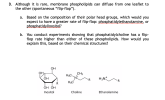 D. Although it is rare, membrane phospholipids can diffuse from one leaflet to the other (spontaneous "flip-flop") a. Based on the composition of their polar head groups, which would you expect to have a greater rate of flip-flop: phosphatidylethanglamine, or phosphatidylinositol? b. You conduct experiments showing that phosphatidylcholine has a flip- flop rate higher than either of these phospholipids. How would you explain this, based on their chemical structures? он он Нас OH OH Inositol Choline Ethanolamine
Q1. Data analysis for Figure 4. a. (SA) For each of the phospholipids in the experiment...
 Q1. Data analysis for Figure 4. a. (SA) For each of the phospholipids in the experiment (DLPC, DLPE and DLPS) state if there is a transporter that catalyzes the transverse motion of that phospholipid (from one side of the lipid bilayer to the other) in RBC, and if the transporter is a passive or active transporter. Briefly explain your reasoning b. [SA] What type(s) of phospholipids is/are preferentially translocated by the flippase? Explain. ) 05 1 1.5 2 253 Time...
You are performing an experiment with a new enzyme. This enzyme removes the heads of phospholipids....
You are performing an experiment with a new enzyme. This enzyme removes the heads of phospholipids. The enzyme cannot pass through plasma membranes. You have cells that have an outer membrane made up of a phospholipid bilayer, with a layer of phospholipids facing the inside of the cell and the other layer facing the fluid environment outside the cell. What do you predict will happen when you add the enzyme to the fluid containing your cells? Choose one: A. Not...
which of the following are not enzymes involved in moving phospholipids from one leaflet to another...
 which of the following are not enzymes involved in moving
phospholipids from one leaflet to another
12. Membrane dynamics Page: 396 Difficulty: 2-。Ans: C Which of the following are not enzymes involved in moving phospholipids from one leaflet to another A) Flippases that move phosphatidylethanolamine and phosphatidylserine B) Floppases that move phospholipids from the cytosolic leaflet to the extracellular leatiet C) Flip-floppases that allow phospholipids to move back and forth between the inner and outer leaflets D) Scramblases that allow...
which of the following are not enzymes involved in moving
phospholipids from one leaflet to another
12. Membrane dynamics Page: 396 Difficulty: 2-。Ans: C Which of the following are not enzymes involved in moving phospholipids from one leaflet to another A) Flippases that move phosphatidylethanolamine and phosphatidylserine B) Floppases that move phospholipids from the cytosolic leaflet to the extracellular leatiet C) Flip-floppases that allow phospholipids to move back and forth between the inner and outer leaflets D) Scramblases that allow...
 A cell membrane consists of a lipid bilayer, which is a double layer of phospholipids. Each phospholipid has a hydrophilic phosphate head and a hydrophobic lipid tail. These phospholipids are not chemically bound to one another, but rather maintain their structure due to the fact that the lipid tails do not like water. They're hydrophobic^2. If they all buddy up, then they can all stay dry. (See figure.) One way to deal with this quantitatively is to realize that there...
 Lipids in a bilayer can diffuse laterally at a relatively fast rate, but "flip-flop" from one leaflet to the other very slowly without catalysis. Three protein families, flippases (or flipases), floppases, and scramblases, catalyze the movement of lipids across the bilayer Classify each phrase as describing flippases, floppases, or scramblases. Flippases Floppases Scramblases
 D. Although it is rare, membrane phospholipids can diffuse from one leaflet to the other (spontaneous "flip-flop") a. Based on the composition of their polar head groups, which would you expect to have a greater rate of flip-flop: phosphatidylethanglamine, or phosphatidylinositol? b. You conduct experiments showing that phosphatidylcholine has a flip- flop rate higher than either of these phospholipids. How would you explain this, based on their chemical structures? он он Нас OH OH Inositol Choline Ethanolamine
 Q1. Data analysis for Figure 4. a. (SA) For each of the phospholipids in the experiment (DLPC, DLPE and DLPS) state if there is a transporter that catalyzes the transverse motion of that phospholipid (from one side of the lipid bilayer to the other) in RBC, and if the transporter is a passive or active transporter. Briefly explain your reasoning b. [SA] What type(s) of phospholipids is/are preferentially translocated by the flippase? Explain. ) 05 1 1.5 2 253 Time...
 which of the following are not enzymes involved in moving
phospholipids from one leaflet to another
12. Membrane dynamics Page: 396 Difficulty: 2-。Ans: C Which of the following are not enzymes involved in moving phospholipids from one leaflet to another A) Flippases that move phosphatidylethanolamine and phosphatidylserine B) Floppases that move phospholipids from the cytosolic leaflet to the extracellular leatiet C) Flip-floppases that allow phospholipids to move back and forth between the inner and outer leaflets D) Scramblases that allow...
which of the following are not enzymes involved in moving
phospholipids from one leaflet to another
12. Membrane dynamics Page: 396 Difficulty: 2-。Ans: C Which of the following are not enzymes involved in moving phospholipids from one leaflet to another A) Flippases that move phosphatidylethanolamine and phosphatidylserine B) Floppases that move phospholipids from the cytosolic leaflet to the extracellular leatiet C) Flip-floppases that allow phospholipids to move back and forth between the inner and outer leaflets D) Scramblases that allow...
Most questions answered within 3 hours.
-
Where is the error in this code sequence?
String s1 = "Hello";
String s2 = "ello";...
asked 10 months ago -
Financial data for Joel de Paris, Inc., for last year
follow:
Joel de Paris, Inc.
Balance...
asked 10 months ago -
Consider this reaction:
Al2(SO4)3 (aq)+ BaCl3
(aq) Al2Cl6 (aq)- +
3BaSO4(s) . What is the...
asked 10 months ago -
Suppose that Savneet is considering increasing her
recent random sample from 20 car rentals to 40...
asked 10 months ago -
Trucks arrive at an unloading terminal at an average rate of 120
per hour.
Trucks arrive...
asked 10 months ago -
Why are methanol and ethanol completely soluble in water while
octanol is not very little soluble....
asked 10 months ago -
A facilities manager at a university reads in a research report
that the mean amount of...
asked 10 months ago -
When the CuSO4 is rehydrated by adding water to the anhydrous
compound, is this an endothermic...
asked 10 months ago -
A ray of sunlight is passing from diamond into crown glass; the
angle of incidence is...
asked 10 months ago -
A block of mass 0.249 kg is placed on top of a light, vertical
spring of...
asked 10 months ago -
how do the kidneys compensate in the presences of acidosis
a) trigger hyperventilate
b) reserve acid...
asked 10 months ago -
Question 501 pts
The rental rate of capital to the firm increases. Which of the
following...
asked 10 months ago