Why would amphipathic molecules in a lipid membrane drive the membrane to self-seal? Why don’t phospholipids...
Homework Answers
1) Amphipathic molecules gets assembled in bilayer and forms a self sealing structure to act as a barrier of cell and organelles. it controls the entry and exit of nutrients and waste. They prevent diffusion of molecules.
2) Phospholipids of lipid bilayer have hydrophillic head facing toward water while hydrophobic tails are repelled by them. Thus they cannot flip flop across a lipid bilayer
Add Answer to:
Why would amphipathic molecules in a lipid membrane drive the
membrane to self-seal?
Why don’t phospholipids...
1. Why are can affect the fluidity of the membrane structure? phospholipids called amphipathic molecules? What...
1. Why are can affect the fluidity of the membrane structure? phospholipids called amphipathic molecules? What are the two properties of phospholipids that 2. How does the cell membrane structure enable it having selective permeability? 3. Where are new phospholipids made in eukaryotic cells? What are the roles of scramblase and flippase?
A cell membrane consists of a lipid bilayer, which is a double layer of phospholipids. Each...
 A cell membrane consists of a lipid bilayer, which is a double layer of phospholipids. Each phospholipid has a hydrophilic phosphate head and a hydrophobic lipid tail. These phospholipids are not chemically bound to one another, but rather maintain their structure due to the fact that the lipid tails do not like water. They're hydrophobic^2. If they all buddy up, then they can all stay dry. (See figure.) One way to deal with this quantitatively is to realize that there...
mins& Grammarly Instant Bio228-001 Fall2018 Part B Why are amphipathic molecules important constituents of membranes? O...
 mins& Grammarly Instant Bio228-001 Fall2018 Part B Why are amphipathic molecules important constituents of membranes? O Amphipathic proteins help in 02 and CO2 transport O Amphipathic proteins are the main components of a membrane O Amphipathic phospholipids start a process of self-organization of membrane . O Amphipathic molecules form hydrophobic interior and hydrophilic surface (on either side) of a membrane Submit Request Answer Part c
How do we know that membrane phospholipids regularly intermingle and move laterally, but rarely flip from...
How do we know that membrane phospholipids regularly intermingle and move laterally, but rarely flip from one side of the phospholipid bilayer to the other?
Which of the following would produce the most fluid lipid bilayer? O phospholipids with tails of...
 Which of the following would produce the most fluid lipid bilayer? O phospholipids with tails of 26 carbon atoms and two double bonds O phospholipids with fully saturated tails of 20 carbon atoms O large amounts of cholesterol O phospholipids with tails of 20 carbon atoms and two double bonds o phospholipids with fully saturated tails of 24 carbon atoms Which of the following can influence the rate at which a molecule will move across a lipid bilayer? (Check all...
Which of the following molecules will diffuse most quickly across a lipid bilayer membrane? a. H2O...
Which of the following molecules will diffuse most quickly across a lipid bilayer membrane? a. H2O b. Na+ c. Glucose d. H2PO4 e. O2 (I've isolated it down to H2O and O2, but I'm not sure which one diffuses faster than the other and why. Thanks!)
D. Although it is rare, membrane phospholipids can diffuse from one leaflet to the other (spontaneous...
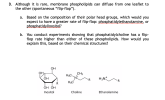 D. Although it is rare, membrane phospholipids can diffuse from one leaflet to the other (spontaneous "flip-flop") a. Based on the composition of their polar head groups, which would you expect to have a greater rate of flip-flop: phosphatidylethanglamine, or phosphatidylinositol? b. You conduct experiments showing that phosphatidylcholine has a flip- flop rate higher than either of these phospholipids. How would you explain this, based on their chemical structures? он он Нас OH OH Inositol Choline Ethanolamine
Which of the below molecules would be expected to be membrane permeable and freely pass through a lipid bilayer? Select...
 Which of the below molecules would be expected to be membrane
permeable and freely pass through a lipid bilayer?
Select all that apply
Which of the below molecules would be expected to be membrane permeable and freely pass through a lipid bilayer? Select all that apply. O=C=0 Nat NEN K+ * H-C-OH Ο Ι Ι HHHHHH
Which of the below molecules would be expected to be membrane
permeable and freely pass through a lipid bilayer?
Select all that apply
Which of the below molecules would be expected to be membrane permeable and freely pass through a lipid bilayer? Select all that apply. O=C=0 Nat NEN K+ * H-C-OH Ο Ι Ι HHHHHH
I need help with number 3 Phospholipids. Thank you 1. What type of bonding is present...
 I need help with number 3 Phospholipids. Thank you
1. What type of bonding is present in phospholipids-ionic or covalent? Explain! You will notice there are several double bonds contained in a phospholipid. What is a double bond and how does it influence the shape of a molecule"? 2. Phospholipids are said to be amphipathic-that is they have one region that is polar and another that is nonpolar. The end containing the phosphorous and nitrogen is the polar end. Can...
I need help with number 3 Phospholipids. Thank you
1. What type of bonding is present in phospholipids-ionic or covalent? Explain! You will notice there are several double bonds contained in a phospholipid. What is a double bond and how does it influence the shape of a molecule"? 2. Phospholipids are said to be amphipathic-that is they have one region that is polar and another that is nonpolar. The end containing the phosphorous and nitrogen is the polar end. Can...
Which of these statements about the composition of membranes is true?
Which of these statements about the composition of membranes is true?A) All biological membranes contain cholesterol.B) Free fatty acids are major components of all membranes. C) The inner and outer membranes of mitochondria have different protein compositions.D) The lipid composition of all membranes of eukaryotic cells is essentially the same.E) The lipid: protein ratio varies from about 1: 4 to 4: 1Membrane proteins:A) ere sometimes covalently attached to lipid moieties:B) are sometimes covalently attached to carbohydrate moieties.C) are composed of...
 A cell membrane consists of a lipid bilayer, which is a double layer of phospholipids. Each phospholipid has a hydrophilic phosphate head and a hydrophobic lipid tail. These phospholipids are not chemically bound to one another, but rather maintain their structure due to the fact that the lipid tails do not like water. They're hydrophobic^2. If they all buddy up, then they can all stay dry. (See figure.) One way to deal with this quantitatively is to realize that there...
 mins& Grammarly Instant Bio228-001 Fall2018 Part B Why are amphipathic molecules important constituents of membranes? O Amphipathic proteins help in 02 and CO2 transport O Amphipathic proteins are the main components of a membrane O Amphipathic phospholipids start a process of self-organization of membrane . O Amphipathic molecules form hydrophobic interior and hydrophilic surface (on either side) of a membrane Submit Request Answer Part c
 Which of the following would produce the most fluid lipid bilayer? O phospholipids with tails of 26 carbon atoms and two double bonds O phospholipids with fully saturated tails of 20 carbon atoms O large amounts of cholesterol O phospholipids with tails of 20 carbon atoms and two double bonds o phospholipids with fully saturated tails of 24 carbon atoms Which of the following can influence the rate at which a molecule will move across a lipid bilayer? (Check all...
 D. Although it is rare, membrane phospholipids can diffuse from one leaflet to the other (spontaneous "flip-flop") a. Based on the composition of their polar head groups, which would you expect to have a greater rate of flip-flop: phosphatidylethanglamine, or phosphatidylinositol? b. You conduct experiments showing that phosphatidylcholine has a flip- flop rate higher than either of these phospholipids. How would you explain this, based on their chemical structures? он он Нас OH OH Inositol Choline Ethanolamine
 Which of the below molecules would be expected to be membrane
permeable and freely pass through a lipid bilayer?
Select all that apply
Which of the below molecules would be expected to be membrane permeable and freely pass through a lipid bilayer? Select all that apply. O=C=0 Nat NEN K+ * H-C-OH Ο Ι Ι HHHHHH
Which of the below molecules would be expected to be membrane
permeable and freely pass through a lipid bilayer?
Select all that apply
Which of the below molecules would be expected to be membrane permeable and freely pass through a lipid bilayer? Select all that apply. O=C=0 Nat NEN K+ * H-C-OH Ο Ι Ι HHHHHH
 I need help with number 3 Phospholipids. Thank you
1. What type of bonding is present in phospholipids-ionic or covalent? Explain! You will notice there are several double bonds contained in a phospholipid. What is a double bond and how does it influence the shape of a molecule"? 2. Phospholipids are said to be amphipathic-that is they have one region that is polar and another that is nonpolar. The end containing the phosphorous and nitrogen is the polar end. Can...
I need help with number 3 Phospholipids. Thank you
1. What type of bonding is present in phospholipids-ionic or covalent? Explain! You will notice there are several double bonds contained in a phospholipid. What is a double bond and how does it influence the shape of a molecule"? 2. Phospholipids are said to be amphipathic-that is they have one region that is polar and another that is nonpolar. The end containing the phosphorous and nitrogen is the polar end. Can...
Most questions answered within 3 hours.
-
Where is the error in this code sequence?
String s1 = "Hello";
String s2 = "ello";...
asked 10 months ago -
Financial data for Joel de Paris, Inc., for last year
follow:
Joel de Paris, Inc.
Balance...
asked 10 months ago -
Consider this reaction:
Al2(SO4)3 (aq)+ BaCl3
(aq) Al2Cl6 (aq)- +
3BaSO4(s) . What is the...
asked 10 months ago -
Suppose that Savneet is considering increasing her
recent random sample from 20 car rentals to 40...
asked 10 months ago -
Trucks arrive at an unloading terminal at an average rate of 120
per hour.
Trucks arrive...
asked 10 months ago -
Why are methanol and ethanol completely soluble in water while
octanol is not very little soluble....
asked 10 months ago -
A facilities manager at a university reads in a research report
that the mean amount of...
asked 10 months ago -
When the CuSO4 is rehydrated by adding water to the anhydrous
compound, is this an endothermic...
asked 10 months ago -
A ray of sunlight is passing from diamond into crown glass; the
angle of incidence is...
asked 10 months ago -
A block of mass 0.249 kg is placed on top of a light, vertical
spring of...
asked 10 months ago -
how do the kidneys compensate in the presences of acidosis
a) trigger hyperventilate
b) reserve acid...
asked 10 months ago -
Question 501 pts
The rental rate of capital to the firm increases. Which of the
following...
asked 10 months ago