Which of the following are the 3 steps involved in the basic mechanism of DNA repair?...
Homework Answers
the 3 steps involved in the basic mechanism of DNA repair are as follows
The segment of damaged strand detected and excised by DNA glycosylase and AP site- Apurine or Apyrimidine site is created which is filled by DNA polymerase.
DNA polymerase fills in the missing nucleotides by polymerization reaction using the bottom strand as a template.
After polymerization reaction the gaps are left behind which is sealed by DNA ligase.
DNA ligase seals the nick and a new repaired DNA is formed
So the correct options are a,b, c
DNA ligase does not excise the segment instead seals the segment of DNA.
Topoisomerase enzyme is not involved in polymerization reaction instead they are involved in releasing stress during replication and is not also involved in repair mechanism.
So the options d and e are wrong
Add Answer to:
Which of the following are the 3 steps involved in the basic
mechanism of DNA repair?...
Which are true about direct repair of DNA? O The damaged base is excised and a...
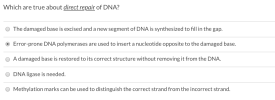 Which are true about direct repair of DNA? O The damaged base is excised and a new segment of DNA is synthesized to fill in the gap. Error-prone DNA polymerases are used to insert a nucleotide opposite to the damaged base. O A damaged base is restored to its correct structure without removing it from the DNA. O DNA ligase is needed. O Methylation marks can be used to distinguish the correct strand from the incorrect strand.
Which of the following is NOT a DNA repair mechanism? a. base excision in which bulky...
Which of the following is NOT a DNA repair mechanism? a. base excision in which bulky lesions are removed and replaced with the original nucleotides b. direct repair of a modified base to the original structure c. repair of mismatched bases to the original pair of nucleotides on opposite strands d. replacement of nucleotides without the use of the complementary strand as a template e. all of the above
Match the enzyme activity in DNA synthesis with its function. DNA pol III (_) fragments Helicase...
 Match the enzyme activity in DNA synthesis with its function. DNA pol III (_) fragments Helicase (_) Primase (_) using template strand DNA pol I (_) double helix DNA ligase (_) adds nucleotides Topoisomerase (_) primer A. anneals DNA B. relieves overwinding C. adds nucleotides D. unwinds parental E. removes RNA primer, F. adds a short RNA 10 Proofreading and repair of the DNA double helix does NOT involves a. detecting a mis-match in base pairs. b. removing the mis-match...
1)Repairing damaged DNA is essential to maintaining the integrity of the genome. One type of repair...
1)Repairing damaged DNA is essential to maintaining the integrity of the genome. One type of repair is known as nucleotide excision repair. In this system, which order do the necessary enzymes act? A) exonuclease, DNA polymerase III, RNA primase B) helicase, DNA polymerase I, DNA ligase C) DNA ligase, nuclease, helicase D) DNA polymerase I, DNA polymerase III, DNA ligase E) endonuclease, DNA polymerase II, DNA ligase 2) What might be the result if all cells had functioning telomerase? A)...
Choose the repair mechanism that is best associated with the statement. Some statements may have more...
Choose the repair mechanism that is best associated with the statement. Some statements may have more than one answer. a. nucleotide excision repair b. mismatch repair c. translesion synthesis d. recombinational repair e. base excision repair _____ 1. Uses an enzyme called the DNA-N-glycosylases. _____ 2. Utilizes a group of proteins called Mut. _____ 3. The disease Xeroderma pigmentosum is caused by a defect in this system. _____ 4. This is associated with the SOS response in bacteria. _____ 5....
21. In DNA replication, new nucleotides are added a. To the 5' end of each nascent...
 21. In DNA replication, new nucleotides are added a. To the 5' end of each nascent strand b. To the 3'end of each nascent strand To both ends of each nascent strand d. To the 5' end of the continuous strand and the 3' end of the discontinuous strand e. To the end of the continuous strand and the end of discontinuous strand fragments 22. DNA unwinding is done by a. Ligase b. Helicase c. Topoisomerase dHexonuclease 23. Proofreading of...
Order steps 1-7, first step (1) and last step (7) Order the events in the repair...
 Order steps 1-7, first step (1) and last step
(7)
Order the events in the repair of a GT base pair in E. coli. • The three-component complex (MutSLH) identifies the old strand by locating a methylation mark. The endonuclease then cleaves the unmethylated (new) strand. • The mismatch-binding protein complex (MutSL) scans the genome after DNA replication to find incorrect base pairs. • DNA polymerase extends the 3'OH of the unmethylated, new strand to synthesize new DNA. • Once...
Order steps 1-7, first step (1) and last step
(7)
Order the events in the repair of a GT base pair in E. coli. • The three-component complex (MutSLH) identifies the old strand by locating a methylation mark. The endonuclease then cleaves the unmethylated (new) strand. • The mismatch-binding protein complex (MutSL) scans the genome after DNA replication to find incorrect base pairs. • DNA polymerase extends the 3'OH of the unmethylated, new strand to synthesize new DNA. • Once...
Identify the various types of DNA repair mechanisms known to counteract the effects of UV radiation....
 Identify the various types of DNA repair mechanisms known to counteract the effects of UV radiation. Recombinational repair Excision repair Photoactivation repair SOS repair 1. is dependent on a photon-activated enzyme that cleaves thymine dimers. 2. is the process by which an endonuclease clips out UV- induced dimers, DNA polymerase III fills in the gap, and DNA ligase rejoins the phosphodiester backbone. 3. uses the corresponding region on the undamaged parental strand of the same polarity. 4. is a process...
In non-error prone DNA repair which of the following is usually the initial step in repairing...
In non-error prone DNA repair which of the following is usually the initial step in repairing a damage base: A. Excision of a small region around the damaged base. B. The binding of a sensor protein to the damaged region of DNA. C. The re-synthesis of the removed segment of DNA by DNA polymerase. D. The integrity of the resynthesized sugar-phosphate backbone is restored by ligase. E. None of the answers listed above (ABCD) are correct.
Why were Meselson and Stahl unable to distinguish between the dispersive and the semiconservative models following...
Why were Meselson and Stahl unable to distinguish between the dispersive and the semiconservative models following only one round of DNA replication? 2. Describe in order, the four repeating steps that repeat over and over on the discontinuous lagging strand of DNA replication and name the major proteins required to carry out each of these steps in E. coli. The first function is given . I. Function: Create RNA primer Enzyme: II. Function: Enzyme: III. Function: Enzyme: IV. Function: Enzyme:...
 Which are true about direct repair of DNA? O The damaged base is excised and a new segment of DNA is synthesized to fill in the gap. Error-prone DNA polymerases are used to insert a nucleotide opposite to the damaged base. O A damaged base is restored to its correct structure without removing it from the DNA. O DNA ligase is needed. O Methylation marks can be used to distinguish the correct strand from the incorrect strand.
 Match the enzyme activity in DNA synthesis with its function. DNA pol III (_) fragments Helicase (_) Primase (_) using template strand DNA pol I (_) double helix DNA ligase (_) adds nucleotides Topoisomerase (_) primer A. anneals DNA B. relieves overwinding C. adds nucleotides D. unwinds parental E. removes RNA primer, F. adds a short RNA 10 Proofreading and repair of the DNA double helix does NOT involves a. detecting a mis-match in base pairs. b. removing the mis-match...
 21. In DNA replication, new nucleotides are added a. To the 5' end of each nascent strand b. To the 3'end of each nascent strand To both ends of each nascent strand d. To the 5' end of the continuous strand and the 3' end of the discontinuous strand e. To the end of the continuous strand and the end of discontinuous strand fragments 22. DNA unwinding is done by a. Ligase b. Helicase c. Topoisomerase dHexonuclease 23. Proofreading of...
 Order steps 1-7, first step (1) and last step
(7)
Order the events in the repair of a GT base pair in E. coli. • The three-component complex (MutSLH) identifies the old strand by locating a methylation mark. The endonuclease then cleaves the unmethylated (new) strand. • The mismatch-binding protein complex (MutSL) scans the genome after DNA replication to find incorrect base pairs. • DNA polymerase extends the 3'OH of the unmethylated, new strand to synthesize new DNA. • Once...
Order steps 1-7, first step (1) and last step
(7)
Order the events in the repair of a GT base pair in E. coli. • The three-component complex (MutSLH) identifies the old strand by locating a methylation mark. The endonuclease then cleaves the unmethylated (new) strand. • The mismatch-binding protein complex (MutSL) scans the genome after DNA replication to find incorrect base pairs. • DNA polymerase extends the 3'OH of the unmethylated, new strand to synthesize new DNA. • Once...
 Identify the various types of DNA repair mechanisms known to counteract the effects of UV radiation. Recombinational repair Excision repair Photoactivation repair SOS repair 1. is dependent on a photon-activated enzyme that cleaves thymine dimers. 2. is the process by which an endonuclease clips out UV- induced dimers, DNA polymerase III fills in the gap, and DNA ligase rejoins the phosphodiester backbone. 3. uses the corresponding region on the undamaged parental strand of the same polarity. 4. is a process...
Most questions answered within 3 hours.
-
Where is the error in this code sequence?
String s1 = "Hello";
String s2 = "ello";...
asked 11 months ago -
Financial data for Joel de Paris, Inc., for last year
follow:
Joel de Paris, Inc.
Balance...
asked 11 months ago -
Consider this reaction:
Al2(SO4)3 (aq)+ BaCl3
(aq) Al2Cl6 (aq)- +
3BaSO4(s) . What is the...
asked 11 months ago -
Suppose that Savneet is considering increasing her
recent random sample from 20 car rentals to 40...
asked 11 months ago -
Trucks arrive at an unloading terminal at an average rate of 120
per hour.
Trucks arrive...
asked 11 months ago -
Why are methanol and ethanol completely soluble in water while
octanol is not very little soluble....
asked 11 months ago -
A facilities manager at a university reads in a research report
that the mean amount of...
asked 11 months ago -
When the CuSO4 is rehydrated by adding water to the anhydrous
compound, is this an endothermic...
asked 11 months ago -
A ray of sunlight is passing from diamond into crown glass; the
angle of incidence is...
asked 11 months ago -
A block of mass 0.249 kg is placed on top of a light, vertical
spring of...
asked 11 months ago -
how do the kidneys compensate in the presences of acidosis
a) trigger hyperventilate
b) reserve acid...
asked 11 months ago -
Question 501 pts
The rental rate of capital to the firm increases. Which of the
following...
asked 11 months ago