Find the weight percent of iron (55.85 g/mol) in a rock. Suppose that a 0.1773 g...
Find the weight percent of iron (55.85 g/mol) in a rock. Suppose that a 0.1773 g rock is crushed and dissolved in nitric acid. The solution is diluted to 100.00 mL. Then 15.00 mL of this solution is mixed with 10 mL 0.200 M chromophore. The resulting Fe complex has an absorption of 0.431 at 508 nm. A second solution is prepared exactly the same as above but spiked with 1 mL of 750 ppm Fe solution, which then gives an absorption of 0.808.
Homework Answers
The instrumental analysis of the rock is carried out following the standard addition method. In this technique, the sample without standard solution has an absorbance given by the equation:
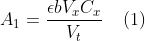
In this form of the Beer's Law, we have:
ε : molar absorptivity of the substance
b: optical path
Vx: volume of the sample
Cx: concentration of the substance in the sample
Vt: volume of the sample after dilution.
With the first addition of standard solution, the absorbance of the sample will be given by the equation:

In this equation
Vs: volume of standard added
Cs: concentration of the standard.
If we divide equation (2) by equation (1), we have:
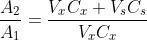
Solving for the concentration of the substance in the sample (Cx):
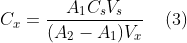
We have the data:
Absorbance without standard: A1 = 0.431
Absorbance with standard: A2 = 0.808
Volume of the sample: Vx = 25.00mL
Volume of the standard: Vs = 1.0mL
Concentration of standard: Cs = 750 ppm Fe+3
Substituting all of these values in equation (3), the concentration of Fe+3 in the measured sample is:

But this sample was prepared by mixing 15.00 mL of the diluted solution of rock with 10 mL of the chromophore. To calculate the concentration of Fe+3 in the 15.00mL we will use:

Where C is the concentration and V is the volume, the subindex -c is referred to the concentrated solution (15.00 mL) and the subindex -D is referred to the diluted solution (25.0 mL). Solving for the concentration in concentrated solution (Cc):

This is the same concentration for the 100 mL stock solution prepared at dissolving the rock in nitric acid. Remember that ppm units can be written as:

Converting 100 mL to liters:

The mass of Fe+3 in that volume is given by:

Converting the mass into gram units:

The weight percent of iron in the rock is given by:
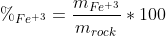
Subtituting known data:

Add Answer to:
Find the weight percent of iron (55.85 g/mol) in a rock. Suppose
that a 0.1773 g...
A standard iron solution was prepared by dissolving 0.0100 g of pure iron in acid then...
 A standard iron solution was prepared by dissolving 0.0100 g of pure iron in acid then transferring to a 50.00 mL volumetric flask with orthophenanthroline as a complexing agent. At a wavelength of 540 nm, the absorbance of the standard was 0.239 in a 1.00 cm cuvette. A 0.149 g sample of an iron ore was crushed and digested in 5 mL of concentrated acid. The digested sample was then transferred to a 10.00 mL volumetric flask and diluted to...
The dreaded rock problem. An ICP experiment was performed to find the concentration of copper in...
The dreaded rock problem. An ICP experiment was performed to find the concentration of copper in a rock (3.1416 g). The rock was ground up and reacted with 40 mL of concentrated nitric acid to dissolve all the copper. The solution was diluted 1:1000 (let’s call this solution R) and gave an emission signal intensity of 46582.9 (arbitrary units). Then a 50 mL aliquot of solution R was mixed with 5 mL of a 16.4 ppm Cu solution and diluted...
A standard solution of iron was made by weighing 0.075 g of Fe(NH4)2(SO4)2 6(H2O) in 250...
A standard solution of iron was made by weighing 0.075 g of Fe(NH4)2(SO4)2 6(H2O) in 250 mL. Aliquots of this standard solution (see below) were transferred to a 100 mL volumetric flask, pH adjusted with citrate, and reacted with hydroquinone and o-phenanthroline and diluted to volume (100 mL). The absorbance was measured in a 1.0-cm cell using a Genesys 20 Spectrophotometer at 508 nm: Aliquot of standard solution Absorbance 1.0 mL 0.079 2.0 mL 0.163 5.0 mL 0.413 10.0 mL...
A. 0.191 g of steel was dissolved in acid and diluted to 100 mL with water. The solution was found to contain 7.7 ppm Mn by atomic absorption analysis. What was the weight percent Mn in the steel? B....
A. 0.191 g of steel was dissolved in acid and diluted to 100 mL with water. The solution was found to contain 7.7 ppm Mn by atomic absorption analysis. What was the weight percent Mn in the steel? B. A multivitamin tablet with a label value of 13 mg Zn per tablet was dissolved in acid and diluted to 100 mL with water. What is the theoretical Zn concentration of the solution? Answer in ppm.
Chromel is an alloy composed of nickel, iron, and chromium. A 0.6445-g sample was dissolved and...
Chromel is an alloy composed of nickel, iron, and chromium. A 0.6445-g sample was dissolved and diluted to 250.0 mL. When a 50.00-mL aliquot of 0.05173 M EDTA was mixed with an equal volume of the diluted sample, all three ions were chelated, and a 5.23-mL back-titration with 0.06139 M copper(II) was required. The chromium in a second 50.0-mL aliquot was masked through the addition of hexamethylenetetramine; titration of the Fe and Ni required 38.95 mL of 0.05173 M EDTA....
Calculate the concentration of each standard in terms of ppm iron. FW= 55.845 g/mol. Please show...
Calculate the concentration of each standard in terms of ppm iron. FW= 55.845 g/mol. Please show your work. First prepare standard solution from a standard Fe stock of 0.13 M. Make 100x dilution (1 mL of stock into 100 mL of water) Then, using a pipet deliver the following volumes of your Fe standard diluted solution into 10 mL volumetric flasks: 0 microliters, 150 micro liters, 300 microliters, 450 microliters, and 600 microliters.
 A standard iron solution was prepared by dissolving 0.0100 g of pure iron in acid then transferring to a 50.00 mL volumetric flask with orthophenanthroline as a complexing agent. At a wavelength of 540 nm, the absorbance of the standard was 0.239 in a 1.00 cm cuvette. A 0.149 g sample of an iron ore was crushed and digested in 5 mL of concentrated acid. The digested sample was then transferred to a 10.00 mL volumetric flask and diluted to...
Most questions answered within 3 hours.
-
Where is the error in this code sequence?
String s1 = "Hello";
String s2 = "ello";...
asked 11 months ago -
Financial data for Joel de Paris, Inc., for last year
follow:
Joel de Paris, Inc.
Balance...
asked 11 months ago -
Consider this reaction:
Al2(SO4)3 (aq)+ BaCl3
(aq) Al2Cl6 (aq)- +
3BaSO4(s) . What is the...
asked 11 months ago -
Suppose that Savneet is considering increasing her
recent random sample from 20 car rentals to 40...
asked 11 months ago -
Trucks arrive at an unloading terminal at an average rate of 120
per hour.
Trucks arrive...
asked 11 months ago -
Why are methanol and ethanol completely soluble in water while
octanol is not very little soluble....
asked 11 months ago -
A facilities manager at a university reads in a research report
that the mean amount of...
asked 11 months ago -
When the CuSO4 is rehydrated by adding water to the anhydrous
compound, is this an endothermic...
asked 11 months ago -
A ray of sunlight is passing from diamond into crown glass; the
angle of incidence is...
asked 11 months ago -
A block of mass 0.249 kg is placed on top of a light, vertical
spring of...
asked 11 months ago -
how do the kidneys compensate in the presences of acidosis
a) trigger hyperventilate
b) reserve acid...
asked 11 months ago -
Question 501 pts
The rental rate of capital to the firm increases. Which of the
following...
asked 11 months ago