How do you expect the KM determined with a substrate that is preferred by the enzyme...
How do you expect the KM determined with a substrate that is preferred by the enzyme to differ from the KM determined with a general enzyme substrate?
Correct, detailed (paragraph explanation) needed for thumbs up
Homework Answers
We all know that enzymes are substrate specific so the substrate
that is preferred by the enzyme will catalyzed faster than the
general substrate.
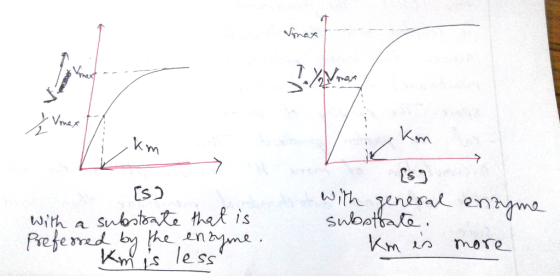
Km is the michaelis menten constant can be defined as the substrate concentration required for the enzyme to attain half maximum velocity of the reaction or 1/2 Vmax.
So it is understandable and acceptable that the substrate that is preferred by the enzyme will react faster and will attain Vmax early than the other substrate. As Vmax is short so value of Km also will be less as it is directly proportional to Vmax. So the value of Km of the substrate that is preferred by the enzyme will be less than the Km determined with a general enzyme substrate.
Find the attached image file for graphical explanation
Add Answer to:
How do you expect the KM determined with a substrate
that is preferred by the enzyme...
Why might PNPA might be a substrate for a hydrolase? Your answer should address the...
Why might PNPA might be a substrate for a hydrolase? Your answer should address the subject of enzyme substrate specificity. Correct, detailed (paragraph explanation) needed for thumbs up
How do competitive inhibitors affect the KM and Vmax of an enzyme? Draw a plot of...
How do competitive inhibitors affect the KM and Vmax of an enzyme? Draw a plot of velocity as a function of substrate concentration, both with and without inhibitor added.
Calculate the KM and Vmax for the enzymatic reaction graphed below. Correct, detailed explanation (with work...
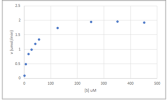 Calculate the KM and Vmax for the
enzymatic reaction graphed below.
Correct, detailed explanation (with work shown) needed for
thumbs up
Wn [s] 005 006 006 002 001 vfumol/min)
Calculate the KM and Vmax for the
enzymatic reaction graphed below.
Correct, detailed explanation (with work shown) needed for
thumbs up
Wn [s] 005 006 006 002 001 vfumol/min)
Problem 3: A) Draw the mechanistic modifications associated with chymotripsin enzyme and its substrate up to...
 Problem 3: A) Draw the mechanistic modifications associated with chymotripsin enzyme and its substrate up to the formation of acyl enzyme intermediate. Specify the role of each of the amino acids in the catalytic triad. B) Provide a Michaelis-Menten rate-law equation. Subsequently, on the same graph draw Lineweaver-Burk plots for i) enzyme which is not inhibited: ii) enzyme inhibited by a non-competitive inhibitor, C) The Km and kcat for hexokinase with as a glucose substarte are 5-10 M and 8-10²...
You are trying to determine the Km for an enzyme. Due to a lab mishap, you have only two usable d...
You are trying to determine the Km for an enzyme. Due to a lab mishap, you have only two usable data points: Substrate concentraion (microM) Reaction Velocity (microM .s^-1) 1)1 5 2)100 50 Please help not sure what to do but I know this answer can be obtained from the Michaelis equation and a Line-Weaver Burk equation isnt needed. Thank you
To determine the kinetic characteristics of an enzyme you used 1 nmol/L of enzyme in a...
To determine the kinetic characteristics of an enzyme you used 1 nmol/L of enzyme in a series of assays where you measured the rate of reactions as you varied the concentration of substrate in each assay (Table A). Estimate from a Michaelis-Menten plot approximate values for Vmax, KM, Kcat, and the specificity constant for this enzyme and substrate. (The only information that is given is this paragraph and the table below). Table 1: [S] (μM) v (μmol/L/min) 0 0 5...
will rate thanks Q1. WHAT ARE ENZYMES? HOW DOES ENZYME-SUBSTRATE BINDING TAKES PLACE? Q2. IN MICHAELIS...
 will rate thanks
Q1. WHAT ARE ENZYMES? HOW DOES ENZYME-SUBSTRATE BINDING TAKES PLACE? Q2. IN MICHAELIS -MENTEN GRAPH, WHY DOES THE CURVE REACHES PLATEAU? Vmax Reaction velocity (v) Vm/2 Km Substrate concentration (S) Q3. IN MICHAELIS MENTEN GRAPH, HOW WOULD YOU INCREASE VELOCITY BEYOND Vmax? Q4. SMALLER VALUE OF THE MICHAELIS CONSTANT (Km) REFLECTS HIGHER EFFICIENCY OF THE ENZYME. (TRUE/FALSE).
will rate thanks
Q1. WHAT ARE ENZYMES? HOW DOES ENZYME-SUBSTRATE BINDING TAKES PLACE? Q2. IN MICHAELIS -MENTEN GRAPH, WHY DOES THE CURVE REACHES PLATEAU? Vmax Reaction velocity (v) Vm/2 Km Substrate concentration (S) Q3. IN MICHAELIS MENTEN GRAPH, HOW WOULD YOU INCREASE VELOCITY BEYOND Vmax? Q4. SMALLER VALUE OF THE MICHAELIS CONSTANT (Km) REFLECTS HIGHER EFFICIENCY OF THE ENZYME. (TRUE/FALSE).
(a) After spending a few weeks isolating the enzyme, you have enough pure enzyme to do...
(a) After spending a few weeks isolating the enzyme, you have enough pure enzyme to do some kinetic experiments, using a chromogenic substrate. The product produced by the enzyme from this substrate has an extinction coefficient of 20,500cm−1M−1 at 486nm, whereas the substrate does not absorb light significantly at this wavelength. For these experiments, you have used an enzyme concentration of 1.75µg/mL and monitored the change of absorbance at 486nm, using cuvettes with a path length of 1cm. The initial...
4. What does enzyme kinetics study? What is Vo, km, Vmax, Kcat, respectively? If you plot...
 4. What does enzyme kinetics study? What is Vo, km, Vmax, Kcat, respectively? If you plot Vo versus (substrate), or 1/Vo versus 1/[substrate], how the curves would look like, and how to get Vmax and Km values?
A.Your summer research project is to study the kinetics of a newly discovered enzyme. You have...
A.Your summer research project is to study the kinetics of a newly discovered enzyme. You have already identified the substrate and optimal reaction conditions. Propose how you would set up experiments to characterize the maximum velocity (Vmax) and Michaelis constant (KM) of this enzyme, assuming that it will display Michaelis-Menten kinetics. B. How would you compare the specificity of the enzyme for its natural substrate versus its specificity for a chromogenic substrate analog that was synthesized in the lab
 Calculate the KM and Vmax for the
enzymatic reaction graphed below.
Correct, detailed explanation (with work shown) needed for
thumbs up
Wn [s] 005 006 006 002 001 vfumol/min)
Calculate the KM and Vmax for the
enzymatic reaction graphed below.
Correct, detailed explanation (with work shown) needed for
thumbs up
Wn [s] 005 006 006 002 001 vfumol/min)
 Problem 3: A) Draw the mechanistic modifications associated with chymotripsin enzyme and its substrate up to the formation of acyl enzyme intermediate. Specify the role of each of the amino acids in the catalytic triad. B) Provide a Michaelis-Menten rate-law equation. Subsequently, on the same graph draw Lineweaver-Burk plots for i) enzyme which is not inhibited: ii) enzyme inhibited by a non-competitive inhibitor, C) The Km and kcat for hexokinase with as a glucose substarte are 5-10 M and 8-10²...
 will rate thanks
Q1. WHAT ARE ENZYMES? HOW DOES ENZYME-SUBSTRATE BINDING TAKES PLACE? Q2. IN MICHAELIS -MENTEN GRAPH, WHY DOES THE CURVE REACHES PLATEAU? Vmax Reaction velocity (v) Vm/2 Km Substrate concentration (S) Q3. IN MICHAELIS MENTEN GRAPH, HOW WOULD YOU INCREASE VELOCITY BEYOND Vmax? Q4. SMALLER VALUE OF THE MICHAELIS CONSTANT (Km) REFLECTS HIGHER EFFICIENCY OF THE ENZYME. (TRUE/FALSE).
will rate thanks
Q1. WHAT ARE ENZYMES? HOW DOES ENZYME-SUBSTRATE BINDING TAKES PLACE? Q2. IN MICHAELIS -MENTEN GRAPH, WHY DOES THE CURVE REACHES PLATEAU? Vmax Reaction velocity (v) Vm/2 Km Substrate concentration (S) Q3. IN MICHAELIS MENTEN GRAPH, HOW WOULD YOU INCREASE VELOCITY BEYOND Vmax? Q4. SMALLER VALUE OF THE MICHAELIS CONSTANT (Km) REFLECTS HIGHER EFFICIENCY OF THE ENZYME. (TRUE/FALSE).
 4. What does enzyme kinetics study? What is Vo, km, Vmax, Kcat, respectively? If you plot Vo versus (substrate), or 1/Vo versus 1/[substrate], how the curves would look like, and how to get Vmax and Km values?
Most questions answered within 3 hours.
-
Where is the error in this code sequence?
String s1 = "Hello";
String s2 = "ello";...
asked 10 months ago -
Financial data for Joel de Paris, Inc., for last year
follow:
Joel de Paris, Inc.
Balance...
asked 10 months ago -
Consider this reaction:
Al2(SO4)3 (aq)+ BaCl3
(aq) Al2Cl6 (aq)- +
3BaSO4(s) . What is the...
asked 10 months ago -
Suppose that Savneet is considering increasing her
recent random sample from 20 car rentals to 40...
asked 10 months ago -
Trucks arrive at an unloading terminal at an average rate of 120
per hour.
Trucks arrive...
asked 10 months ago -
Why are methanol and ethanol completely soluble in water while
octanol is not very little soluble....
asked 10 months ago -
A facilities manager at a university reads in a research report
that the mean amount of...
asked 10 months ago -
When the CuSO4 is rehydrated by adding water to the anhydrous
compound, is this an endothermic...
asked 10 months ago -
A ray of sunlight is passing from diamond into crown glass; the
angle of incidence is...
asked 10 months ago -
A block of mass 0.249 kg is placed on top of a light, vertical
spring of...
asked 10 months ago -
how do the kidneys compensate in the presences of acidosis
a) trigger hyperventilate
b) reserve acid...
asked 10 months ago -
Question 501 pts
The rental rate of capital to the firm increases. Which of the
following...
asked 10 months ago