in C++ Problem: Subtract 4 to any element's value that is greater than maxVal. Ex: If...
in C++
Problem:
Subtract 4 to any element's value that is greater than maxVal.
Ex: If maxVal = 10, then dataPoints = {2, 12, 9, 20} becomes {2, 8, 9, 16}.
------------------------
#include
#include
using namespace std;
int main() {
int maxVal;
int NUM_POINTS;
unsigned int i;
cin >> maxVal;
cin >> NUM_POINTS;
vector dataPoints(NUM_POINTS);
for (i = 0; i < dataPoints.size(); ++i) {
cin >> dataPoints.at(i);
}
/* Your solution goes here */
for (i = 0; i < dataPoints.size(); ++i) {
cout << dataPoints.at(i) << " " ;
}
cout << endl;
return 0;
}
Homework Answers
Code:
#include<iostream>
#include<vector>
using namespace std;
int main() {
int maxVal;
int NUM_POINTS;
unsigned int i;
cin >> maxVal;
cin >> NUM_POINTS;
vector<int> dataPoints(NUM_POINTS);
for (i = 0; i < dataPoints.size(); ++i) {
cin >> dataPoints.at(i);
}
/* Your solution goes here */
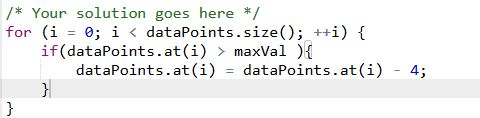
for (i = 0; i < dataPoints.size(); ++i) {
if(dataPoints.at(i) > maxVal ){
dataPoints.at(i) =
dataPoints.at(i) - 4;
}
}
for (i = 0; i < dataPoints.size(); ++i) {
cout << dataPoints.at(i) << " " ;
}
cout << endl;
return 0;
}
Only added a for block.
Add Answer to:
in C++
Problem:
Subtract 4 to any element's value that is greater than
maxVal.
Ex: If...
In the C language Double any element's value that is less than controlVal. Ex: If controlVal...
In the C language Double any element's value that is less than controlVal. Ex: If controlVal = 10, then dataPoints = {2, 12, 9, 20} becomes {4, 12, 18, 20}. #include <stdio.h> int main(void) { const int NUM_POINTS = 4; int dataPoints[NUM_POINTS]; int controlVal; int i; scanf("%d", &controlVal); for (i = 0; i < NUM_POINTS; ++i) { scanf("%d ", &(dataPoints[i])); } /* Your solution goes here */ for (i = 0; i < NUM_POINTS; ++i) { printf("%d ", dataPoints[i]); }...
Double any element's value that is less than minVal. Ex: If minVal = 10, then dataPoints...
Double any element's value that is less than minVal. Ex: If minVal = 10, then dataPoints = {2, 12, 9, 20} becomes {4, 12, 18, 20}. #include <stdio.h> int main(void) { const int NUM_POINTS = 4; int dataPoints[NUM_POINTS]; int minVal; int i; dataPoints[0] = 2; dataPoints[1] = 12; dataPoints[2] = 9; dataPoints[3] = 20; minVal = 10; /* Your solution goes here */ for (i = 0; i < NUM_POINTS; ++i) { printf("%d ", dataPoints[i]); } printf("\n"); return 0; }
Double any element's value that is less than minValue. Ex: If minValue 10, then dataPoints =...
 Double any element's value that is less than minValue. Ex: If minValue 10, then dataPoints = {2, 12, 9, 20) becomes {4, 12, 18, 20). public static void main (String ] args) { Scanner scnr = new Scanner(System.in); 4 5 final int NUM_POINTS = 4; int dataPoints = int minValue int i new int[NUM POINTS]; 7 8 minValue 10 scnr.nextInt(); 11 for (i 0; i dataPoints[i] } dataPoints.length; ++i) { scnr.nextInt); 12 13 14 15 /Your solution goes here */...
C++ Write a function so that the main() code below can be replaced by the simpler...
C++ Write a function so that the main() code below can be replaced by the simpler code that calls function MphAndMinutesToMiles(). Original main(): int main() { double milesPerHour; double minutesTraveled; double hoursTraveled; double milesTraveled; cin >> milesPerHour; cin >> minutesTraveled; hoursTraveled = minutesTraveled / 60.0; milesTraveled = hoursTraveled * milesPerHour; cout << "Miles: " << milesTraveled << endl; return 0; } 1 2 3 4 5 6 7 8 9 10 11 12 13 14 15 16 #include <iostream> using...
C++ Write a loop that subtracts 1 from each element in lowerScores. If the element was...
C++ Write a loop that subtracts 1 from each element in lowerScores. If the element was already 0 or negative, assign 0 to the element. Ex: lowerScores = {5, 0, 2, -3} becomes {4, 0, 1, 0}. #include <iostream> using namespace std; int main() { const int SCORES_SIZE = 4; int lowerScores[SCORES_SIZE]; int i; for (i = 0; i < SCORES_SIZE; ++i) { cin >> lowerScores[i]; } /* Your solution goes here */ for (i = 0; i < SCORES_SIZE;...
3.3.2: If-else statements. C++ Print "userNum1 is negative." if userNum1 is less than 0. End with...
3.3.2: If-else statements. C++ Print "userNum1 is negative." if userNum1 is less than 0. End with newline. Assign userNum2 with 1 if userNum2 is greater than 12. Otherwise, print "userNum2 is less or equal 12.". End with newline. #include <iostream> using namespace std; int main() { int userNum1; int userNum2; cin >> userNum1; cin >> userNum2; /*answer goes here*/ cout << "userNum2 is " << userNum2 << endl; return 0; }
Assign numMatches with the number of elements in userValues that equal matchValue. userValues has NUM_VALS elements....
Assign numMatches with the number of elements in userValues that equal matchValue. userValues has NUM_VALS elements. Ex: If userValues is {2, 2, 1, 2} and matchValue is 2 , then numMatches should be 3. Your code will be tested with the following values: * matchValue: 2, userValues: {2, 2, 1, 2} (as in the example program above) * matchValue: 0, userValues: {0, 0, 0, 0} * matchValue: 50, userValues: {10, 20, 30, 40} (Notes) #include <iostream> #include <vector> using namespace...
C++ class 3.2.4: If-else statement: Fix errors. Re-type the code and fix any errors. The code...
C++ class 3.2.4: If-else statement: Fix errors. Re-type the code and fix any errors. The code should convert non-positive numbers to 1. if (userNum > 0) cout << "Positive." << endl; else cout << "Not positive, converting to 1." << endl; Answer #include using namespace std; int main() { int userNum; cin >> userNum; /* Your solution goes here */ return 0; userNum = 1; cout << "Final: " << userNum << endl;
Re-type the code and fix any errors. The code should convert non-positive numbers to 1. if...
Re-type the code and fix any errors. The code should convert non-positive numbers to 1. if (userNum > 0) cout << "Positive." << endl; else cout << "Not positive, converting to 1." << endl; userNum = 1; cout << "Final: " << userNum << endl; answer: #include <iostream> using namespace std; int main() { int userNum; cin >> userNum; /* Your solution goes here */ return 0; }
Write an expression that executes the loop while the user enters a number greater than or...
Write an expression that executes the loop while the user enters a number greater than or equal to 0. Note: These activities may test code with different test values. This activity will perform three tests, with userNum initially 9 and user input of 5, 2, -1, then with userNum initially 0 and user input of -17, then with userNum initially -1. See "How to Use zyBooks". . Also note: If the submitted code has an infinite loop, the system will...
 Double any element's value that is less than minValue. Ex: If minValue 10, then dataPoints = {2, 12, 9, 20) becomes {4, 12, 18, 20). public static void main (String ] args) { Scanner scnr = new Scanner(System.in); 4 5 final int NUM_POINTS = 4; int dataPoints = int minValue int i new int[NUM POINTS]; 7 8 minValue 10 scnr.nextInt(); 11 for (i 0; i dataPoints[i] } dataPoints.length; ++i) { scnr.nextInt); 12 13 14 15 /Your solution goes here */...
Most questions answered within 3 hours.
-
Where is the error in this code sequence?
String s1 = "Hello";
String s2 = "ello";...
asked 10 months ago -
Financial data for Joel de Paris, Inc., for last year
follow:
Joel de Paris, Inc.
Balance...
asked 10 months ago -
Consider this reaction:
Al2(SO4)3 (aq)+ BaCl3
(aq) Al2Cl6 (aq)- +
3BaSO4(s) . What is the...
asked 10 months ago -
Suppose that Savneet is considering increasing her
recent random sample from 20 car rentals to 40...
asked 10 months ago -
Trucks arrive at an unloading terminal at an average rate of 120
per hour.
Trucks arrive...
asked 10 months ago -
Why are methanol and ethanol completely soluble in water while
octanol is not very little soluble....
asked 10 months ago -
A facilities manager at a university reads in a research report
that the mean amount of...
asked 10 months ago -
When the CuSO4 is rehydrated by adding water to the anhydrous
compound, is this an endothermic...
asked 10 months ago -
A ray of sunlight is passing from diamond into crown glass; the
angle of incidence is...
asked 10 months ago -
A block of mass 0.249 kg is placed on top of a light, vertical
spring of...
asked 10 months ago -
how do the kidneys compensate in the presences of acidosis
a) trigger hyperventilate
b) reserve acid...
asked 10 months ago -
Question 501 pts
The rental rate of capital to the firm increases. Which of the
following...
asked 10 months ago