In the C language Double any element's value that is less than controlVal. Ex: If controlVal...
In the C language
Double any element's value that is less than controlVal. Ex: If
controlVal = 10, then dataPoints = {2, 12, 9, 20} becomes {4, 12,
18, 20}.
#include <stdio.h>
int main(void) {
const int NUM_POINTS = 4;
int dataPoints[NUM_POINTS];
int controlVal;
int i;
scanf("%d", &controlVal);
for (i = 0; i < NUM_POINTS; ++i) {
scanf("%d ", &(dataPoints[i]));
}
/* Your solution goes here */
for (i = 0; i < NUM_POINTS; ++i) {
printf("%d ", dataPoints[i]);
}
printf("\n");
return 0;
}
Homework Answers
#include <stdio.h>
int main(void)
{
const int NUM_POINTS = 4;
int dataPoints[NUM_POINTS];
int controlVal;
int i;
scanf("%d", &controlVal);
for (i = 0; i < NUM_POINTS; ++i)
{
scanf("%d ", &(dataPoints[i]));
}
//if the dataPoint value is less than controlVal then double
it
for (i = 0; i < NUM_POINTS; ++i)
{
if(dataPoints[i]<controlVal)
{
dataPoints[i] = 2 * dataPoints[i];
}
}
for (i = 0; i < NUM_POINTS; ++i)
{
printf("%d ", dataPoints[i]);
}
printf("\n");
return 0;
}
INPUT:

OUTPUT:

Add Answer to:
In the C language
Double any element's value that is less than controlVal. Ex: If
controlVal...
Double any element's value that is less than minVal. Ex: If minVal = 10, then dataPoints...
Double any element's value that is less than minVal. Ex: If minVal = 10, then dataPoints = {2, 12, 9, 20} becomes {4, 12, 18, 20}. #include <stdio.h> int main(void) { const int NUM_POINTS = 4; int dataPoints[NUM_POINTS]; int minVal; int i; dataPoints[0] = 2; dataPoints[1] = 12; dataPoints[2] = 9; dataPoints[3] = 20; minVal = 10; /* Your solution goes here */ for (i = 0; i < NUM_POINTS; ++i) { printf("%d ", dataPoints[i]); } printf("\n"); return 0; }
Double any element's value that is less than minValue. Ex: If minValue 10, then dataPoints =...
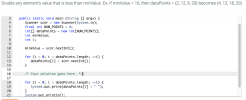 Double any element's value that is less than minValue. Ex: If minValue 10, then dataPoints = {2, 12, 9, 20) becomes {4, 12, 18, 20). public static void main (String ] args) { Scanner scnr = new Scanner(System.in); 4 5 final int NUM_POINTS = 4; int dataPoints = int minValue int i new int[NUM POINTS]; 7 8 minValue 10 scnr.nextInt(); 11 for (i 0; i dataPoints[i] } dataPoints.length; ++i) { scnr.nextInt); 12 13 14 15 /Your solution goes here */...
in C++ Problem: Subtract 4 to any element's value that is greater than maxVal. Ex: If...
in C++ Problem: Subtract 4 to any element's value that is greater than maxVal. Ex: If maxVal = 10, then dataPoints = {2, 12, 9, 20} becomes {2, 8, 9, 16}. ------------------------ #include #include using namespace std; int main() { int maxVal; int NUM_POINTS; unsigned int i; cin >> maxVal; cin >> NUM_POINTS; vector dataPoints(NUM_POINTS); for (i = 0; i < dataPoints.size(); ++i) { cin >> dataPoints.at(i); } /* Your solution goes here */ for (i = 0; i <...
For any element in keysList with a value greater than 50. print the corresponding value in...
 For any element in keysList with a value greater than 50. print the corresponding value in itemsList, followed by a comma (no spaces) Ex: If the input is 32 105 101 35 10 20 30 40 the output is 20,30, 1 include <stdio.h> 2 3 int main(void) { 4 const int SIZE LIST - 4 5 int keysList[SIZE LISTI: 6 int itemslist[SIZE_LIST); 7 int 1; 8 9 scanf("%d", &keysList[0]); 10 scanf("%d", &keyslist[1]); 11 scanf("%d", &keysList[2]); 12 scanf("%d", &keysList[]); 13 14...
for c CHALLENGE ACTIVITY 9.7.1: Decrement array elements. Write a loop that subtracts 1 from each...
 for c
CHALLENGE ACTIVITY 9.7.1: Decrement array elements. Write a loop that subtracts 1 from each element in lowerScores. If the element was already 0 or negative, assign 0 to the element. Ex lowerScores = {5,0,2,-3) becomes {4.0, 1.0). 1 include <stdio.h> 3 int main(void) 0 const int SCORES_SIZE - 4; int lowerScores [SCORES_SIZE]: int i; for (1 - 0; i < SCORES_SIZE; ++) { scanf("%d", &(lowerScores[i])); /" Your solution goes here / { 15 for (i = 0; i...
for c
CHALLENGE ACTIVITY 9.7.1: Decrement array elements. Write a loop that subtracts 1 from each element in lowerScores. If the element was already 0 or negative, assign 0 to the element. Ex lowerScores = {5,0,2,-3) becomes {4.0, 1.0). 1 include <stdio.h> 3 int main(void) 0 const int SCORES_SIZE - 4; int lowerScores [SCORES_SIZE]: int i; for (1 - 0; i < SCORES_SIZE; ++) { scanf("%d", &(lowerScores[i])); /" Your solution goes here / { 15 for (i = 0; i...
C - Language Write a loop that sets each array element to the sum of itself...
C - Language Write a loop that sets each array element to the sum of itself and the next element, except for the last element which stays the same. Be careful not to index beyond the last element. Ex: Initial scores: 10, 20, 30, 40 Scores after the loop: 30, 50, 70, 40 The first element is 30 or 10 + 20, the second element is 50 or 20 + 30, and the third element is 70 or 30 +...
I need the programming to be in language C. I am using a program called Zybook...
I need the programming to be in language C. I am using a program called Zybook Prompt: Write a statement that outputs variable numObjects. End with a newline. Given: #include <stdio.h> int main(void) { int numObjects; scanf("%d", &numObjects); return 0; } What I did so far. I am not sure if its right tho? #include <stdio.h> int main(void) { int numObjects; scanf("%d", &numObjects); printf(" num Objects is "); printf("%d\n", userAge); return 0; }
In C please Write a function so that the main() code below can be replaced by...
 In C please
Write a function so that the main() code below can be replaced by the simpler code that calls function MphAndMinutesToMiles(). Original maino: int main(void) { double milesPerHour, double minutes Traveled; double hours Traveled; double miles Traveled; scanf("%f", &milesPerHour); scanf("%lf", &minutes Traveled); hours Traveled = minutes Traveled / 60.0; miles Traveled = hours Traveled * milesPerHour; printf("Miles: %1f\n", miles Traveled); return 0; 1 #include <stdio.h> 3/* Your solution goes here */ 1 test passed 4 All tests passed...
In C please
Write a function so that the main() code below can be replaced by the simpler code that calls function MphAndMinutesToMiles(). Original maino: int main(void) { double milesPerHour, double minutes Traveled; double hours Traveled; double miles Traveled; scanf("%f", &milesPerHour); scanf("%lf", &minutes Traveled); hours Traveled = minutes Traveled / 60.0; miles Traveled = hours Traveled * milesPerHour; printf("Miles: %1f\n", miles Traveled); return 0; 1 #include <stdio.h> 3/* Your solution goes here */ 1 test passed 4 All tests passed...
Translate the following C program to Pep/9 assembly language. #include <stdio.h> const int limit = 5;...
Translate the following C program to Pep/9 assembly language. #include <stdio.h> const int limit = 5; int main() { int number; scanf("%d",&number); while (number < limit){ number++; printf("%d",number); } return 0; }
CHALLENGE ACTIVITY 5.71 String library functions. Assign the size of userinput to stringSize. Ex: if userinput...
 CHALLENGE ACTIVITY 5.71 String library functions. Assign the size of userinput to stringSize. Ex: if userinput is 'Hello output is: Size of user Input: 5 1 #include <stdio.h> 2 #include <string.h> 4 int main(void) { char user Input[50]; int stringSize; BO scanf("%s", userInput); /* Your solution goes here" printf("Size of user Input: %d\n", stringsize); return ; Run
 Double any element's value that is less than minValue. Ex: If minValue 10, then dataPoints = {2, 12, 9, 20) becomes {4, 12, 18, 20). public static void main (String ] args) { Scanner scnr = new Scanner(System.in); 4 5 final int NUM_POINTS = 4; int dataPoints = int minValue int i new int[NUM POINTS]; 7 8 minValue 10 scnr.nextInt(); 11 for (i 0; i dataPoints[i] } dataPoints.length; ++i) { scnr.nextInt); 12 13 14 15 /Your solution goes here */...
 For any element in keysList with a value greater than 50. print the corresponding value in itemsList, followed by a comma (no spaces) Ex: If the input is 32 105 101 35 10 20 30 40 the output is 20,30, 1 include <stdio.h> 2 3 int main(void) { 4 const int SIZE LIST - 4 5 int keysList[SIZE LISTI: 6 int itemslist[SIZE_LIST); 7 int 1; 8 9 scanf("%d", &keysList[0]); 10 scanf("%d", &keyslist[1]); 11 scanf("%d", &keysList[2]); 12 scanf("%d", &keysList[]); 13 14...
 for c
CHALLENGE ACTIVITY 9.7.1: Decrement array elements. Write a loop that subtracts 1 from each element in lowerScores. If the element was already 0 or negative, assign 0 to the element. Ex lowerScores = {5,0,2,-3) becomes {4.0, 1.0). 1 include <stdio.h> 3 int main(void) 0 const int SCORES_SIZE - 4; int lowerScores [SCORES_SIZE]: int i; for (1 - 0; i < SCORES_SIZE; ++) { scanf("%d", &(lowerScores[i])); /" Your solution goes here / { 15 for (i = 0; i...
for c
CHALLENGE ACTIVITY 9.7.1: Decrement array elements. Write a loop that subtracts 1 from each element in lowerScores. If the element was already 0 or negative, assign 0 to the element. Ex lowerScores = {5,0,2,-3) becomes {4.0, 1.0). 1 include <stdio.h> 3 int main(void) 0 const int SCORES_SIZE - 4; int lowerScores [SCORES_SIZE]: int i; for (1 - 0; i < SCORES_SIZE; ++) { scanf("%d", &(lowerScores[i])); /" Your solution goes here / { 15 for (i = 0; i...
 In C please
Write a function so that the main() code below can be replaced by the simpler code that calls function MphAndMinutesToMiles(). Original maino: int main(void) { double milesPerHour, double minutes Traveled; double hours Traveled; double miles Traveled; scanf("%f", &milesPerHour); scanf("%lf", &minutes Traveled); hours Traveled = minutes Traveled / 60.0; miles Traveled = hours Traveled * milesPerHour; printf("Miles: %1f\n", miles Traveled); return 0; 1 #include <stdio.h> 3/* Your solution goes here */ 1 test passed 4 All tests passed...
In C please
Write a function so that the main() code below can be replaced by the simpler code that calls function MphAndMinutesToMiles(). Original maino: int main(void) { double milesPerHour, double minutes Traveled; double hours Traveled; double miles Traveled; scanf("%f", &milesPerHour); scanf("%lf", &minutes Traveled); hours Traveled = minutes Traveled / 60.0; miles Traveled = hours Traveled * milesPerHour; printf("Miles: %1f\n", miles Traveled); return 0; 1 #include <stdio.h> 3/* Your solution goes here */ 1 test passed 4 All tests passed...
 CHALLENGE ACTIVITY 5.71 String library functions. Assign the size of userinput to stringSize. Ex: if userinput is 'Hello output is: Size of user Input: 5 1 #include <stdio.h> 2 #include <string.h> 4 int main(void) { char user Input[50]; int stringSize; BO scanf("%s", userInput); /* Your solution goes here" printf("Size of user Input: %d\n", stringsize); return ; Run
Most questions answered within 3 hours.
-
Where is the error in this code sequence?
String s1 = "Hello";
String s2 = "ello";...
asked 11 months ago -
Financial data for Joel de Paris, Inc., for last year
follow:
Joel de Paris, Inc.
Balance...
asked 11 months ago -
Consider this reaction:
Al2(SO4)3 (aq)+ BaCl3
(aq) Al2Cl6 (aq)- +
3BaSO4(s) . What is the...
asked 11 months ago -
Suppose that Savneet is considering increasing her
recent random sample from 20 car rentals to 40...
asked 11 months ago -
Trucks arrive at an unloading terminal at an average rate of 120
per hour.
Trucks arrive...
asked 11 months ago -
Why are methanol and ethanol completely soluble in water while
octanol is not very little soluble....
asked 11 months ago -
A facilities manager at a university reads in a research report
that the mean amount of...
asked 11 months ago -
When the CuSO4 is rehydrated by adding water to the anhydrous
compound, is this an endothermic...
asked 11 months ago -
A ray of sunlight is passing from diamond into crown glass; the
angle of incidence is...
asked 11 months ago -
A block of mass 0.249 kg is placed on top of a light, vertical
spring of...
asked 11 months ago -
how do the kidneys compensate in the presences of acidosis
a) trigger hyperventilate
b) reserve acid...
asked 11 months ago -
Question 501 pts
The rental rate of capital to the firm increases. Which of the
following...
asked 11 months ago