Suppose the advertising decisions of two firms are inter-related. Firm 1 always spends $2 million plus...
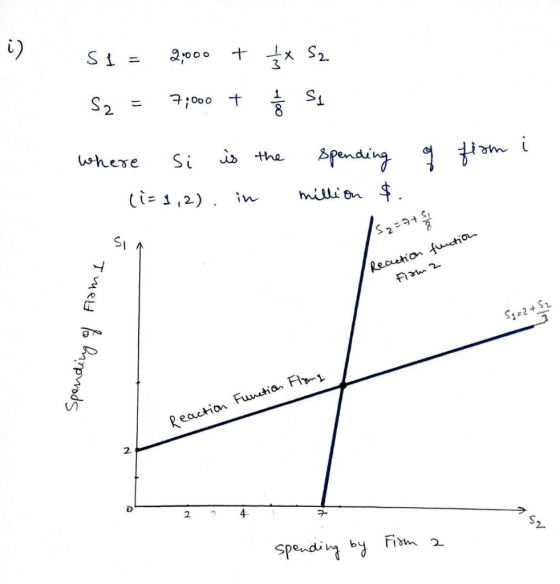
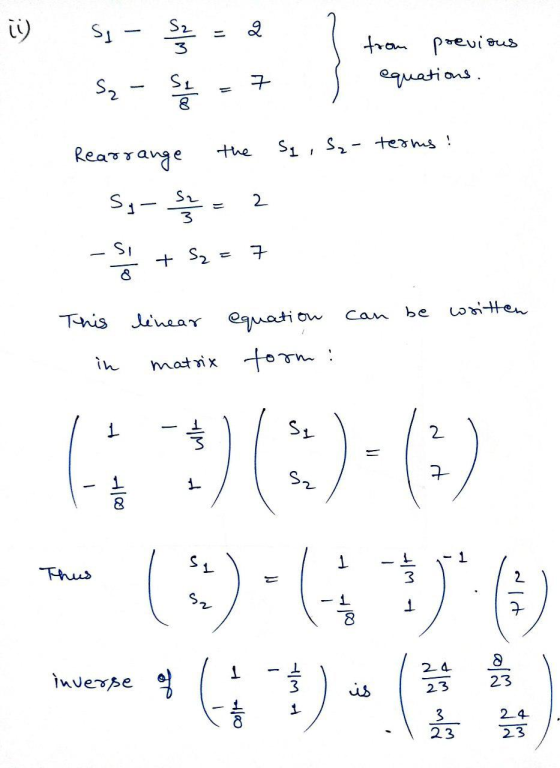
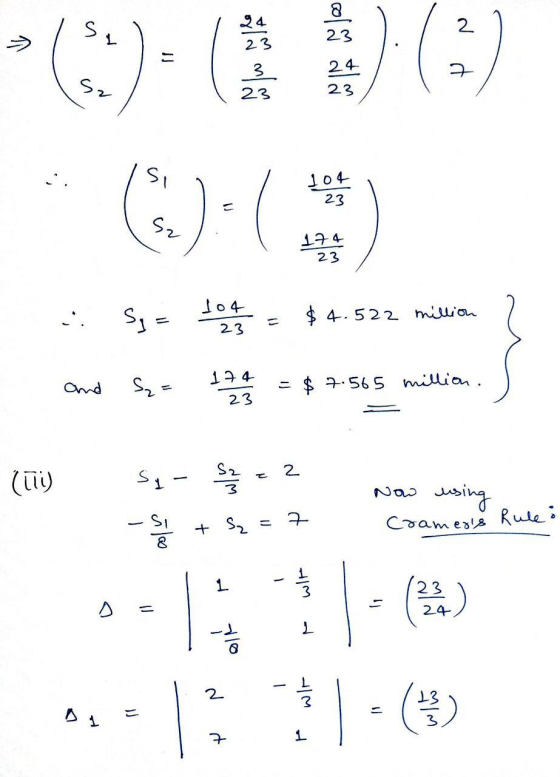
Suppose the advertising decisions of two firms are inter-related. Firm 1 always spends $2 million plus 33⅓% of what firm 2 spends on advertising. And firm 2 always spends $7 million plus 12.5% of what firm 1 spends on advertising.
i) Draw the reaction functions for the firms in this problem (in the same diagram). Be sure to label each curve and the axes.
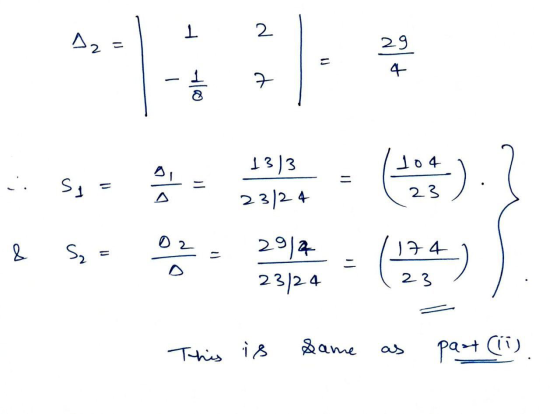
ii) Use the inverse matrix method to find the Nash equilibrium in this problem. iii) Now use Cramer's rule to verify your answer in part ii).
Homework Answers
Reaction function ( also known as best response function ) shows the optimal output q1 as a function of q2.
Add Answer to:
Suppose the advertising decisions of two firms are
inter-related. Firm 1 always spends $2 million plus...
qn 1 (15) 1. Suppose the advertising decisions of two firms are inter-related. Firm I always...
 qn 1
(15) 1. Suppose the advertising decisions of two firms are inter-related. Firm I always spends $2 million plus what firm 2 spends on advertising. And firm 2 always spends $7 million plus 12.5% of what firm I spends advertising of ! i) Draw the reaction functions for the firms in this problem label each curve and the axes in the same diagram Best Use the inverse matrix method to find the Nash equilibrium in this problem Now use...
qn 1
(15) 1. Suppose the advertising decisions of two firms are inter-related. Firm I always spends $2 million plus what firm 2 spends on advertising. And firm 2 always spends $7 million plus 12.5% of what firm I spends advertising of ! i) Draw the reaction functions for the firms in this problem label each curve and the axes in the same diagram Best Use the inverse matrix method to find the Nash equilibrium in this problem Now use...
Consider two firms (Firm A and Firm B) competing in this market. They simultaneously decide on...
Consider two firms (Firm A and Firm B) competing in this market. They simultaneously decide on the price of the product in a typical Bertrand fashion while producing an identical product. Both firms face the same cost function: C(qA) = 12qA and C(qB) = 12qB, where qA is the output of Firm A and qB is the output of Firm B. The demand curve is P = 30 - Q. (i) What will be the Bertrand-Nash equilibrium price (pB) chosen...
Problem 5. (20 points) There are two competing firms. Each firm decides when to exit the...
 Problem 5. (20 points) There are two competing firms. Each firm decides when to exit the market: (i) immediately, (ii) after 6 months, or (iii) after 1 year. If a firm decides to exit the market, it does not get any payoff from that point on (that is, its utility stays the same). After every 6 months firms gain or lose utilities as follow: if both firms are still in the market, they both lose -1 and if only one...
Consider two firms 1 and 2 engaging into the following one-shot game: if firm 1 advertises...
Consider two firms 1 and 2 engaging into the following one-shot game: if firm 1 advertises and firm 2 does not, firm 1 will make $20 million in profits and firm 2 will make $6 million. If firm 2 advertises and firm 1 does not, firm 1 will make $2 million and firm 2 will make $6 million. If firm 1 advertises and firm 2 advertises, each firm earns $10 million. If neither firm advertises, firm 2 will make $8...
Problem three Two firms in a homogencous-product duopoly market (firm 1 and firm 2) have the following cost and demand functions: TC 4 TC24q2 and Q-40-P: Q-+2 a Derive the reaction function/best-resp...
 Problem three Two firms in a homogencous-product duopoly market (firm 1 and firm 2) have the following cost and demand functions: TC 4 TC24q2 and Q-40-P: Q-+2 a Derive the reaction function/best-response function for each firm. b) Assume that the firms play a simultaneous move game. Characterize the Nash Equilibrium. cSuppose the two firms play game is a sequential game with the following timing of events: 1. Firm 1 chooses output 2. Firm 2 observes firm 1's output and then...
1. Consider a three firm (n = 3) Cournot oligopoly. The market inverse demand function is p (Q) = 24 Q. Firm 1 has constant average and marginal costs of $12 per unit, while firms 2 and 3 have constan...
1. Consider a three firm (n = 3) Cournot oligopoly. The market inverse demand function is p (Q) = 24 Q. Firm 1 has constant average and marginal costs of $12 per unit, while firms 2 and 3 have constant average and marginal costs of $15 per unit. a)Verify that the following are Nash equilibrium quantities for this market: q1 = 9 / 2 and q2 = q3 = 3 / 2 . b)How much profit does each firm earn...
question 2 answer needed. Ql) Consider an oligopoly with 2 firms. The inverse demand curve is given by P- 100- Q1-Q2. Firm 1's total cost function is TC 30Q1. Firm 2's total cost...
 question 2 answer needed.
Ql) Consider an oligopoly with 2 firms. The inverse demand curve is given by P- 100- Q1-Q2. Firm 1's total cost function is TC 30Q1. Firm 2's total cost function is TC2 -20Q2. Analyze this using a Cournot model of oligopoly. Find the Nash Equi- librium quantity that each firm produces. Q2) Analyze the demand and cost functions in Question 1 using a Bertrand model of oligopoly where products are identical. Find the Nash equilbrium(a) prices....
question 2 answer needed.
Ql) Consider an oligopoly with 2 firms. The inverse demand curve is given by P- 100- Q1-Q2. Firm 1's total cost function is TC 30Q1. Firm 2's total cost function is TC2 -20Q2. Analyze this using a Cournot model of oligopoly. Find the Nash Equi- librium quantity that each firm produces. Q2) Analyze the demand and cost functions in Question 1 using a Bertrand model of oligopoly where products are identical. Find the Nash equilbrium(a) prices....
1. Consider the coupon game. But suppose that instead of decisions being made simultaneously, they are made sequentially, with Firm 1 choosing first, and its choice observed by Firm 2 before Firm 2 ma...
 1. Consider the coupon game. But suppose that instead of
decisions being made simultaneously, they are made sequentially,
with Firm 1 choosing first, and its choice observed by Firm 2
before Firm 2 makes its choice.
a. Draw a game tree representing this game.
b. Use backward induction to find the solution. (Remember that
your solution should include both firms’ strategies, and that Firm
2’s strategy should be complete!)
2. Two duopolists produce a homogeneous product, and each has a...
1. Consider the coupon game. But suppose that instead of
decisions being made simultaneously, they are made sequentially,
with Firm 1 choosing first, and its choice observed by Firm 2
before Firm 2 makes its choice.
a. Draw a game tree representing this game.
b. Use backward induction to find the solution. (Remember that
your solution should include both firms’ strategies, and that Firm
2’s strategy should be complete!)
2. Two duopolists produce a homogeneous product, and each has a...
3. There are two firms that compete according to Cournot competition. Fim 1 has a cost func tion Cia1) 318. Firm 2 has a cost function C2()3. These firms cannot discriminate, so there is just one...
 3. There are two firms that compete according to Cournot competition. Fim 1 has a cost func tion Cia1) 318. Firm 2 has a cost function C2()3. These firms cannot discriminate, so there is just one price that is determined by the aggregate demand. The inverse demand equation is P Q) 300-0 Where total supply 0-2 (a) Setup the profit maximization problem for firm 1 with all necessary equations plugged in. (2 point) (b) Solve firm I's profit maximization peoblem...
hi i need answer from part d Question 2 (48 marks) Consider a firm which produces a good, y, using two factors of...
 hi i need answer from part d
Question 2 (48 marks) Consider a firm which produces a good, y, using two factors of production, xi and x2 The firm's production function is Note that (4) is a special case of the production function in Question 1, in which α-1/2 and β-14. Consequently, any properties that the production function in Q1 has been shown to possess, must also be possessed by the production function defined in (4). The firm faces exogenously...
hi i need answer from part d
Question 2 (48 marks) Consider a firm which produces a good, y, using two factors of production, xi and x2 The firm's production function is Note that (4) is a special case of the production function in Question 1, in which α-1/2 and β-14. Consequently, any properties that the production function in Q1 has been shown to possess, must also be possessed by the production function defined in (4). The firm faces exogenously...
 qn 1
(15) 1. Suppose the advertising decisions of two firms are inter-related. Firm I always spends $2 million plus what firm 2 spends on advertising. And firm 2 always spends $7 million plus 12.5% of what firm I spends advertising of ! i) Draw the reaction functions for the firms in this problem label each curve and the axes in the same diagram Best Use the inverse matrix method to find the Nash equilibrium in this problem Now use...
qn 1
(15) 1. Suppose the advertising decisions of two firms are inter-related. Firm I always spends $2 million plus what firm 2 spends on advertising. And firm 2 always spends $7 million plus 12.5% of what firm I spends advertising of ! i) Draw the reaction functions for the firms in this problem label each curve and the axes in the same diagram Best Use the inverse matrix method to find the Nash equilibrium in this problem Now use...
 Problem 5. (20 points) There are two competing firms. Each firm decides when to exit the market: (i) immediately, (ii) after 6 months, or (iii) after 1 year. If a firm decides to exit the market, it does not get any payoff from that point on (that is, its utility stays the same). After every 6 months firms gain or lose utilities as follow: if both firms are still in the market, they both lose -1 and if only one...
 Problem three Two firms in a homogencous-product duopoly market (firm 1 and firm 2) have the following cost and demand functions: TC 4 TC24q2 and Q-40-P: Q-+2 a Derive the reaction function/best-response function for each firm. b) Assume that the firms play a simultaneous move game. Characterize the Nash Equilibrium. cSuppose the two firms play game is a sequential game with the following timing of events: 1. Firm 1 chooses output 2. Firm 2 observes firm 1's output and then...
 question 2 answer needed.
Ql) Consider an oligopoly with 2 firms. The inverse demand curve is given by P- 100- Q1-Q2. Firm 1's total cost function is TC 30Q1. Firm 2's total cost function is TC2 -20Q2. Analyze this using a Cournot model of oligopoly. Find the Nash Equi- librium quantity that each firm produces. Q2) Analyze the demand and cost functions in Question 1 using a Bertrand model of oligopoly where products are identical. Find the Nash equilbrium(a) prices....
question 2 answer needed.
Ql) Consider an oligopoly with 2 firms. The inverse demand curve is given by P- 100- Q1-Q2. Firm 1's total cost function is TC 30Q1. Firm 2's total cost function is TC2 -20Q2. Analyze this using a Cournot model of oligopoly. Find the Nash Equi- librium quantity that each firm produces. Q2) Analyze the demand and cost functions in Question 1 using a Bertrand model of oligopoly where products are identical. Find the Nash equilbrium(a) prices....
 1. Consider the coupon game. But suppose that instead of
decisions being made simultaneously, they are made sequentially,
with Firm 1 choosing first, and its choice observed by Firm 2
before Firm 2 makes its choice.
a. Draw a game tree representing this game.
b. Use backward induction to find the solution. (Remember that
your solution should include both firms’ strategies, and that Firm
2’s strategy should be complete!)
2. Two duopolists produce a homogeneous product, and each has a...
1. Consider the coupon game. But suppose that instead of
decisions being made simultaneously, they are made sequentially,
with Firm 1 choosing first, and its choice observed by Firm 2
before Firm 2 makes its choice.
a. Draw a game tree representing this game.
b. Use backward induction to find the solution. (Remember that
your solution should include both firms’ strategies, and that Firm
2’s strategy should be complete!)
2. Two duopolists produce a homogeneous product, and each has a...
 3. There are two firms that compete according to Cournot competition. Fim 1 has a cost func tion Cia1) 318. Firm 2 has a cost function C2()3. These firms cannot discriminate, so there is just one price that is determined by the aggregate demand. The inverse demand equation is P Q) 300-0 Where total supply 0-2 (a) Setup the profit maximization problem for firm 1 with all necessary equations plugged in. (2 point) (b) Solve firm I's profit maximization peoblem...
 hi i need answer from part d
Question 2 (48 marks) Consider a firm which produces a good, y, using two factors of production, xi and x2 The firm's production function is Note that (4) is a special case of the production function in Question 1, in which α-1/2 and β-14. Consequently, any properties that the production function in Q1 has been shown to possess, must also be possessed by the production function defined in (4). The firm faces exogenously...
hi i need answer from part d
Question 2 (48 marks) Consider a firm which produces a good, y, using two factors of production, xi and x2 The firm's production function is Note that (4) is a special case of the production function in Question 1, in which α-1/2 and β-14. Consequently, any properties that the production function in Q1 has been shown to possess, must also be possessed by the production function defined in (4). The firm faces exogenously...
Most questions answered within 3 hours.
-
Where is the error in this code sequence?
String s1 = "Hello";
String s2 = "ello";...
asked 11 months ago -
Financial data for Joel de Paris, Inc., for last year
follow:
Joel de Paris, Inc.
Balance...
asked 11 months ago -
Consider this reaction:
Al2(SO4)3 (aq)+ BaCl3
(aq) Al2Cl6 (aq)- +
3BaSO4(s) . What is the...
asked 11 months ago -
Suppose that Savneet is considering increasing her
recent random sample from 20 car rentals to 40...
asked 11 months ago -
Trucks arrive at an unloading terminal at an average rate of 120
per hour.
Trucks arrive...
asked 11 months ago -
Why are methanol and ethanol completely soluble in water while
octanol is not very little soluble....
asked 11 months ago -
A facilities manager at a university reads in a research report
that the mean amount of...
asked 11 months ago -
When the CuSO4 is rehydrated by adding water to the anhydrous
compound, is this an endothermic...
asked 11 months ago -
A ray of sunlight is passing from diamond into crown glass; the
angle of incidence is...
asked 11 months ago -
A block of mass 0.249 kg is placed on top of a light, vertical
spring of...
asked 11 months ago -
how do the kidneys compensate in the presences of acidosis
a) trigger hyperventilate
b) reserve acid...
asked 11 months ago -
Question 501 pts
The rental rate of capital to the firm increases. Which of the
following...
asked 11 months ago