Explain how G-protein linked receptors increase the amount of cAMP.
Homework Answers
G protein-coupled receptors (GPCRs) belong to a family of integral membrane proteins which respond to a variety of extracellular stimuli. Each GPCR binds to and is activated by a specific ligand having a large range of sizes. On activation by its extracellular ligand, a conformational change is induced in the GPCR that is transmitted to an attached intracellular heterotrimeric G protein complex. The Gs alpha subunit of the G-protein complex gets activated.
The activated Gs alpha subunit binds and activates adenylyl cyclase, which leads to the conversion of ATP into cyclic adenosine monophosphate (cAMP) and thus increasing the concentration of cAMP.
Choose all of the following that are differences between kinase receptors and G- protein linked receptors....
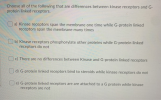 Choose all of the following that are differences between kinase receptors and G- protein linked receptors. a) Kinase receptors span the membrane one time while G-protein linked receptors span the membrane many times b) Kinase receptors phosphorylate other proteins while G-protein linked receptors do not c) There are no differences between Kinase and G-protein linked receptors d) G-protein linked receptors bind to steroids while kinase receptors do not e) G-protein linked receptors are are attached to a G protein while...
How are g-protein linked receptors relative to psychotropic drugs
How are g-protein linked receptors relative to psychotropic drugs
Signaling of GPCRs (G-protein coupled receptors) is terminated by which mechanism? Phosphorylation of receptors by cAMP...
Signaling of GPCRs (G-protein coupled receptors) is terminated by which mechanism? Phosphorylation of receptors by cAMP (cyclic adenosine monophosphate) activated PKA (protein kinase A), which blocks the interaction with G-protein Cleavage of the GPCRs by receptor-specific serine or threonine proteases Hydrolysis of GTP (guanosine triphosphate) to GDP (guonosine diphosphate) by G-protein α. None of the above All of the above
3. Describe general mechanism of G-protein-linked receptors activating G proteins to relay signal from extracellular space...
 3. Describe general mechanism of G-protein-linked receptors activating G proteins to relay signal from extracellular space to cytosol. (4 points)
A chemical messenger uses a G-Protein-linked, cAMP pathway to transduce its signal, which eventually leads to...
A chemical messenger uses a G-Protein-linked, cAMP pathway to transduce its signal, which eventually leads to the activation of enzyme X. Bob has a genetic defect which inhibits GTP hydrolysis in his cells. How would this affect activation of enzyme X?
Some G-protein coupled receptors (GPCRs) are associated with a protein called RGS, which stimulates the GTPase...
Some G-protein coupled receptors (GPCRs) are associated with a protein called RGS, which stimulates the GTPase activity of the receptor’s G-protein. What effect does RGS have on GPCR signaling? a. Signaling events are activated (upregulated) due to an increase in cAMP levels. b. Signaling events are downregulated due to disruption of the receptor-ligand interaction. c. Signaling events are activated as PKA as inhibition from the regulatory subunits is abolished. d. Signaling events are downregulated as the G-protein adopts its inactive...
Explain using simple details and correspoding "ON" "OFF" signals. Describe signaling through the G-protein linked receptor....
Explain using simple details and correspoding "ON" "OFF" signals. Describe signaling through the G-protein linked receptor. Be sure to include the details of the receptor the associating G protein and its subunits, and the events in the sequence they occur. Be sure to include the reset for every step that is activated. Describe the signaling pathway that involves cAMP and G proteins. Include how each step is rest. Include dephosphorylation events. Assume involvement of PKA
Question 6 You and your G-protein coupled receptors o You have encountered G-protein coupled receptors in...
 Question 6 You and your G-protein coupled receptors o You have encountered G-protein coupled receptors in Intro Bio I lecture (or soon will), and will encounter them briefly again in Intro Bio II. You will spend 2 or 3 lectures on them in Cell Bio. They are integral (transmembrane) proteins embedded in the plasma membrane of every eukaryotic cell in your body. We will treat them as being 50 Angstroms in diameter. Considering the plasma membrane scaled up to the...
Rationalise the concept of multiple receptor states for G protein coupled receptors and how this might...
Rationalise the concept of multiple receptor states for G protein coupled receptors and how this might be used to develop novel and more selective drugs.
In the cAMP signal transduction pathway, a protein kinase is activated. What happens next G protein...
 In the cAMP signal transduction pathway, a protein kinase is activated. What happens next G protein is activated. cAMP is converted to ATP. The protein kinase activates a cellular response. GDP is replaced by GTP. Adenylyl cyclase is activated.
 Choose all of the following that are differences between kinase receptors and G- protein linked receptors. a) Kinase receptors span the membrane one time while G-protein linked receptors span the membrane many times b) Kinase receptors phosphorylate other proteins while G-protein linked receptors do not c) There are no differences between Kinase and G-protein linked receptors d) G-protein linked receptors bind to steroids while kinase receptors do not e) G-protein linked receptors are are attached to a G protein while...
 3. Describe general mechanism of G-protein-linked receptors activating G proteins to relay signal from extracellular space to cytosol. (4 points)
 Question 6 You and your G-protein coupled receptors o You have encountered G-protein coupled receptors in Intro Bio I lecture (or soon will), and will encounter them briefly again in Intro Bio II. You will spend 2 or 3 lectures on them in Cell Bio. They are integral (transmembrane) proteins embedded in the plasma membrane of every eukaryotic cell in your body. We will treat them as being 50 Angstroms in diameter. Considering the plasma membrane scaled up to the...
 In the cAMP signal transduction pathway, a protein kinase is activated. What happens next G protein is activated. cAMP is converted to ATP. The protein kinase activates a cellular response. GDP is replaced by GTP. Adenylyl cyclase is activated.
Most questions answered within 3 hours.
-
Where is the error in this code sequence?
String s1 = "Hello";
String s2 = "ello";...
asked 10 months ago -
Financial data for Joel de Paris, Inc., for last year
follow:
Joel de Paris, Inc.
Balance...
asked 10 months ago -
Consider this reaction:
Al2(SO4)3 (aq)+ BaCl3
(aq) Al2Cl6 (aq)- +
3BaSO4(s) . What is the...
asked 10 months ago -
Suppose that Savneet is considering increasing her
recent random sample from 20 car rentals to 40...
asked 10 months ago -
Trucks arrive at an unloading terminal at an average rate of 120
per hour.
Trucks arrive...
asked 10 months ago -
Why are methanol and ethanol completely soluble in water while
octanol is not very little soluble....
asked 10 months ago -
A facilities manager at a university reads in a research report
that the mean amount of...
asked 10 months ago -
When the CuSO4 is rehydrated by adding water to the anhydrous
compound, is this an endothermic...
asked 10 months ago -
A ray of sunlight is passing from diamond into crown glass; the
angle of incidence is...
asked 10 months ago -
A block of mass 0.249 kg is placed on top of a light, vertical
spring of...
asked 10 months ago -
how do the kidneys compensate in the presences of acidosis
a) trigger hyperventilate
b) reserve acid...
asked 10 months ago -
Question 501 pts
The rental rate of capital to the firm increases. Which of the
following...
asked 10 months ago