Make a Conceptual Map of the different types of vectors and their characteristics in molecular biology....
Make a Conceptual Map of the different types of vectors and their characteristics in molecular biology. Add bibliography, not Wikipedia
Homework Answers
DNA molecule used for carrying
an exogenous DNA into a host organism and facilitates stable
integration and replication inside the host system is termed as
Vector. Molecular cloning involves series of sequential steps which
includes restriction digestion of DNA fragments both target DNA and
vector, ligation of the target DNA with the vector and introduction
into a host organism for multiplication. Then the fragments
resulted after digestion with restriction enzymes are ligated to
other DNA molecules that serve as
vectors.
In general, vectors should have following
characteristics:
• Capable of replicating inside the host.
• Have compatible restriction site for insertion of DNA molecule
(insert).
• Capable of autonomous replication inside the host (ori
site).
• Smaller in size and able to incorporate larger insert size.
• Have a selectable marker for screening of recombinant
organism.
Cloning Vector:
By cloning, one can produce unlimited amounts of any particular fragment of DNA. In principle, the DNA isolated and cut pieces are introduced into a suitable host cell, usually a bacterium such as Escherichia coli, where it is replicated, as the cell grows and divides.
However, replication will only occur if the DNA contains a sequence which is recognized by the cell as an origin of replication. Since such sequences are infrequent, this will rarely be so, and therefore, the DNA to be cloned, has to be attached to a carrier, or vector DNA which does contain an origin of replication.
Criteria of an Ideal Vector:
Vectors are those DNA molecules that can carry a foreign DNA fragment when inserted into it. A vector must possess certain minimum qualifications to be an efficient agent for the transfer, maintenance and amplification of the passenger DNA.
1. The vector should be small and easy to isolate.
2. They must have one or more origins of replication so that they will stably maintain themselves within host cell.
3. Vector should have one or more unique restriction sites into which the recombinant DNA can be inserted.
4. They should have a selectable marker (antibiotic resistance gene) which allows recognition of transformants.
5. Vector DNA can be introduced into a cell.
6. The vector should not be toxic to host .
Types:-
Plasmid :-
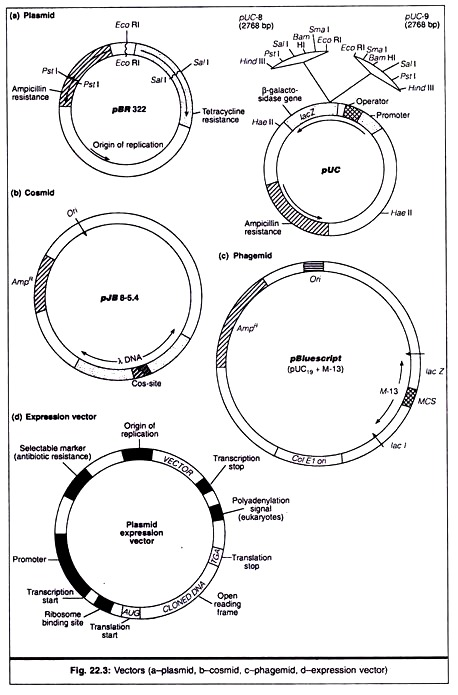
Plasmids are the extra-chromosomal, self-replicating, and double stranded closed and circular DNA molecules present in the bacterial cell. A number of properties are specified by plasmids such as antibiotic and heavy metal resistance, nitrogen fixation, pollutant degradation, bacteriocin and toxin production, colicin factors, etc.
Plasmids have following advantages as cloning vehicle :-
1. It can be readily isolated from the cells.
2. It possesses a single restriction site for one or more restriction enzymes.
3. Insertion of foreign DNA does not alter the replication properties.
4. It can be reintroduced into cell.
5. Selective marker is present.
6. Transformants can be selected easily by using selective medium.
Types of
Plasmids
The plasmids are divided into 6 major classes as described below
depending on the
phenotype:
i) Resistance or R plasmids carry genes which give resistance to
the bacteria from one or more chemical agents, such as
antibacterial agents. R plasmids are very important in clinical
microbiology as they can have profound consequences in the
treatment of bacterial infections. Eg: RP4 plasmid, which is
commonly found in Pseudomonas and in many other bacteria.
ii) Fertility or F plasmids are conjugative plasmid found in F+
bacterium with higher frequency of conjugation. F plasmid carries
transfer gene (tra) and has the ability to form Conjugation Bridge
(F pilus) with F-bacterium. Eg: F plasmid of E. coli.
iii) Col plasmids have genes that code for colicins, proteins that
kill other bacteria. Eg: ColE1 of E. coli.
iv) Degradative plasmids allow the host bacterium to metabolize
unusual molecules such as toluene and salicylic acid. Eg TOL of
Pseudomonas putida.
v) Virulence plasmids confer pathogenicity on the host bacterium. Eg: Ti plasmids of Agrobacterium tumefaciens, which induce crown gall disease on dicotyledonous plants.
vi) Cryptic Plasmids do not have any apparent effect on the
phenotype of the cell harboring them. They just code for enzymes
required for their replication and
maintenance in the host cell.
Based on the origin or source of plasmids, they have been divided
into two major classes: such as natural and artificial.
i) Natural plasmids: They occur naturally in prokaryotes or
eukaryotes. Example: ColE1.
ii) Artificial plasmids: They are constructed in-vitro by
re-combining selected segments of two or more other plasmids
(natural or artificial). Example: pBR322.
pBR322
pBR322 is a widely-used E. coli cloning vector. It was created in
1977 in the laboratory of Herbert Boyer at the University of
California San Francisco. The p
stands for "plasmid" and BR for "Bolivar" and "Rodriguez",
researchers who constructed it.
pBR322 is 4361 base pairs in length.
pBR322 plasmid has the following elements:
- “rep” replicon from plasmid pMB1 which is responsible for replication of the plasmid.“
- rop” gene encoding Rop protein. Rop proteins are associated with stability of RNAI-RNAII complex and also decrease copy number. The source of “rop” gene is pMB1plasmid.
- “tet” gene encoding tetracycline resistance derived from pSC101 plasmid.
- “bla” gene encoding β lactamase which provide ampicillin resistance .
pUC
plasmids are small, high copy number plasmids of size 2686bp.
- This series of cloning vectors were developed by Messing and co-workers in the University of California. The p in its name stands for plasmid and UC represents the University of California.
- pUC vectors contain a lacZ sequence and multiple cloning site (MCS) within lacZ. This helps in use of broad spectrum of restriction endonucleases and permits rapid visual detection of an insert.
- pUC18 and pUC19 vectors are identical apart from the fact that the MCS is arranged in opposite orientation.
pUC vectors consists of following elements:
- pMB1 “rep” replicon region derived from plasmid pBR322 with single point mutation (to increase copy number).
- “bla” gene encoding β lactamase which provide ampicillin resistance which is derived from pBR322. This site is different from pBR322 by two point mutations.
- E.coli lac operon system.
- “rop” gene is removed from this vector which leads to an increase in copy number.
Bacteriophage:
The bacteriophage has linear DNA molecule, a single break will generate two fragments, foreign DNA can be inserted to generate chimeric phage particle. But as the capacity of phage head is limited, some segments of phage DNA, not having essential genes, may be removed. This technique has been followed in λ (Lambda) phage vectors to clone large foreign particle.
Plasmid can clone up to 20 to 25 kb long fragments of eukaryotic genome. The examples of different Lambda phage vectors are λ gt 10, λ gt 11, EMBL 3, etc. M-13 is a filamentous bacteriophage of E. coli whose single stranded circular DNA has been modified variously to give rise M-13 series of cloning vectors.
Cosmid:
Cosmids are plasmid particles, into which certain specific DNA sequences, namely those for cos sites are inserted which enable the DNA to get packed in X particle. Like plasmids, the cosmids perpetuate in bacteria without lytic development. The cosmids have high efficiency to produce a complete genomic library
Phagemid:
These are prepared artificially by combining features of phages with plasmids. One commonly used phagemid is pBluescript IIKs derived from pUC-19.
Plant and Animal Viruses:
A number of plant and animal viruses have also been used as vectors both for introducing foreign genes into cells and for gene amplification. Cauliflower Mosaic Viruses (CaMV), Tobacco Mosaic Viruses (TMV) and Gemini Virus are three groups of viruses that have been used as vectors for cloning of DNA segments in plant system. SV 40 (Simian Virus 40), human adenoviruses and retroviruses are potential as vectors for gene transfer into animal cells.
Artificial Chromosomes:
Yeast Artificial Chromosome (YAC) or Bacterial Artificial Chromosome (BAC) vectors allow cloning of several hundred kb pairs which may represent the whole chromosome. It can be cloned in yeast or bacteria by ligating them to vector sequences that allow their propagation as linear artificial chromosome.
Transposons:
Transposable elements like Ac-Ds or Mu-1 of Maize, P-element of Drosophila may also be used for cloning vector and transfer of gene among eukaryotes.
Expression Vector:
A vector that has been constructed in such a way that inserted DNA molecule is put under appropriate promoter and terminator sequences for high level expression through efficient transcription and translation. Example: Use of promoters (‘nos’ from T-DNA) or expression cassettes (pRT plasmids) (Fig. 22.3d).
Shuttle Vector:
There are plasmids capable of propagating and transferring genes between two organisms (e.g., E. coli and A. tumefciciens). It has unique origins of replication for each cell type as well as different selectable markers. It can, therefore, be used to shuttle gene from prokaryotes to eukaryotes. Example:pBin19.
Specialized Expression Vectors:
In molecular biology, vectors are generally designed for cloning a foreign gene into a host genome so that the host produces proteins which are normally not produced by host. But, apart from these applications, different specialized vectors have been constructed to achieve different application in genetic and molecular biology studies. The vectors constructed for thus specialized functions are termed as specialized vectors. Molecular and genetics study of a gene or protein can be aided by specialized vectors. Some of the applications of specialized vectors have been discussed below
Promoter Probe Vectors: Specialized vectors used for identification of efficient promoter region in a DNA segment are termed promoter probe vectors. Promoter-less reported genes (lacZ, GFP etc) are used for construction of promoter probe vectors. The expression of the reporter genes can be monitored and quantified easily using various biochemical or fluorescent techniques. Fusion of DNA fragment containing a promoter region upstream of the reporter gene drives the expression of the reported gene. However, there is no guarantee that the DNA sequence that behaves as promoter in recombinant host can behave in the same way in its native host (Pseudo- promoter). Further characterization is necessary to define a true novel promoter. Some of the widely used promoter probe vectors families are: pOT (eg. pRU1161, pRU1097 etc) and pJP2 (eg. pRU1156, pRU1157 etc). pOT vectors have higher copy number but lower stability as compared to pJP2 vectors.
Gene Fusion Vectors: Fusion of one gene to another gene in order to produce a fusion protein is widely used in molecular biology studies. Fusion proteins are generated by cloning two or more target genes with a reporter gene (His-tag, gfp, rfp, lacZ etc) by using gene fusion vectors. Fusion proteins may provide improved properties like easy isolation and purification of target protein (His-tag), easy monitoring of gene expression level (GFP, RFP, lacZ), intracellular protein localization studies (GFP, RFP, LUC) etc. The target gene is cloned downstream of the promoter region present in the vector. Depending on the requirement, the target protein can be cloned either to the N-terminal or C-terminal of the reporter protein. Different vectors have been commercially available to provide such flexibility in cloning site and reporter gene.
Viral Vectors:
In recombinant molecular biology, virus particles has been modified to use as a carrier of nucleic acid into a cell, termed as viral vectors. Viral vectors are highly efficient in transferring target DNA/RNA segment to the host cells with high specificity. Wild type virus are modified by deleting the non-essential genes and incorporating exogenous nucleic acid segments to construct a viral vector. Viral vectors have wide application in gene therapy and targeted drug delivery systems. Main advantages of viral vectors are-high transfer efficiency and high cell specificity. Although, there are certain safety issues associated with viral vectors and careful handing is essential during the experimental procedure. Commonly used viral vectors are- Adenovirus, retrovirus, lentivirus, adeno associated virus (AAV), herpes simplex virus (HSV) etc.
Yeast Vector System:
Cloning and expression of a gene using yeast system has several advantages over E.coli system due to presence of eukaryotic post-translational modification machinery. Expression of complex proteins with proper modification and folding can be achieved by yeast eukaryotic system. These vectors have yeast origin of replication (ARS) for replication and maintenance in the yeast system and bacterial ori for maintaining inside a bacterial system. Different types of yeast vector include YIp (yeast integrative plasmid), YEp (yeast episomal plasmid), YRp (yeast replicating plasmid), YCp (yeast centromere plasmid) etc. YIp (yeast integrative plasmid) can integrate to the host genome by homologous recombination. This generally yields a single copy of recombinant vector DNA integrated to the host genome. YEp (yeast episomal plasmid) can be maintained in the yeast system as an autonomously replicating episomal plasmid. This vector contains a part of 2µ plasmid which is essential for autonomous replication of the vector inside the yeast.
YRp (yeast replicating plasmid) are used to obtain a high copy number inside the host (upto 100 copy number). YCp (yeast centromere plasmid) possess a centromeric region in addition to ARS which facilitates the mitotic segregation of the linear plasmid during replication. The copy number of this vector is essentially one per cell.
Bibliography
• Cohen S.N., Chang A.C., Boyer H.W., Helling R.B. 1973. Construction of biologically functional bacterial plasmids in vitro. Proc Natl Acad Sci USA 70: 32403244.
• Esposito D, Garvey L.A, Chakiath C.S. 2009. Gateway Cloning for Protein Expression. Met Mol Biol 498: 31-54.
• Karunakaran R, Mauchline T.H, Hosie A.H, Poole P.S. 2005. A family of promoter probe vectors incorporating autofluorescent and chromogenic reporter proteins for studying gene expression in Gram-negative bacteria; Microbiology.151(10):32493256.
• Kay M. A, Glorioso J. C., Naldini L. 2001. Viral vectors for gene therapy: the art of turning infectious agents into vehicles of therapeutics; Nat. Med. Rev. 7(1): 33-40.
• Kost T. A. and Condreay J. P. 2002. Recombinant baculoviruses as mammalian cell gene-delivery vectors; Trends in Biotechnol 20(4).
• Kroll J, Klinter S, Schneider C, Voss I, Steinbüchel A. 2010. Plasmid addiction systems: perspectives and applications in biotechnology. Microb Biotechnol. 3(6):634-57.
• Nilsson B., Abrahmsen L., Uhlen M. 1985. Immobilization and purification of enzymes with Staphylococcal protein A gene fusion vectors; The EMBO Journal 4(4):1075-1080.
• pET System Manual (10th edition); Novagen Inc.
Add Answer to:
Make a Conceptual Map of the different types of
vectors and their characteristics in molecular biology....
Make a conceptual map of the different types of vectors and their characteristics in molecular biology....
Make a conceptual map of the different types of vectors and their characteristics in molecular biology. Add bibliography, not Wikipedia
Make a conceptual map about the analysis of mitochondrial DNA and its usefulness. Add bibliography, not...
Make a conceptual map about the analysis of mitochondrial DNA and its usefulness. Add bibliography, not Wikipedia.
Make a conceptual map that includes all the mechanisms of recombinant DNA induction: transduction, transformation and...
Make a conceptual map that includes all the mechanisms of recombinant DNA induction: transduction, transformation and transfection (chemical induction, of competent cells, transformation with calcium chloride, electroporation, pyrobalistics, protoplasts, microinjection and lipofection) .. Add bibliography, No Wikipedia.
There are different types of product returns, each with different characteristics. What recommendations would you make...
There are different types of product returns, each with different characteristics. What recommendations would you make in terms of selecting the overall objectives or goals to deal with different types of returns?
Map out the central dogma of molecular biology in tandem with the endomembrane system. Sketch out/...
Map out the central dogma of molecular biology in tandem with the endomembrane system. Sketch out/ use a flowchart to illustrate the central dogma in parallel with all relevant organelles/ organelle systems tracing the path of secretion of a new membrane protein.
CELL BIOLOGY Consider three types of molecular motor proteins: kinesin 1, cytoplasmic dynein, myosin II. First,...
CELL BIOLOGY Consider three types of molecular motor proteins: kinesin 1, cytoplasmic dynein, myosin II. First, make a list of several properties and functions that these proteins have in common, and then second, make a list of ways that these proteins differ from each other. When considered together, your lists should provide a summary of the roles of these proteins in cellular motility.
BIOL 3020 Name Molecular Biology of Cell 7. Write the type or types of DNA alterations...
 BIOL 3020 Name Molecular Biology of Cell 7. Write the type or types of DNA alterations that are repaired by each of the following DNA repair mechanisms and how each repairs the alteration. a. Photoreactivation b. Base excision repair c. Nucleotide Excision repair: d. Mismatch repair: e. Homologous recombination
Describe the key characteristics of the different types of management. (25 marks)
Describe the key characteristics of the different types of management. (25 marks)
There are a number of different types of lightning with different characteristics. One estimate for a...
 There are a number of different types of lightning with different characteristics. One estimate for a large bolt of positive-polarity lightning is that it transfers 350 C of charge and has an average current of 120 kA. Estimate how long the lightning current flows. Δι-Number Units
Types of Hypersensitivity Instructions: Be creative! Create a handout, powerpoint, venn diagram, or Concept Map comparing...
Types of Hypersensitivity Instructions: Be creative! Create a handout, powerpoint, venn diagram, or Concept Map comparing & contrasting the FOUR types of hypersensitivity reactions. Your descriptions should include the (1) Characteristics and Mechanism of action used by each type; (2) type of immune cells involved in the reaction; (3) Amount of time before noticing clinical signs; (4) Examples If you choose to use the venn diagram for your comparison, make sure to label correctly the diagram. If you choose to...
 BIOL 3020 Name Molecular Biology of Cell 7. Write the type or types of DNA alterations that are repaired by each of the following DNA repair mechanisms and how each repairs the alteration. a. Photoreactivation b. Base excision repair c. Nucleotide Excision repair: d. Mismatch repair: e. Homologous recombination
 There are a number of different types of lightning with different characteristics. One estimate for a large bolt of positive-polarity lightning is that it transfers 350 C of charge and has an average current of 120 kA. Estimate how long the lightning current flows. Δι-Number Units
Most questions answered within 3 hours.
-
Where is the error in this code sequence?
String s1 = "Hello";
String s2 = "ello";...
asked 10 months ago -
Financial data for Joel de Paris, Inc., for last year
follow:
Joel de Paris, Inc.
Balance...
asked 10 months ago -
Consider this reaction:
Al2(SO4)3 (aq)+ BaCl3
(aq) Al2Cl6 (aq)- +
3BaSO4(s) . What is the...
asked 10 months ago -
Suppose that Savneet is considering increasing her
recent random sample from 20 car rentals to 40...
asked 10 months ago -
Trucks arrive at an unloading terminal at an average rate of 120
per hour.
Trucks arrive...
asked 10 months ago -
Why are methanol and ethanol completely soluble in water while
octanol is not very little soluble....
asked 10 months ago -
A facilities manager at a university reads in a research report
that the mean amount of...
asked 10 months ago -
When the CuSO4 is rehydrated by adding water to the anhydrous
compound, is this an endothermic...
asked 10 months ago -
A ray of sunlight is passing from diamond into crown glass; the
angle of incidence is...
asked 10 months ago -
A block of mass 0.249 kg is placed on top of a light, vertical
spring of...
asked 10 months ago -
how do the kidneys compensate in the presences of acidosis
a) trigger hyperventilate
b) reserve acid...
asked 10 months ago -
Question 501 pts
The rental rate of capital to the firm increases. Which of the
following...
asked 10 months ago