In this scenario, two species are competing and you have the following information to work with:...
In this scenario, two species are competing and you have the following information to work with:
For Species 1: K1 = 800 For Species 2: K2 = 700 The competitive coefficients are: α12 = 0.6 α21 = 0.95
Q: What do you predict is the competitive outcome, if, given the Scenario 1 information above, you have a starting density where N1 = 10, N2 = 20 ?
Species 1 wins
Species 2 wins
Stable Coexistence
Unstable Coexistence
Q:
What do you predict is the competitive outcome, if, given the Scenario 1 information above, you have a starting density where N1 = 1000, N2 = 2000?
Species 1 wins
Species 2 wins
Stable Coexistence
Unstable Coexistence
Q:
What do you predict is the competitive outcome, if, given the Scenario 1 information above, you have a starting density where N1 = 700, N2 = 50?
Species 1 wins
Species 2 wins
Stable Coexistence
Unstable Coexistence
Homework Answers
Answer: Interspecific competition occurs between individuals of different species that share the use of a resource that limits their growth, survival, or reproduction.
Species within similar resources compete.
K1 and K2 are the carrying capacity for species 1 and species 2, respectively. The values means that this will be the highest number of respective species in the absence of the other species.
 12
is the effect of species 1 on species 2.
21 is the effect of species 2 on species 1. These are the
competitive coefficients.
value greater than 0 indicates that there are some resource
overlapping.
12
is the effect of species 1 on species 2.
21 is the effect of species 2 on species 1. These are the
competitive coefficients.
value greater than 0 indicates that there are some resource
overlapping.
According to the Lotka-Volterra model of interspecific competition,


Assuming that the polation size is unchanged over time, zero growth isocline can be computed for both the species.
In the starting density, N1 = 10, N2 = 20, there will stable coexistance. It is because the values fall below the isocline for both the species. The intercept of the carrying capacities for both the species is lower and hence both the species will co-exist. The isoclines cross each other, hence, niether species will win.
In the starting density, N1 = 1000, N2 = 2000, there will coexistance but might be unstable as they fall outside the isoclines.
In the starting density, N1 = 700, N2 = 50, there will be stable coexistance as the point fall below the isoclines.
Add Answer to:
In this scenario, two species are competing and you have the
following information to work with:...
What is the predicted outcome of interspecific competition between these two species given the following starting...
 What is the predicted outcome of interspecific competition between these two species given the following starting conditions? Species 1 Ni 100 Q.12 0.25 IK₂/20 Species 2 N 50 | A21 1 K2 10 Unstable Coexistence Competitive Exclusion, Species 1 Wins Stable Coexistence Cannot determine the answer without r values
What will be the outcome of competition between the two species shown on the phase plane...
 What will be the outcome of competition between the two species shown on the phase plane graph? Species 2 will win for any starting values of N1 and N2. There are multiple possible outcomes, depending on the starting values of N1 and N2. Species 1 will win for any starting values of N1 and N2. Both species will coexist in stable equilibrium, for any starting values of N1 and N2. Interspecific competition will be greatest in which of the following...
Given the transition to online learning, you now have more time to study the spiders in...
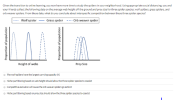 Given the transition to online learning, you now have more time to study the spiders in your neighborhood. Using appropriate social distancing, you and your friends collect the following data on the average web height off the ground and prey size for three spider species: wolf spiders, grass spiders, and orb weaver spiders. From these data, what do you conclude about interspecific competition between these three spider species? - Wolfspider — Grass spider --- Orb weaver spider Proportion of population...
What outcome could you predict with the information provided in this figure? A. Competitor 1 (squirrels)...
 What outcome could you predict with the information provided in this figure? A. Competitor 1 (squirrels) B. Competitor 2 (chipmunks) C. Either competitor could outcompete the other D. Neither, they can coexist Competitor 2 (N2) K1 K2 B Competitor 1 (N)
What outcome could you predict with the information provided in this figure? A. Competitor 1 (squirrels)...
 What outcome could you predict with the information provided in this figure? A. Competitor 1 (squirrels) B. Competitor 2 (chipmunks) C. Either competitor could outcompete the other D. Neither, they can coexist Competitor 2 (N2) K2= B K1 Competitor 1 (N)
272 is incorrect Scenario 5.6: Consider the information in the table below, describing choices for a...
 272 is incorrect
Scenario 5.6: Consider the information in the table below, describing choices for a new doctor. The outcomes represent different macroeconomic environments, which the individual cannot predict. We assume the doctor's utility of income function is given as: U(1) = 10.5, where I represents income. Outcome 1 Outcome 2 Prob. Income Prob. Income 0.95 $100,000 0.05 $60,000 Job Choice Work for HMO Own practice Research 0.2 $250,000 0.8 $30,000 0.1 $500,000 0.9 $50,000 Refer to Scenario 5.6. The...
272 is incorrect
Scenario 5.6: Consider the information in the table below, describing choices for a new doctor. The outcomes represent different macroeconomic environments, which the individual cannot predict. We assume the doctor's utility of income function is given as: U(1) = 10.5, where I represents income. Outcome 1 Outcome 2 Prob. Income Prob. Income 0.95 $100,000 0.05 $60,000 Job Choice Work for HMO Own practice Research 0.2 $250,000 0.8 $30,000 0.1 $500,000 0.9 $50,000 Refer to Scenario 5.6. The...
option 500 is incorrect please help Scenario 5.6: Consider the information in the table below, describing...
 option 500 is incorrect please help
Scenario 5.6: Consider the information in the table below, describing choices for a new doctor. The outcomes represent different macroeconomic environments, which the individual cannot predict. We assume the doctor's utility of income function is given as: U(I) = 10.5, where I represents income. Outcome 1 Outcome 2 Prob. Income Prob. Income Job Choice Work for HMO 0.95 $100,000 0.05 $60,000 0.2 $250,000 0.8 $30,000 Own practice Research 0.1 $500,000 0.9 $50,000 Refer to...
option 500 is incorrect please help
Scenario 5.6: Consider the information in the table below, describing choices for a new doctor. The outcomes represent different macroeconomic environments, which the individual cannot predict. We assume the doctor's utility of income function is given as: U(I) = 10.5, where I represents income. Outcome 1 Outcome 2 Prob. Income Prob. Income Job Choice Work for HMO 0.95 $100,000 0.05 $60,000 0.2 $250,000 0.8 $30,000 Own practice Research 0.1 $500,000 0.9 $50,000 Refer to...
option 308 is incorrect please help me solve this hw problem Scenario 5.6: Consider the information...
 option 308 is incorrect please help me solve this hw
problem
Scenario 5.6: Consider the information in the table below, describing choices for a new doctor. The outcomes represent different macroeconomic environments, which the individual cannot predict. We assume the doctor's utility of income function is given as: U(I) = 10.5, where I represents income. Outcome 1 Outcome 2 Job Choice Prob. Income Prob. Income 0.95 $100,000 0.05 $60,000 Work for HMO Own practice Research 0.2 $250,000 0.8 $30,000 0.1...
option 308 is incorrect please help me solve this hw
problem
Scenario 5.6: Consider the information in the table below, describing choices for a new doctor. The outcomes represent different macroeconomic environments, which the individual cannot predict. We assume the doctor's utility of income function is given as: U(I) = 10.5, where I represents income. Outcome 1 Outcome 2 Job Choice Prob. Income Prob. Income 0.95 $100,000 0.05 $60,000 Work for HMO Own practice Research 0.2 $250,000 0.8 $30,000 0.1...
Consider two closely related bacterial species. The first species has no IS elements, while the second...
Consider two closely related bacterial species. The first species has no IS elements, while the second has many IS elements. Which species do you think would be easier to map via HFR mapping? Group of answer choices A. Species 1 would be easier to map. B.Species 2 would be easier to map. C.There is on way to predict this given the information presented. D.Both would be eqaully easy to map.
DNA STRUCTURE Imagine two species, X & Y. Each species is haploid and has a single...
 DNA STRUCTURE Imagine two species, X & Y. Each species is haploid and has a single chromosome of 10,000 base pairs (bp or 10 kbp). You are analyzing their DNA, and you find that 2 kbp of species X are adenine and 4 kbp of species Y are guanine. Use this information to answer the following questions: 9. For species X, how many kbp of DNA there are for each of the four nitrogenous bases: adenine (A), thymine (T), guanine...
 What is the predicted outcome of interspecific competition between these two species given the following starting conditions? Species 1 Ni 100 Q.12 0.25 IK₂/20 Species 2 N 50 | A21 1 K2 10 Unstable Coexistence Competitive Exclusion, Species 1 Wins Stable Coexistence Cannot determine the answer without r values
 What will be the outcome of competition between the two species shown on the phase plane graph? Species 2 will win for any starting values of N1 and N2. There are multiple possible outcomes, depending on the starting values of N1 and N2. Species 1 will win for any starting values of N1 and N2. Both species will coexist in stable equilibrium, for any starting values of N1 and N2. Interspecific competition will be greatest in which of the following...
 Given the transition to online learning, you now have more time to study the spiders in your neighborhood. Using appropriate social distancing, you and your friends collect the following data on the average web height off the ground and prey size for three spider species: wolf spiders, grass spiders, and orb weaver spiders. From these data, what do you conclude about interspecific competition between these three spider species? - Wolfspider — Grass spider --- Orb weaver spider Proportion of population...
 What outcome could you predict with the information provided in this figure? A. Competitor 1 (squirrels) B. Competitor 2 (chipmunks) C. Either competitor could outcompete the other D. Neither, they can coexist Competitor 2 (N2) K1 K2 B Competitor 1 (N)
 What outcome could you predict with the information provided in this figure? A. Competitor 1 (squirrels) B. Competitor 2 (chipmunks) C. Either competitor could outcompete the other D. Neither, they can coexist Competitor 2 (N2) K2= B K1 Competitor 1 (N)
 272 is incorrect
Scenario 5.6: Consider the information in the table below, describing choices for a new doctor. The outcomes represent different macroeconomic environments, which the individual cannot predict. We assume the doctor's utility of income function is given as: U(1) = 10.5, where I represents income. Outcome 1 Outcome 2 Prob. Income Prob. Income 0.95 $100,000 0.05 $60,000 Job Choice Work for HMO Own practice Research 0.2 $250,000 0.8 $30,000 0.1 $500,000 0.9 $50,000 Refer to Scenario 5.6. The...
272 is incorrect
Scenario 5.6: Consider the information in the table below, describing choices for a new doctor. The outcomes represent different macroeconomic environments, which the individual cannot predict. We assume the doctor's utility of income function is given as: U(1) = 10.5, where I represents income. Outcome 1 Outcome 2 Prob. Income Prob. Income 0.95 $100,000 0.05 $60,000 Job Choice Work for HMO Own practice Research 0.2 $250,000 0.8 $30,000 0.1 $500,000 0.9 $50,000 Refer to Scenario 5.6. The...
 option 500 is incorrect please help
Scenario 5.6: Consider the information in the table below, describing choices for a new doctor. The outcomes represent different macroeconomic environments, which the individual cannot predict. We assume the doctor's utility of income function is given as: U(I) = 10.5, where I represents income. Outcome 1 Outcome 2 Prob. Income Prob. Income Job Choice Work for HMO 0.95 $100,000 0.05 $60,000 0.2 $250,000 0.8 $30,000 Own practice Research 0.1 $500,000 0.9 $50,000 Refer to...
option 500 is incorrect please help
Scenario 5.6: Consider the information in the table below, describing choices for a new doctor. The outcomes represent different macroeconomic environments, which the individual cannot predict. We assume the doctor's utility of income function is given as: U(I) = 10.5, where I represents income. Outcome 1 Outcome 2 Prob. Income Prob. Income Job Choice Work for HMO 0.95 $100,000 0.05 $60,000 0.2 $250,000 0.8 $30,000 Own practice Research 0.1 $500,000 0.9 $50,000 Refer to...
 option 308 is incorrect please help me solve this hw
problem
Scenario 5.6: Consider the information in the table below, describing choices for a new doctor. The outcomes represent different macroeconomic environments, which the individual cannot predict. We assume the doctor's utility of income function is given as: U(I) = 10.5, where I represents income. Outcome 1 Outcome 2 Job Choice Prob. Income Prob. Income 0.95 $100,000 0.05 $60,000 Work for HMO Own practice Research 0.2 $250,000 0.8 $30,000 0.1...
option 308 is incorrect please help me solve this hw
problem
Scenario 5.6: Consider the information in the table below, describing choices for a new doctor. The outcomes represent different macroeconomic environments, which the individual cannot predict. We assume the doctor's utility of income function is given as: U(I) = 10.5, where I represents income. Outcome 1 Outcome 2 Job Choice Prob. Income Prob. Income 0.95 $100,000 0.05 $60,000 Work for HMO Own practice Research 0.2 $250,000 0.8 $30,000 0.1...
 DNA STRUCTURE Imagine two species, X & Y. Each species is haploid and has a single chromosome of 10,000 base pairs (bp or 10 kbp). You are analyzing their DNA, and you find that 2 kbp of species X are adenine and 4 kbp of species Y are guanine. Use this information to answer the following questions: 9. For species X, how many kbp of DNA there are for each of the four nitrogenous bases: adenine (A), thymine (T), guanine...
Most questions answered within 3 hours.
-
Where is the error in this code sequence?
String s1 = "Hello";
String s2 = "ello";...
asked 10 months ago -
Financial data for Joel de Paris, Inc., for last year
follow:
Joel de Paris, Inc.
Balance...
asked 10 months ago -
Consider this reaction:
Al2(SO4)3 (aq)+ BaCl3
(aq) Al2Cl6 (aq)- +
3BaSO4(s) . What is the...
asked 10 months ago -
Suppose that Savneet is considering increasing her
recent random sample from 20 car rentals to 40...
asked 10 months ago -
Trucks arrive at an unloading terminal at an average rate of 120
per hour.
Trucks arrive...
asked 10 months ago -
Why are methanol and ethanol completely soluble in water while
octanol is not very little soluble....
asked 10 months ago -
A facilities manager at a university reads in a research report
that the mean amount of...
asked 10 months ago -
When the CuSO4 is rehydrated by adding water to the anhydrous
compound, is this an endothermic...
asked 10 months ago -
A ray of sunlight is passing from diamond into crown glass; the
angle of incidence is...
asked 10 months ago -
A block of mass 0.249 kg is placed on top of a light, vertical
spring of...
asked 10 months ago -
how do the kidneys compensate in the presences of acidosis
a) trigger hyperventilate
b) reserve acid...
asked 10 months ago -
Question 501 pts
The rental rate of capital to the firm increases. Which of the
following...
asked 10 months ago