TERT is the enzyme that works to solve the end replication problem in eukaryotes. How does...
- TERT is the enzyme that works to solve the end replication problem in eukaryotes.
How does it do that?
a) TERT=telomerase reverse transcriptase. Why is this a reverse transcriptase? Explain
b) Does this conform to the basic DNA--> RNA--> protein dogma? Why?
Homework Answers
A. Telomerase is a reverse transcriptase enzyme which helps to solve end replication problem in eukaryotes. Eukaryotic DNA is linear in shape and therefore after every round of DNA replication, the length of chromosome is shortened. If this will continue, then after repeated rounds of DNA replication, the chromosome will be loss and the cell will die. Therefore eukaryotes have developed an extensive mechanism of solving this problem. Eukaryotic cell have a special reverse transcriptase enzyme called as telomerase. This enzyme at repetitive sequences add the tips of chromosomes called as telomerase. The enzyme works in a reverse transcription manner and this is why the enzyme is a reverse transcriptase enzyme. It itself provides an RNA template for the synthesis of repetitive sequence of DNA. The process of formation of DNA from RNA is called as reverse transcription.
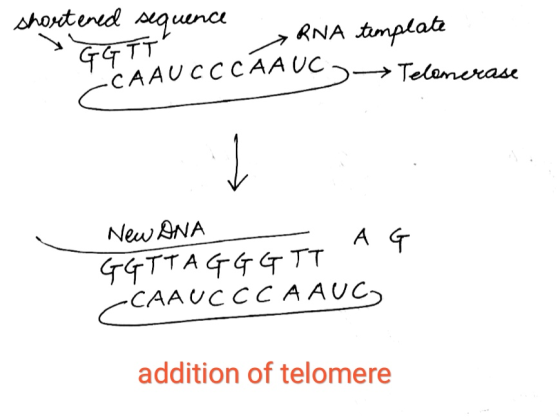
The working of enzyme telomerase does not go along with the central dogma of Molecular Biology. This is because according to this dogma, genetic information always flows from DNA to RNA and then to proteins. The working of telomerase is flowing from RNA to DNA and that is why it is called as reverse transcription.
Please rate high.
Add Answer to:
TERT is the enzyme that works to solve the end
replication problem in eukaryotes.
How does...
What does the enzyme reverse transcriptase do? A) Using the amino acid sequence of a protein...
What does the enzyme reverse transcriptase do? A) Using the amino acid sequence of a protein as a template, it makes an RNA molecule. B) Using RNA as a template, it makes a DNA molecule. C) Using RNA as a template, it makes an RNA molecule. D) Using DNA as a template, it makes an RNA molecule. E) Using DNA as a template, it makes a DNA molecule.
Question 16 1 pts Which is true of RNA polymerases in both prokaryotic and eukaryotic organisms?...
 Question 16 1 pts Which is true of RNA polymerases in both prokaryotic and eukaryotic organisms? They have the same number of cofactors in prokaryotes and eukaryotes. They are composed of an analogous a 2ßß'w core. They make copies of RNA from either DNA or RNA templates. There is a single enzyme type per organism. Question 17 1 pts What are E. coli sigma (o) subunits in RNA synthesis? transcription factors receptor proteins RNA polymerases ODNA promoter regions Question 11...
What does the enzyme reverse transcriptase do? How might that be useful for studying RNA viruses...
What does the enzyme reverse transcriptase do? How might that be useful for studying RNA viruses like SARS-CoV-2?
1.4. In linear eukaryotic DNA, the replication of DNA ends is carried out by a) DNA...
 1.4. In linear eukaryotic DNA, the replication of DNA ends is carried out by a) DNA Poll b) DNA Pol III c) Telomerase d) DNA Gyrase 1.5. Based on what we know regarding gene expression, which of the following basic mechanisms of gene expression is most logical? a) DNA → RN → protein b) DNA → MRNA → protein c) mRNA → DNA → rRNA → protein d) DNA → cell [TURN OVER] 1.6. Which of the following processes does...
Cancer Biology 8. Re-expression of telomerase can confer immortality to emerging clones of tumor cells, and...
 Cancer Biology
8. Re-expression of telomerase can confer immortality to emerging clones of tumor cells, and was originally viewed as an attractive target for drug discovery. However, which of the following best explains the lack of therapeutic efficacy for telomerase inhibitors? a. Telomerase alone is sufficient for transformation in human cells. b. Telomerase is required for the maintenance of somatic cell populations. c. Too many post-inhibition cell doublings would be required to see anti-tumor efficacy. d. Telomerase has sequence and...
Cancer Biology
8. Re-expression of telomerase can confer immortality to emerging clones of tumor cells, and was originally viewed as an attractive target for drug discovery. However, which of the following best explains the lack of therapeutic efficacy for telomerase inhibitors? a. Telomerase alone is sufficient for transformation in human cells. b. Telomerase is required for the maintenance of somatic cell populations. c. Too many post-inhibition cell doublings would be required to see anti-tumor efficacy. d. Telomerase has sequence and...
4. A) List the similarities and the differences between DNA replication in prokaryotes and eukaryotes. B)...
4. A) List the similarities and the differences between DNA replication in prokaryotes and eukaryotes. B) Do prokaryotes have telomeres? Explain why do or why don
Why were Meselson and Stahl unable to distinguish between the dispersive and the semiconservative models following...
Why were Meselson and Stahl unable to distinguish between the dispersive and the semiconservative models following only one round of DNA replication? 2. Describe in order, the four repeating steps that repeat over and over on the discontinuous lagging strand of DNA replication and name the major proteins required to carry out each of these steps in E. coli. The first function is given . I. Function: Create RNA primer Enzyme: II. Function: Enzyme: III. Function: Enzyme: IV. Function: Enzyme:...
What DNA/RNA/protein(s) is/are involved in the following processes in... DNA Replication Transcription - Prokaryotes Transcription -...
 What DNA/RNA/protein(s) is/are involved in the following processes in... DNA Replication Transcription - Prokaryotes Transcription - Eukaryotes What serves as the template? Unwinding of DNA Initiation Elongation What direction does elongation occur? Termination What is the end product of this process? How many strands? Processing after?
ATCase is an important enzyme in DNA replication. a) What does this enzyme do and what...
ATCase is an important enzyme in DNA replication. a) What does this enzyme do and what are its substrates? b) This enzyme demonstrates feedback regulation. Describe its quaternary structure in this regard. c) Besides substrate(s) and product, what other molecules are involved in the feedback regulation of ATCase? Describe their function and how they interact?
ATCase is an important enzyme in DNA replication. a) What does this enzyme do and what...
ATCase is an important enzyme in DNA replication. a) What does this enzyme do and what are its substrates? b) This enzyme demonstrates feedback regulation. Describe its quaternary structure in this regard. c) Besides substrate(s) and product, what other molecules are involved in the feedback regulation of ATCase? Describe their function and how they interact?
 Question 16 1 pts Which is true of RNA polymerases in both prokaryotic and eukaryotic organisms? They have the same number of cofactors in prokaryotes and eukaryotes. They are composed of an analogous a 2ßß'w core. They make copies of RNA from either DNA or RNA templates. There is a single enzyme type per organism. Question 17 1 pts What are E. coli sigma (o) subunits in RNA synthesis? transcription factors receptor proteins RNA polymerases ODNA promoter regions Question 11...
 1.4. In linear eukaryotic DNA, the replication of DNA ends is carried out by a) DNA Poll b) DNA Pol III c) Telomerase d) DNA Gyrase 1.5. Based on what we know regarding gene expression, which of the following basic mechanisms of gene expression is most logical? a) DNA → RN → protein b) DNA → MRNA → protein c) mRNA → DNA → rRNA → protein d) DNA → cell [TURN OVER] 1.6. Which of the following processes does...
 Cancer Biology
8. Re-expression of telomerase can confer immortality to emerging clones of tumor cells, and was originally viewed as an attractive target for drug discovery. However, which of the following best explains the lack of therapeutic efficacy for telomerase inhibitors? a. Telomerase alone is sufficient for transformation in human cells. b. Telomerase is required for the maintenance of somatic cell populations. c. Too many post-inhibition cell doublings would be required to see anti-tumor efficacy. d. Telomerase has sequence and...
Cancer Biology
8. Re-expression of telomerase can confer immortality to emerging clones of tumor cells, and was originally viewed as an attractive target for drug discovery. However, which of the following best explains the lack of therapeutic efficacy for telomerase inhibitors? a. Telomerase alone is sufficient for transformation in human cells. b. Telomerase is required for the maintenance of somatic cell populations. c. Too many post-inhibition cell doublings would be required to see anti-tumor efficacy. d. Telomerase has sequence and...
 What DNA/RNA/protein(s) is/are involved in the following processes in... DNA Replication Transcription - Prokaryotes Transcription - Eukaryotes What serves as the template? Unwinding of DNA Initiation Elongation What direction does elongation occur? Termination What is the end product of this process? How many strands? Processing after?
Most questions answered within 3 hours.
-
Where is the error in this code sequence?
String s1 = "Hello";
String s2 = "ello";...
asked 11 months ago -
Financial data for Joel de Paris, Inc., for last year
follow:
Joel de Paris, Inc.
Balance...
asked 11 months ago -
Consider this reaction:
Al2(SO4)3 (aq)+ BaCl3
(aq) Al2Cl6 (aq)- +
3BaSO4(s) . What is the...
asked 11 months ago -
Suppose that Savneet is considering increasing her
recent random sample from 20 car rentals to 40...
asked 11 months ago -
Trucks arrive at an unloading terminal at an average rate of 120
per hour.
Trucks arrive...
asked 11 months ago -
Why are methanol and ethanol completely soluble in water while
octanol is not very little soluble....
asked 11 months ago -
A facilities manager at a university reads in a research report
that the mean amount of...
asked 11 months ago -
When the CuSO4 is rehydrated by adding water to the anhydrous
compound, is this an endothermic...
asked 11 months ago -
A ray of sunlight is passing from diamond into crown glass; the
angle of incidence is...
asked 11 months ago -
A block of mass 0.249 kg is placed on top of a light, vertical
spring of...
asked 11 months ago -
how do the kidneys compensate in the presences of acidosis
a) trigger hyperventilate
b) reserve acid...
asked 11 months ago -
Question 501 pts
The rental rate of capital to the firm increases. Which of the
following...
asked 11 months ago