Kc= [Fe(SCN)2+]/ [Fe3+][SCN-] Assume we have a way to remove almost all Fe3+ from the equilibrated...
Kc= [Fe(SCN)2+]/ [Fe3+][SCN-]
- Assume we have a way to remove almost all Fe3+ from the equilibrated solution.
Initially, would Q be greater than, less than, or equal to Kc? How (if at all) would
the value of Q change as the equilibrium was reestablished after removal of Fe3+?
Would the concentration of FeSCN2+ increase or decrease as equilibrium was
reestablished?
Homework Answers

Add Answer to:
Kc= [Fe(SCN)2+]/
[Fe3+][SCN-]
Assume we have a way to remove almost all Fe3+ from the
equilibrated...
My question is #2 for the reaction Fe3+ (aq) + SCN- (aq) FeSCN2+ (aq). The goal...
 My question is #2 for the reaction Fe3+ (aq) + SCN- (aq)
FeSCN2+ (aq). The goal is to predict the color change (darker or
lighter) for test tubes 2-8. I have attached the supplemental
sheets given to help with the problem. The test tubes 2-8 are being
manipulated either by temperature or things being added which can
be seen by one of the pictures.
2. For reaction "UCTIONS are increased by the same amount. Fe3+ (aq) + SCN (aq) $...
My question is #2 for the reaction Fe3+ (aq) + SCN- (aq)
FeSCN2+ (aq). The goal is to predict the color change (darker or
lighter) for test tubes 2-8. I have attached the supplemental
sheets given to help with the problem. The test tubes 2-8 are being
manipulated either by temperature or things being added which can
be seen by one of the pictures.
2. For reaction "UCTIONS are increased by the same amount. Fe3+ (aq) + SCN (aq) $...
Fe (aq)SCN-(aq) FeSCN (aq) thiocyanate iron(II) thiocyanoiron(il) Introduction When the reactants shown above, are combined, chemical...
 Fe (aq)SCN-(aq) FeSCN (aq) thiocyanate iron(II) thiocyanoiron(il) Introduction When the reactants shown above, are combined, chemical equilibrium is reached rapidly. Once equilibrium is established, the equilibrium constant can be calculated if the concentration of all the ions are known: [FeSCNP.he [SCN-... and (Feng Your task is to prepare three different equilibrium systems that contain different concentrations of these ions. Keep in mind that although the concentrations will be different, the value of the equilibrium constant Ke will be indeed constant...
1. For the following reaction N2 (g) + 3 H2(g) — 2 NH3(g) AH° = -92.4...
 1. For the following reaction N2 (g) + 3 H2(g) — 2 NH3(g) AH° = -92.4 kJ K = 1.245 x 10⁻⁵ at 427°C for each change listed, predict the equilibrium shift and the effect on the indicated quantity. Direction of Shift Gt; or no change) Effect on Quantity Change Effect (increase, decrease, or no change) amount of NH3(g) amount of N2(g) (a) decrease in volume (b) Decrease temperature (c) addition of H2(g) (d) addition of NH3(g) (e) removal of...
LAB INFORMATION: Initial Fe3+ =2.00 x 10⁻³ M SCN- = 2.00 x 10⁻³ M FeSCN3+ =...
LAB INFORMATION: Initial Fe3+ =2.00 x 10⁻³ M SCN- = 2.00 x 10⁻³ M FeSCN3+ = 1.50 x 10⁻⁴ M MIXTURE ABSORBANCE FeSCN2+ 1 0.149 3.08 x 10^-5 2 .250 5.17 x 10^-5 3 0.314 6.49 x 10^-5 4 0.437 9.03 x 10^-5 5 0.521 1.08 x 10^-5 I am supposed to complete a table for each of them; table looks like this for all five of the mixtures: Mixture ## [Fe^3+] [SCN^-1] [FeSCN^2+] Initial Change Equilibrium Kc= But I'm...
Consider the following system at equilibrium where H° = 10.4 kJ, and Kc = 1.80×10⁻², at...
Consider the following system at equilibrium where H° = 10.4 kJ, and Kc = 1.80×10⁻², at 698 K: 2HI(g) =H2(g) + I2(g) If the TEMPERATURE on the equilibrium system is suddenly decreased: The value of Kc A. Increases B. Decreases C. Remains the same The value of Qc A. Is greater than Kc B. Is equal to Kc C. Is less than Kc The reaction must: A. Run in the forward direction to restablish equilibrium. B. Run in the reverse direction...
III ) Fe+3(aq) + SCN-(aq) ß→ Fe(SCN)+2(aq) (3) Prepare a stock solution by mixing 2mL each...
III ) Fe+3(aq) + SCN-(aq) ß→ Fe(SCN)+2(aq) (3) Prepare a stock solution by mixing 2mL each of 0.1M FeCl3 and 0.1M KSCN in 100mL graduated cylinder. Add enough water to make 100mL solution. Note the color. If you are the first one to use this station, make this solution and save it for the rest of the class. If you are using someone else's stock solution, make sure to make observations of each reactant. (4) *Add about 1mL of 0.1M...
G-10 Assume the equilibrium constant K 1 for a reaction A + B 2 C. You...
 G-10 Assume the equilibrium constant K 1 for a reaction A + B 2 C. You prepare a solution that has the following initial concentrations. For each solution, calculate the reaction quotient Q and state if the concentrations of reactants and products will (increase, decrease, or stay the same). a) [A] 1 M, [B] 1M, [C] 2 M. b) [A] 2 M, [B] 1 M,(C] 1 M. Answers: Q 4 >K, [A, B] increase, [C] decreases Q=0.5 < K, [A,...
Consider the following system at equilibrium where delta H° = 87.9 kJ/mol, and Kc = 1.20×10⁻²,...
Consider the following system at equilibrium where delta H° = 87.9 kJ/mol, and Kc = 1.20×10⁻², at 500 K. PCl5(g) ⇌ PCl3(g) + Cl2(g) When 0.15 moles of PCl5(g) are removed from the equilibrium system at constant temperature: Answer the following: The value of Kc _________ (possible answers: increases, decreases, or remains the same) The value of Qc _________(possible answers: is greater than, is equal to, or is less than) Kc. The reaction must (choose a, b, or c from...
2. At a wastewater-treatment plant FeCl3(s) is added to remove excess phosphate from the effluent. Assume...
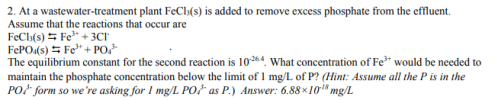 2. At a wastewater-treatment plant FeCl3(s) is added to remove excess phosphate from the effluent. Assume that the reactions that occur are FeCl3(s) 5 Fe+ + 3C1 FePO4(s) 5 Fe3+ + PO3- The equilibrium constant for the second reaction is 10-26.4. What concentration of Felt would be needed to maintain the phosphate concentration below the limit of 1 mg/L of P? (Hint: Assume all the P is in the PO form so we're asking for 1 mg/L PO, as P.)...
are theses correct? please correct me if they are not. Results Fe Test Tube 2: FeSCN...
 are
theses correct?
please correct me if they are not.
Results Fe Test Tube 2: FeSCN (aa) SCN () Fe Chemical equation: Explanation: The equilibrium shifted toward the increased the due to the addition of Fe(NO,)) because it of the Test Tube 3: FESCN 0) SCN () (as Chemical equation: Fe(ag) Explanation: Test Tube 4: Chemical equation: Fe(agk FeSCN( (aq)h Explanation: Test Tube 5: Chemical equation: Fe"( SCN () FESCN 3+ + (sq) Explanation: Test Tube 6 Chemical equation: Fe(a...
are
theses correct?
please correct me if they are not.
Results Fe Test Tube 2: FeSCN (aa) SCN () Fe Chemical equation: Explanation: The equilibrium shifted toward the increased the due to the addition of Fe(NO,)) because it of the Test Tube 3: FESCN 0) SCN () (as Chemical equation: Fe(ag) Explanation: Test Tube 4: Chemical equation: Fe(agk FeSCN( (aq)h Explanation: Test Tube 5: Chemical equation: Fe"( SCN () FESCN 3+ + (sq) Explanation: Test Tube 6 Chemical equation: Fe(a...
 My question is #2 for the reaction Fe3+ (aq) + SCN- (aq)
FeSCN2+ (aq). The goal is to predict the color change (darker or
lighter) for test tubes 2-8. I have attached the supplemental
sheets given to help with the problem. The test tubes 2-8 are being
manipulated either by temperature or things being added which can
be seen by one of the pictures.
2. For reaction "UCTIONS are increased by the same amount. Fe3+ (aq) + SCN (aq) $...
My question is #2 for the reaction Fe3+ (aq) + SCN- (aq)
FeSCN2+ (aq). The goal is to predict the color change (darker or
lighter) for test tubes 2-8. I have attached the supplemental
sheets given to help with the problem. The test tubes 2-8 are being
manipulated either by temperature or things being added which can
be seen by one of the pictures.
2. For reaction "UCTIONS are increased by the same amount. Fe3+ (aq) + SCN (aq) $...
 Fe (aq)SCN-(aq) FeSCN (aq) thiocyanate iron(II) thiocyanoiron(il) Introduction When the reactants shown above, are combined, chemical equilibrium is reached rapidly. Once equilibrium is established, the equilibrium constant can be calculated if the concentration of all the ions are known: [FeSCNP.he [SCN-... and (Feng Your task is to prepare three different equilibrium systems that contain different concentrations of these ions. Keep in mind that although the concentrations will be different, the value of the equilibrium constant Ke will be indeed constant...
 1. For the following reaction N2 (g) + 3 H2(g) — 2 NH3(g) AH° = -92.4 kJ K = 1.245 x 10⁻⁵ at 427°C for each change listed, predict the equilibrium shift and the effect on the indicated quantity. Direction of Shift Gt; or no change) Effect on Quantity Change Effect (increase, decrease, or no change) amount of NH3(g) amount of N2(g) (a) decrease in volume (b) Decrease temperature (c) addition of H2(g) (d) addition of NH3(g) (e) removal of...
 G-10 Assume the equilibrium constant K 1 for a reaction A + B 2 C. You prepare a solution that has the following initial concentrations. For each solution, calculate the reaction quotient Q and state if the concentrations of reactants and products will (increase, decrease, or stay the same). a) [A] 1 M, [B] 1M, [C] 2 M. b) [A] 2 M, [B] 1 M,(C] 1 M. Answers: Q 4 >K, [A, B] increase, [C] decreases Q=0.5 < K, [A,...
 2. At a wastewater-treatment plant FeCl3(s) is added to remove excess phosphate from the effluent. Assume that the reactions that occur are FeCl3(s) 5 Fe+ + 3C1 FePO4(s) 5 Fe3+ + PO3- The equilibrium constant for the second reaction is 10-26.4. What concentration of Felt would be needed to maintain the phosphate concentration below the limit of 1 mg/L of P? (Hint: Assume all the P is in the PO form so we're asking for 1 mg/L PO, as P.)...
 are
theses correct?
please correct me if they are not.
Results Fe Test Tube 2: FeSCN (aa) SCN () Fe Chemical equation: Explanation: The equilibrium shifted toward the increased the due to the addition of Fe(NO,)) because it of the Test Tube 3: FESCN 0) SCN () (as Chemical equation: Fe(ag) Explanation: Test Tube 4: Chemical equation: Fe(agk FeSCN( (aq)h Explanation: Test Tube 5: Chemical equation: Fe"( SCN () FESCN 3+ + (sq) Explanation: Test Tube 6 Chemical equation: Fe(a...
are
theses correct?
please correct me if they are not.
Results Fe Test Tube 2: FeSCN (aa) SCN () Fe Chemical equation: Explanation: The equilibrium shifted toward the increased the due to the addition of Fe(NO,)) because it of the Test Tube 3: FESCN 0) SCN () (as Chemical equation: Fe(ag) Explanation: Test Tube 4: Chemical equation: Fe(agk FeSCN( (aq)h Explanation: Test Tube 5: Chemical equation: Fe"( SCN () FESCN 3+ + (sq) Explanation: Test Tube 6 Chemical equation: Fe(a...
Most questions answered within 3 hours.
-
Where is the error in this code sequence?
String s1 = "Hello";
String s2 = "ello";...
asked 11 months ago -
Financial data for Joel de Paris, Inc., for last year
follow:
Joel de Paris, Inc.
Balance...
asked 11 months ago -
Consider this reaction:
Al2(SO4)3 (aq)+ BaCl3
(aq) Al2Cl6 (aq)- +
3BaSO4(s) . What is the...
asked 11 months ago -
Suppose that Savneet is considering increasing her
recent random sample from 20 car rentals to 40...
asked 11 months ago -
Trucks arrive at an unloading terminal at an average rate of 120
per hour.
Trucks arrive...
asked 11 months ago -
Why are methanol and ethanol completely soluble in water while
octanol is not very little soluble....
asked 11 months ago -
A facilities manager at a university reads in a research report
that the mean amount of...
asked 11 months ago -
When the CuSO4 is rehydrated by adding water to the anhydrous
compound, is this an endothermic...
asked 11 months ago -
A ray of sunlight is passing from diamond into crown glass; the
angle of incidence is...
asked 11 months ago -
A block of mass 0.249 kg is placed on top of a light, vertical
spring of...
asked 11 months ago -
how do the kidneys compensate in the presences of acidosis
a) trigger hyperventilate
b) reserve acid...
asked 11 months ago -
Question 501 pts
The rental rate of capital to the firm increases. Which of the
following...
asked 11 months ago