What is post-translational processing, and why is it important for protein function?
What is post-translational processing, and why is it important for protein function?
Homework Answers
Post translational processing is a biochemical modification that occurs to one or more amino acids on a protein after the protein has been translated by a ribosome.
It plays a fundamental role in regulating the folding of proteins, their targeting to specific subcellular compartment , their interaction with ligands or other proteins.
Add Answer to:
What is post-translational processing, and why is it important
for protein function?
Describe the following: 1) how the function of pRb protein is regulated by post-translational modifications during...
Describe the following: 1) how the function of pRb protein is regulated by post-translational modifications during the normal mitotic cell cycle and 2) how the modifications control the normal cell cycle progression through the R-point and initiation of the S-phase of the cell cycle.
Which of the following is an example of post-translational control? A protein is phosphorylated on a...
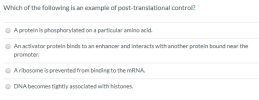 Which of the following is an example of post-translational control? A protein is phosphorylated on a particular amino acid. An activator protein binds to an enhancer and interacts with another protein bound near the promoter. O A ribosome is prevented from binding to the mRNA. ODNA becomes tightly associated with histones.
is to post-translational ER protein import. O PDI (multiple choice) Mitochondrial hsp 70 is to matrix...
 is to post-translational ER protein import. O PDI (multiple choice) Mitochondrial hsp 70 is to matrix protein import what Ribosome Osec61 Osec63 O BiP 9. O co
Explain an example of post-translational modification of enzyme activity using examples from plants? Why is post-translational...
 Explain an example of post-translational modification of enzyme activity using examples from plants? Why is post-translational modification of proteins useful in cells? (4) Explain how extremes of cold or heat affect the balance between the light and dark (light-independent) parts of photosynthesis (use a diagram) (5)
Why is important (for determining the function of a membrane protein) to know if it spans...
Why is important (for determining the function of a membrane protein) to know if it spans the bilayer or appears only on one face of the membrane?
Some proteins can function as enzymes. How does a protein become phosphorylated? What effect can this...
Some proteins can function as enzymes. How does a protein become phosphorylated? What effect can this post-translational modification (PTM) have on a protein?
You prepared a translational fusion of protein Z and the yellow fluorescent protein YFP (ZYFP) then...
You prepared a translational fusion of protein Z and the yellow fluorescent protein YFP (ZYFP) then expressed it in an animal cell line. You hypothesize that protein Z is a component of two different complexes in a cell. To test this idea, you intend to image Z-YFP using a fluorescence microscope equipped with a 60x objective (NA=0.9), and a 540 nm filter to detect YFP emission. Can you distinguish these complexes if they are approximately 330 nm apart? Explain why...
Explain the difference between translational, post-translational, transcriptional, and post-transcriptional gene regulation. Give brief examples of each.
Explain the difference between translational, post-translational, transcriptional, and post-transcriptional gene regulation. Give brief examples of each.
What is the difference between a transcriptional and a translational start site? A) there is no...
What is the difference between a transcriptional and a translational start site? A) there is no difference-these terms are interchangeable B) The transcriptional start site is used to initiate the production of the polypeptide while translation start site is used to initiate the production of the initial RNA transcript C) The translational start site is important for determining the half-life of the RNA D) The translational start site is used to initiate the production of the polypeptide while transcriptional start...
Where does the following regulation happen? •transcriptional regulation •post-transcriptional regulation •post-translational regulation •miRNA/siRNA (mRNA degradation) •Ubiquitination/phosphorylation...
Where does the following regulation happen? •transcriptional regulation •post-transcriptional regulation •post-translational regulation •miRNA/siRNA (mRNA degradation) •Ubiquitination/phosphorylation (protein degradation)
 Which of the following is an example of post-translational control? A protein is phosphorylated on a particular amino acid. An activator protein binds to an enhancer and interacts with another protein bound near the promoter. O A ribosome is prevented from binding to the mRNA. ODNA becomes tightly associated with histones.
 is to post-translational ER protein import. O PDI (multiple choice) Mitochondrial hsp 70 is to matrix protein import what Ribosome Osec61 Osec63 O BiP 9. O co
 Explain an example of post-translational modification of enzyme activity using examples from plants? Why is post-translational modification of proteins useful in cells? (4) Explain how extremes of cold or heat affect the balance between the light and dark (light-independent) parts of photosynthesis (use a diagram) (5)
Most questions answered within 3 hours.
-
Where is the error in this code sequence?
String s1 = "Hello";
String s2 = "ello";...
asked 11 months ago -
Financial data for Joel de Paris, Inc., for last year
follow:
Joel de Paris, Inc.
Balance...
asked 11 months ago -
Consider this reaction:
Al2(SO4)3 (aq)+ BaCl3
(aq) Al2Cl6 (aq)- +
3BaSO4(s) . What is the...
asked 11 months ago -
Suppose that Savneet is considering increasing her
recent random sample from 20 car rentals to 40...
asked 11 months ago -
Trucks arrive at an unloading terminal at an average rate of 120
per hour.
Trucks arrive...
asked 11 months ago -
Why are methanol and ethanol completely soluble in water while
octanol is not very little soluble....
asked 11 months ago -
A facilities manager at a university reads in a research report
that the mean amount of...
asked 11 months ago -
When the CuSO4 is rehydrated by adding water to the anhydrous
compound, is this an endothermic...
asked 11 months ago -
A ray of sunlight is passing from diamond into crown glass; the
angle of incidence is...
asked 11 months ago -
A block of mass 0.249 kg is placed on top of a light, vertical
spring of...
asked 11 months ago -
how do the kidneys compensate in the presences of acidosis
a) trigger hyperventilate
b) reserve acid...
asked 11 months ago -
Question 501 pts
The rental rate of capital to the firm increases. Which of the
following...
asked 11 months ago