Some proteins can function as enzymes. How does a protein become phosphorylated? What effect can this...
Some proteins can function as enzymes. How does a protein become phosphorylated? What effect can this post-translational modification (PTM) have on a protein?
Homework Answers
A.Protein phosphorylation is a reversible post-translational modification of proteins in which an amino acid residue is phosphorylated by a protein kinase by the addition of a covalently bound phosphate group. Phosphorylation alters the structural conformation of a protein, causing it to become activated, deactivated, or modifying its function.A 13000 human proteins have sites that are phosphorylated.
Protein phosphorylation was first reported in 1906 by Phoebus Levene at the Rockefeller Institute for Medical Research with the discovery of phosphorylated vitellin.However, it was nearly 50 years until the enzymatic phosphorylation of proteins by protein kinases was discovered.
While phosphorylation is a prevalent post-translational modification (PTM) for regulating protein function, it only occurs at the side chains of three amino acids, serine, threonine and tyrosine, in eukaryotic cells.
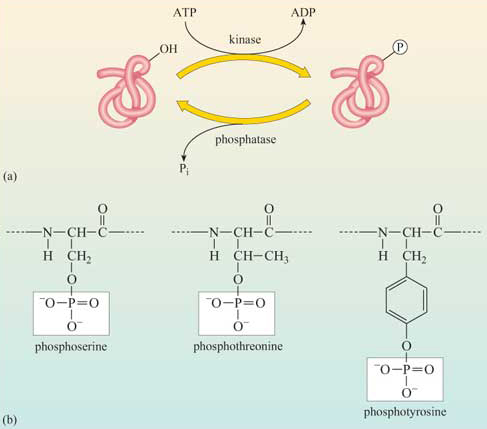
Figure 1:Protein phosphorylation. (a) A phosphate group is transferred from ATP to a hydroxyl group on the protein by a kinase and can be removed by a phosphatase. (b) Phosphorylation can occur on Ser, Thr or Tyr residues.
Phosphorylation introduces a charged and hydrophilic group in the side chain of amino acids, possibly changing a protein's structure by altering interactions with nearby amino acids. Some proteins such as p53 contain multiple phosphorylation sites, facilitating complex, multi-level regulation. Because of the ease with which proteins can be phosphorylated and dephosphorylated, this type of modification is a flexible mechanism for cells to respond to external signals and environmental conditions.
Reversible phosphorylation of proteins occurs in both prokaryotic and eukaryotic organisms.
B.Protein post-translational modifications (PTMs) increase the functional diversity of the proteome by the covalent addition of functional groups or proteins, proteolytic cleavage of regulatory subunits, or degradation of entire proteins.
These modifications include phosphorylation, glycosylation, ubiquitination, nitrosylation, methylation, acetylation, lipidation and proteolysis and influence almost all aspects of normal cell biology and pathogenesis. Therefore, identifying and understanding PTMs is critical in the study of cell biology and disease treatment and prevention.
Within the last few decades, scientists have discovered that the human proteome is vastly more complex than the human genome. While it is estimated that the human genome comprises between 20,000 and 25,000 genes, the total number of proteins in the human proteome is estimated at over 1 million. These estimations demonstrate that single genes encode multiple proteins. Genomic recombination, transcription initiation at alternative promoters, differential transcription termination, and alternative splicing of the transcript are mechanisms that generate different mRNA transcripts from a single gene.
The increase in complexity from the level of the genome to the proteome is further facilitated by protein post-translational modifications (PTMs). PTMs are chemical modifications that play a key role in functional proteomic because they regulate activity, localization, and interaction with other cellular molecules such as proteins, nucleic acids, lipids and cofactors.
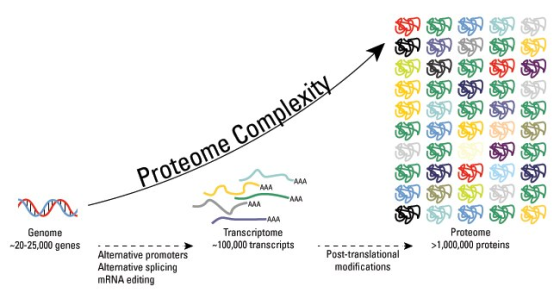
Post-translational modifications are key mechanisms to increase proteomic diversity.While the genome comprises 20,000 to 25,000 genes, the proteome is estimated to encompass over 1 million proteins. Changes at the transcriptional and mRNA levels increase the size of the transcriptome relative to the genome, and the myriad of different post-translational modifications exponentially increases the complexity of the proteome relative to both the transcriptome and genome.
Additionally, the human proteome is dynamic and changes in response to a legion of stimuli, and post-translational modifications are commonly employed to regulate cellular activity. PTMs occur at distinct amino acid side chains or peptide linkages, and they are most often mediated by enzymatic activity. Indeed, it is estimated that 5% of the proteome comprises enzymes that perform more than 200 types of post-translational modifications. These enzymes include kinases, phosphatases, transferases and ligases, which add or remove functional groups, proteins, lipids or sugars to or from amino acid side chains; and proteases, which cleave peptide bonds to remove specific sequences or regulatory subunits. Many proteins can also modify themselves using autocatalytic domains, such as autokinase and autoprotolytic domains.
Post-translational modification can occur at any step in the "life cycle" of a protein. For example, many proteins are modified shortly after translation is completed to mediate proper protein folding or stability or to direct the nascent protein to distinct cellular compartments (e.g., nucleus, membrane). Other modifications occur after folding and localization are completed to activate or inactivate catalytic activity or to otherwise influence the biological activity of the protein. Proteins are also covalently linked to tags that target a protein for degradation. Besides single modifications, proteins are often modified through a combination of post-translational cleavage and the addition of functional groups through a step-wise mechanism of protein maturation or activation.
Protein PTMs can also be reversible depending on the nature of the modification. For example, kinases phosphorylate proteins at specific amino acid side chains, which is a common method of catalytic activation or inactivation. Conversely, phosphatases hydrolyze the phosphate group to remove it from the protein and reverse the biological activity. Proteolytic cleavage of peptide bonds is a thermodynamically favorable reaction and therefore permanently removes peptide sequences or regulatory domains.
Consequently, the analysis of proteins and their post-translational modifications is particularly important for the study of heart disease, cancer, neurodegenerative diseases and diabetes. The characterization of PTMs, although challenging, provides invaluable insight into the cellular functions underlying etiological processes. Technically, the main challenges to studying post-translationally modified proteins are the development of specific detection and purification methods. Fortunately, these technical obstacles are being overcome with a variety of new and refined proteomics technologies.
Add Answer to:
Some proteins can function as enzymes. How does a protein become
phosphorylated? What effect can this...
what enzymes phosphorylate/dephosphorylate proteins and what is the importance of this for protein function?
what enzymes phosphorylate/dephosphorylate proteins and what is the importance of this for protein function?
-How can Chimeric proteins be used to study protein sorting? - What effect would the addition...
-How can Chimeric proteins be used to study protein sorting? - What effect would the addition of a lysosome‐targeting signal have on the subcellular localization of a. A protein that is normally cytosolic? b. A protein that is normally secreted?
Proteins have different parts, or domains, that have different functions. What is the function of an...
 Proteins have different parts, or domains, that have different functions. What is the function of an SH2 domain? A. Binds to a phosphorylated tyrosine on itself B. Binds to a phosphorylated tyrosine on a different protein C. binds to a proline rich sequence in another protein D. Binds to a kinase
Proteins have different parts, or domains, that have different functions. What is the function of an...
Proteins have different parts, or domains, that have different functions. What is the function of an SH2 domain? a. binds to a proline-rich sequence in another protein b. binds to a phosphorylated tyrosine on itself c. binds to a kinase d. binds to a phosphorylated tyrosine on a different protein
How many Kcal are proteins per gram no matter the source? Calculate how much protein YOU...
How many Kcal are proteins per gram no matter the source? Calculate how much protein YOU should have each day (show your math)? What is the function of enzymes and how do they differ from collagen?
Phosphatases are a family of enzymes that remove phosphate groups from specific proteins; these phosphate groups had been added to the proteins by protein kinases. Vanadate is an inhibitor of phosphat...
Phosphatases are a family of enzymes that remove phosphate groups from specific proteins; these phosphate groups had been added to the proteins by protein kinases. Vanadate is an inhibitor of phosphatases in eukaryotic cells. What effect would vanadate have on the response of cells to signals received by receptor kinases? A) The signal would still bind the receptor, so there would be no effect. B) The response of the cell would last longer than it normally would. C) The response...
Regulation of Gene Expression in Eukaryotes In eukaryotes, the Central Dogma of Genetics can be expanded...
Regulation of Gene Expression in Eukaryotes In eukaryotes, the Central Dogma of Genetics can be expanded to include post-transcriptional processing and post-translational processing, thus the Dogma becomes: Replication - Transcription Post-transcriptional Processing -Translation - Post-translational Processing - Functional Protein - Expressed Trait. This is the flow of information from the genetic material to the actual physical, chemical or behavioral trait in an organism. Of course, some traits are controlled by multiple genes and some also have an environmental component. At...
You are studying a protein of unknown function in human fibroblasts and make the following observations...
You are studying a protein of unknown function in human fibroblasts and make the following observations The protein is normally very stable When you add a membrane-permeant hormone, your protein suddenly becomes phosphorylated Soon after phosphorylation, the protein disappears! When the hormone is removed, your protein again accumulates, and is not phosphorylated. Propose a simple, logical model that explains all of your findings. Use any proteins/pathways that we have discussed since the last exam in your...
Answer ALL questions please. ALL QUESTIONS 1) Protein kinase A (PKA) is a family of enzymes...
 Answer ALL questions please. ALL QUESTIONS
1) Protein kinase A (PKA) is a family of enzymes that are part of cell signal systems, and their effect is to phosphorylate proteins, altering their activity. As an example, PKA can phosphorylate the enzyme acetyl- CoA carboxylase, causing it to activate. The ?G for this phosphorylation is +4.2 kcal/mol. How is ATP used to phosphorylate this enzyme, and how does phosphorylation affect enzyme activity?
Answer ALL questions please. ALL QUESTIONS
1) Protein kinase A (PKA) is a family of enzymes that are part of cell signal systems, and their effect is to phosphorylate proteins, altering their activity. As an example, PKA can phosphorylate the enzyme acetyl- CoA carboxylase, causing it to activate. The ?G for this phosphorylation is +4.2 kcal/mol. How is ATP used to phosphorylate this enzyme, and how does phosphorylation affect enzyme activity?
How do DNA sequences change protein structure and what are some affects to the protein structures...
How do DNA sequences change protein structure and what are some affects to the protein structures that can have an effect on the PTC receptor?
 Proteins have different parts, or domains, that have different functions. What is the function of an SH2 domain? A. Binds to a phosphorylated tyrosine on itself B. Binds to a phosphorylated tyrosine on a different protein C. binds to a proline rich sequence in another protein D. Binds to a kinase
 Answer ALL questions please. ALL QUESTIONS
1) Protein kinase A (PKA) is a family of enzymes that are part of cell signal systems, and their effect is to phosphorylate proteins, altering their activity. As an example, PKA can phosphorylate the enzyme acetyl- CoA carboxylase, causing it to activate. The ?G for this phosphorylation is +4.2 kcal/mol. How is ATP used to phosphorylate this enzyme, and how does phosphorylation affect enzyme activity?
Answer ALL questions please. ALL QUESTIONS
1) Protein kinase A (PKA) is a family of enzymes that are part of cell signal systems, and their effect is to phosphorylate proteins, altering their activity. As an example, PKA can phosphorylate the enzyme acetyl- CoA carboxylase, causing it to activate. The ?G for this phosphorylation is +4.2 kcal/mol. How is ATP used to phosphorylate this enzyme, and how does phosphorylation affect enzyme activity?
Most questions answered within 3 hours.
-
Where is the error in this code sequence?
String s1 = "Hello";
String s2 = "ello";...
asked 10 months ago -
Financial data for Joel de Paris, Inc., for last year
follow:
Joel de Paris, Inc.
Balance...
asked 10 months ago -
Consider this reaction:
Al2(SO4)3 (aq)+ BaCl3
(aq) Al2Cl6 (aq)- +
3BaSO4(s) . What is the...
asked 10 months ago -
Suppose that Savneet is considering increasing her
recent random sample from 20 car rentals to 40...
asked 10 months ago -
Trucks arrive at an unloading terminal at an average rate of 120
per hour.
Trucks arrive...
asked 10 months ago -
Why are methanol and ethanol completely soluble in water while
octanol is not very little soluble....
asked 10 months ago -
A facilities manager at a university reads in a research report
that the mean amount of...
asked 10 months ago -
When the CuSO4 is rehydrated by adding water to the anhydrous
compound, is this an endothermic...
asked 10 months ago -
A ray of sunlight is passing from diamond into crown glass; the
angle of incidence is...
asked 10 months ago -
A block of mass 0.249 kg is placed on top of a light, vertical
spring of...
asked 10 months ago -
how do the kidneys compensate in the presences of acidosis
a) trigger hyperventilate
b) reserve acid...
asked 10 months ago -
Question 501 pts
The rental rate of capital to the firm increases. Which of the
following...
asked 10 months ago