3. Discuss the organization of a protein, from its linear amino acid sequence, to its final...
3. Discuss the organization of a protein, from its linear amino acid sequence, to its final three– dimensional configuration, which may include one or more polypeptides. Include what types of bonds help to stabilize each structural level, from primary through quaternary.
Homework Answers
Answer=
Organization of a protein
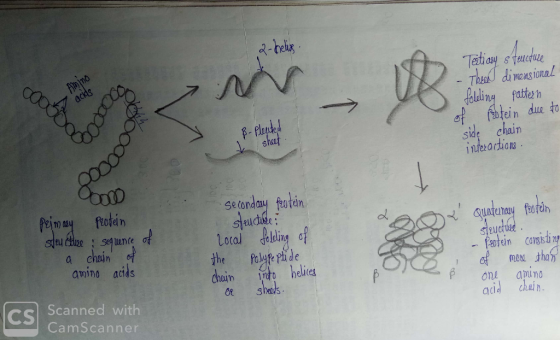
there are four levels of organization of proteins:primary,secondary,tertiary and quaternary structure.
1.primarystructure =
The unique linear sequence of amino acids joined by peptide bond i.e. amide bond that amke up a protein or polypeptide chain.secondary,tertiary and quaternary structure.
-Higher levels of organization of proteins are dependent on the primary structure.
-primary structure is stabilized by peptide bond.
-Example of primary structure -
1. The simplest protein is insulin.consists of 51 amino acid residues.
-It is the first protein to have its primary structure determined.
- Insulin is a protein hormone composed of two polypetide chains: A chain (21 amino acids) and B chain(30 amino acids).
-A and B chains are linked together by two disulfide bonds.It also have an additional disulfide bond formed within chain A.
2.secondary structure = The spatial arrangement of amino acid residues that are adjacent in the primary structure by twisting and folding of the polypeptide chain.
there are types of sec.structures: helix,
 pleated sheet,loops and turns.
secondary structure is stabilized by Hydrogen bonding.
3.Tertiary structure=peptide chain with its secondary structure may be folded and twisted about itself forming 3D arrangement of a functional protein.
- Ter.structure is the complete three dimensional arrangement of polypetide chain.
- It is a compact structure.Hydrophobic side chains held interior and hydrophillic groups are on the surface of the protein molecule.
-The function of protein depends on its tertiary structure.
-the final 3D shape is determined by a variety of bonding interactions between the "side chains" on the amino acids.
- Hydrogen bonds
- Ionic bonds
- Disulfide bridges
- Hydrophobic interactions- greatly contribute to the folding and shaping of a protein.
The "R" group either hydrophobic or hydrophillic.
Example- Myoglobin
4.Quaternary structure= refers to the structure of a protein macromolecule formed by interactions between multiple polypeptide chains.Each polypeptide chain is referred to as subunit.Proteins with quaternary structure may consist of more than one of the same type of protein subunit.They may be composed of different subunits.
Example- Hemoglobin -it contains four subunits:2 alpha and 2 beta subunits.
Add Answer to:
3. Discuss the organization of a protein, from its linear amino
acid sequence, to its final...
19. The _structure of a protein refers to the linear sequence of amino acids in that...
 19. The _structure of a protein refers to the linear sequence of amino acids in that protein. 20. Make up an example of the primary structure of a protein in the space below 21. The structure of a protein refers to a regular, recurring arrangement of the amino acid chain. One such arrangement, called the occurs when the amino acid chain forms a spiral or coil. Draw an example of this structure in the space below. 22. Another type of_...
6.) Provide short answers for the questions about protein structure below: a.) True or False, amino...
6.) Provide short answers for the questions about protein structure below: a.) True or False, amino acid sequence defines the native structure of protein. b.) What is the main type of bonding responsible for stabilizing the secondary structure of proteins? c.) Briefly discuss the thermodynamics of protein folding into its native 3D structure. Is this process enthalpy driven or entropy driven? d.) Give an example of 2 major secondary structural motifs found in polypeptides. Do any of these motifs appear...
QU. 5. You have identified the complete amino acid sequence on protein sequencing techniques. "Y" is...
 QU. 5. You have identified the complete amino acid sequence on protein sequencing techniques. "Y" is composed of 44 amino acids with the po below. No information is available about its genetic sequence. Your task sequence for protein "Y". Assume that the gene sequence is unique in the human 5 BRIEFLY EXPLAIN methodically and accurately how you will decipher the gene seg "Y". (3 POINTS). no acid sequence of a human protein called "Y" using 1.44 amino acids with the...
Protein Structure A protein contains a string of amino acids (usually more than 50) that has...
 Protein Structure A protein contains a string of amino acids (usually more than 50) that has a biological function. 15ecause proteins are so large, their structure has several levels, all of which are important for the proper functioning of the protein. Ultimately, the sequence of amino acids (ordering of polar and nonpolar amino acids) dictates the 3-dimensional shape of a protein and this dictates its primary function. Level 1: Primary (1") The amino acid sequence of a polypeptide Protein Backbone...
3. Suppose the polypeptide below (where each circle represents an amino acid residue) was to form...
 3. Suppose the polypeptide below (where each circle represents an amino acid residue) was to form a folded structure stabilized primarily by a disulfide linkage. a. Draw the folded structure (using circles) and illustrate the disulfide bond. Asp Met LeuCys Gly GlyY Val IleTyrXSerVal CysPhe b. What level of protein structure is being illustrated in the folded forrm? Primary, secondary, tertiary, or quaternary? c. What other type of intramolecular interaction might stabilize the folded form of this polypeptide? 4. The...
A chain GIVEQCCASVCSLYQLENYCN B chain FVNQHLCGSHLVEALYLVCGERGFFYTPKA Shown above is the amino acid sequence of the hormone...
 A chain GIVEQCCASVCSLYQLENYCN B chain FVNQHLCGSHLVEALYLVCGERGFFYTPKA Shown above is the amino acid sequence of the hormone insulin. This structure was determined by Frederick Sanger and his coworkers. Most of this work is described in a series of articles published in the Biochemical Journal from 1945 to 1955. When Sanger and colleagues began their work in 1945, it was known that insulin was a small protein consisting of two or four polypeptide chains linked by disulfide bonds. Sanger and his coworkers...
In protein biosynthesis Question options: A. each amino acid recognizes its codon on the mRNA template...
In protein biosynthesis Question options: A. each amino acid recognizes its codon on the mRNA template because of structural specificity. B. exactness of read-out is assured by the presence of traces of DNA on the ribosome. C. each amino acid is first attached to tRNA that has an anticodon specific for the amino acid. D. a given codon-anticodon pair must have identical base sequences to avoid the formation of degenerate proteins. E. each amino acid recognizes its codon through recognition...
Since the secondary structure of a protein results from hydrogen bonding between components shared by all amino acids
Distinguish between the different levels of protein structure, including primary, secondary, tertiary, and quaternary Question Is the following statement true? If not, explain why not: Since the secondary structure of a protein results from hydrogen bonding between components shared by all amino acids (a hydrogen on an amide N on one amino acid interacts with an oxygen on the carbonyl of another amino acid), the secondary structure does not depend on the specific amino acid groups (the R-groups) in the amino acid chain. Select...
You are studying an interesting protein in nematode worms that is 100 amino acids in length....
 You are studying an interesting protein in nematode worms that is 100 amino acids in length. Of particular interest is the fact that the last seven amino acids are all tryptophan (codons 94 through 100). Draw here the mRNA sequence for codons 94-100: Draw here the sequence of the DNA strand RNA polymerase used as its template (show 5' 3' polarity): You mutagenize the wild type worm. Assume for the next questions you are able to isolate both normal and...
anyone can help me with it? A protein biochemist attempted to determine the amino acid sequence...
 anyone can help me with it?
A protein biochemist attempted to determine the amino acid sequence of a decapeptide. Use the results from the trypsin, chymotrypsin, and cyanogen bromide treatments to suggest the amino acid sequence of this decapeptide. Trypsin digestion gave two fragments with multiple residues (not in order): • T1: Ala, Arg, Phe, Gly, Thr, Trp, Tyr • T2: Lys, Met, Val Chymotrypsin digestion gave four fragments with multiple residues (not in order): • CT1: Ala, Phe •...
anyone can help me with it?
A protein biochemist attempted to determine the amino acid sequence of a decapeptide. Use the results from the trypsin, chymotrypsin, and cyanogen bromide treatments to suggest the amino acid sequence of this decapeptide. Trypsin digestion gave two fragments with multiple residues (not in order): • T1: Ala, Arg, Phe, Gly, Thr, Trp, Tyr • T2: Lys, Met, Val Chymotrypsin digestion gave four fragments with multiple residues (not in order): • CT1: Ala, Phe •...
 19. The _structure of a protein refers to the linear sequence of amino acids in that protein. 20. Make up an example of the primary structure of a protein in the space below 21. The structure of a protein refers to a regular, recurring arrangement of the amino acid chain. One such arrangement, called the occurs when the amino acid chain forms a spiral or coil. Draw an example of this structure in the space below. 22. Another type of_...
 QU. 5. You have identified the complete amino acid sequence on protein sequencing techniques. "Y" is composed of 44 amino acids with the po below. No information is available about its genetic sequence. Your task sequence for protein "Y". Assume that the gene sequence is unique in the human 5 BRIEFLY EXPLAIN methodically and accurately how you will decipher the gene seg "Y". (3 POINTS). no acid sequence of a human protein called "Y" using 1.44 amino acids with the...
 Protein Structure A protein contains a string of amino acids (usually more than 50) that has a biological function. 15ecause proteins are so large, their structure has several levels, all of which are important for the proper functioning of the protein. Ultimately, the sequence of amino acids (ordering of polar and nonpolar amino acids) dictates the 3-dimensional shape of a protein and this dictates its primary function. Level 1: Primary (1") The amino acid sequence of a polypeptide Protein Backbone...
 3. Suppose the polypeptide below (where each circle represents an amino acid residue) was to form a folded structure stabilized primarily by a disulfide linkage. a. Draw the folded structure (using circles) and illustrate the disulfide bond. Asp Met LeuCys Gly GlyY Val IleTyrXSerVal CysPhe b. What level of protein structure is being illustrated in the folded forrm? Primary, secondary, tertiary, or quaternary? c. What other type of intramolecular interaction might stabilize the folded form of this polypeptide? 4. The...
 A chain GIVEQCCASVCSLYQLENYCN B chain FVNQHLCGSHLVEALYLVCGERGFFYTPKA Shown above is the amino acid sequence of the hormone insulin. This structure was determined by Frederick Sanger and his coworkers. Most of this work is described in a series of articles published in the Biochemical Journal from 1945 to 1955. When Sanger and colleagues began their work in 1945, it was known that insulin was a small protein consisting of two or four polypeptide chains linked by disulfide bonds. Sanger and his coworkers...
 You are studying an interesting protein in nematode worms that is 100 amino acids in length. Of particular interest is the fact that the last seven amino acids are all tryptophan (codons 94 through 100). Draw here the mRNA sequence for codons 94-100: Draw here the sequence of the DNA strand RNA polymerase used as its template (show 5' 3' polarity): You mutagenize the wild type worm. Assume for the next questions you are able to isolate both normal and...
 anyone can help me with it?
A protein biochemist attempted to determine the amino acid sequence of a decapeptide. Use the results from the trypsin, chymotrypsin, and cyanogen bromide treatments to suggest the amino acid sequence of this decapeptide. Trypsin digestion gave two fragments with multiple residues (not in order): • T1: Ala, Arg, Phe, Gly, Thr, Trp, Tyr • T2: Lys, Met, Val Chymotrypsin digestion gave four fragments with multiple residues (not in order): • CT1: Ala, Phe •...
anyone can help me with it?
A protein biochemist attempted to determine the amino acid sequence of a decapeptide. Use the results from the trypsin, chymotrypsin, and cyanogen bromide treatments to suggest the amino acid sequence of this decapeptide. Trypsin digestion gave two fragments with multiple residues (not in order): • T1: Ala, Arg, Phe, Gly, Thr, Trp, Tyr • T2: Lys, Met, Val Chymotrypsin digestion gave four fragments with multiple residues (not in order): • CT1: Ala, Phe •...
Most questions answered within 3 hours.
-
Where is the error in this code sequence?
String s1 = "Hello";
String s2 = "ello";...
asked 11 months ago -
Financial data for Joel de Paris, Inc., for last year
follow:
Joel de Paris, Inc.
Balance...
asked 11 months ago -
Consider this reaction:
Al2(SO4)3 (aq)+ BaCl3
(aq) Al2Cl6 (aq)- +
3BaSO4(s) . What is the...
asked 11 months ago -
Suppose that Savneet is considering increasing her
recent random sample from 20 car rentals to 40...
asked 11 months ago -
Trucks arrive at an unloading terminal at an average rate of 120
per hour.
Trucks arrive...
asked 11 months ago -
Why are methanol and ethanol completely soluble in water while
octanol is not very little soluble....
asked 11 months ago -
A facilities manager at a university reads in a research report
that the mean amount of...
asked 11 months ago -
When the CuSO4 is rehydrated by adding water to the anhydrous
compound, is this an endothermic...
asked 11 months ago -
A ray of sunlight is passing from diamond into crown glass; the
angle of incidence is...
asked 11 months ago -
A block of mass 0.249 kg is placed on top of a light, vertical
spring of...
asked 11 months ago -
how do the kidneys compensate in the presences of acidosis
a) trigger hyperventilate
b) reserve acid...
asked 11 months ago -
Question 501 pts
The rental rate of capital to the firm increases. Which of the
following...
asked 11 months ago