How do you design a simple synchronous counter with an asynchronous reset? Please draw examples of:...
How do you design a simple synchronous counter with an asynchronous reset?
Please draw examples of:
(a) a 2-bit counter with these specifications
and (b) a 3-bit counter with these specifications
Homework Answers
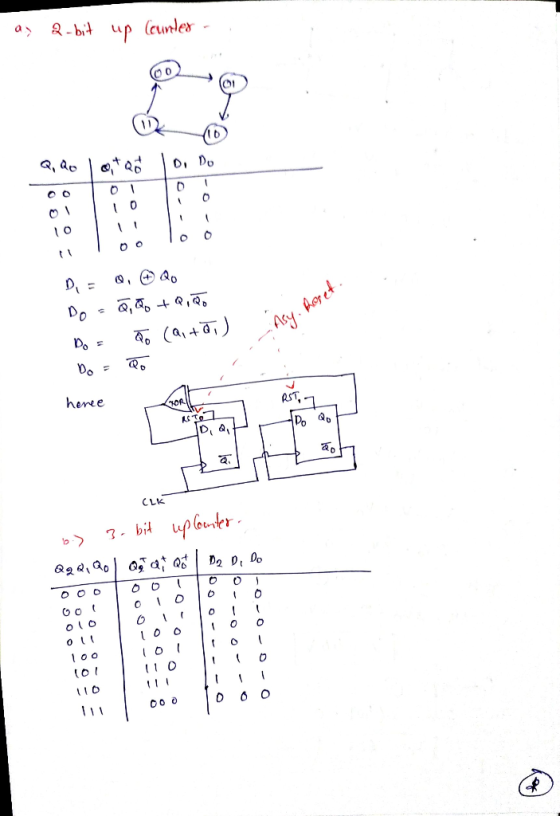
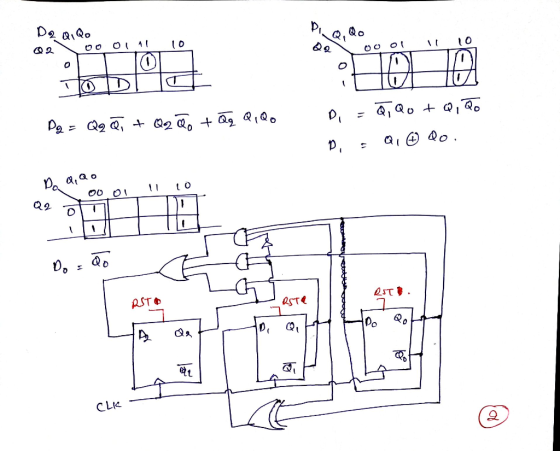
Asynchronous reset means, whenever rst=1 it will reset the synchronous counter no matter what the state of synchronous counter. That means, asynchronous reset will not depend on either state of the counter or state of the clock, it will reset the counter whenever rst=1.
Add Answer to:
How do you design a simple synchronous counter with an
asynchronous reset?
Please draw examples of:...
(b)(i) Using T flip-flop as main components, design a 3-bit synchronous counter that perform counting as...
 (b)(i) Using T flip-flop as main components, design a 3-bit synchronous counter that perform counting as the following sequence 0,2,4,6,1,3,5,7 then repeats (its sequence) [20 marks] (ii) Draw a complete circuit to show how the T flip-flops are interconnected and label it appropriately. Also show how the counter can be asynchronous reset. [5 marks] (iii) Draw a timing diagram for at least four clock cycles [8 marks)
Design serial (asynchronous) counter modulo 7 using synchronous flip-flops (T, D or JK). The counter should count up.
Design serial (asynchronous) counter modulo 7 using synchronous flip-flops (T, D or JK). The counter should count up.
pleas help fast Problem #3 (30 points) a. Design an Asynchronous Modulo 9 counter (a counter...
 pleas help fast
Problem #3 (30 points) a. Design an Asynchronous Modulo 9 counter (a counter that counts from 0 to 8) using JK Flip-Flops. Sketch the circuit only. (15 pts) b. Design a Synchronous Modulo 9 counter (a counter that counts from 0 to 8) using JK Flip- Flops. Sketch the circuit only. (15 pts)
pleas help fast
Problem #3 (30 points) a. Design an Asynchronous Modulo 9 counter (a counter that counts from 0 to 8) using JK Flip-Flops. Sketch the circuit only. (15 pts) b. Design a Synchronous Modulo 9 counter (a counter that counts from 0 to 8) using JK Flip- Flops. Sketch the circuit only. (15 pts)
Q3. Synchronous Counter Figure 8.3(a) shows a modulo-8 synchronous up-counter (Modulo-8 because this counter can count...
 Q3. Synchronous Counter Figure 8.3(a) shows a modulo-8 synchronous up-counter (Modulo-8 because this counter can count only from 0 to 7 with its 3 bits qo, q1 and 92.). Treat each gray cell in the figure as a component and write generic VHDL codes to create a modulo-2N counter, where N is the number of flip-flops required. Use nominal mapping for this problem while instantiating components. When the asynchronous reset signal rst is high, the counter is set to 0...
subject: (digital circuit: REGISTER, SYNCHRONOUS COUNTER AND ASYNCHRONOUS COUNTER.) Question: 1. Explain about SISO, SIPO, PISO,...
subject: (digital circuit: REGISTER, SYNCHRONOUS COUNTER AND ASYNCHRONOUS COUNTER.) Question: 1. Explain about SISO, SIPO, PISO, PIPO, and how it works! Simulate! 2. Create a series of Shift Register Ring Counter, BCD Counter, and Johnson Counter!
bas Q3) Write a Verilog description of a 4-bit counter with asynchronous reset that has two...
 bas Q3) Write a Verilog description of a 4-bit counter with asynchronous reset that has two control inputs Munctionaloyg C1 and CO with the following functionality: 10 marks] CI CO Action 0 0No Change 0 1 Count up by 1 10 Count up by 2 1 1 Count up by 3
MULTISIM: Design a synchronous counter with up to 16 states in any selected order. Draw the...
 MULTISIM: Design a synchronous counter
with up to 16 states in any selected order. Draw the circuit design
using MULTISIM
+5.0 V 1.0 k2 74LS76A § 74LS76A PRE PRE QA Ов JA JB o CLK DCLK es KA KB CLR CLR Clock Reset NO pushbutton 1.Ο ΚΩ +5.0 V
MULTISIM: Design a synchronous counter
with up to 16 states in any selected order. Draw the circuit design
using MULTISIM
+5.0 V 1.0 k2 74LS76A § 74LS76A PRE PRE QA Ов JA JB o CLK DCLK es KA KB CLR CLR Clock Reset NO pushbutton 1.Ο ΚΩ +5.0 V
Consider the circuit in Figure 1. It is a 4-bit (QQ2Q3) synchronous counter which uses four T-typ...
 Consider the circuit in Figure 1. It is a 4-bit (QQ2Q3) synchronous counter which uses four T-type flip-flops. The counter increases its value on each positive edge of the clock if the Enable signal is asserted. The counter is reset to 0 by setting the Clear signal low. You are to implement an 8-bit counter of this type Enable T Q Clock Clear Figure 1. 4-bit synchronous counter (but you need to implement 8-bit counter in this lab) Specific notes:...
Please design a 4 bit synchrous counter (0-9 count) using t flip flops. Counter should reset...
Please design a 4 bit synchrous counter (0-9 count) using t flip flops. Counter should reset to 0 after 9. Kindly provide all steps including state table. I will be thankful to you.
Using Proteus, design Synchronous 4 bit Up binary counter using JK flip flops (Use 74HC76 JK flipflop). The circuit count from 0000 to 1111, etc.
 Q2) 4-bit Synchronous Counter Using Proteus, design Synchronous 4 bit Up binary counter using JK flip flops (Use 74HC76 JK flipflop). The circuit count from 0000 to 1111, etc. Experiment procedure: طريقة اجراء التجربة a) Complete the circuit. You can use external gates based on the following conditions: o Flipflop A switches every clock. o Flipflop B switches when the output of flipflop A=1 o Flipflop C switches when the outputs of A-B=1 o Flipflop D switches when the outputs of A=B=C=1 b) What is the typical feature of...
 (b)(i) Using T flip-flop as main components, design a 3-bit synchronous counter that perform counting as the following sequence 0,2,4,6,1,3,5,7 then repeats (its sequence) [20 marks] (ii) Draw a complete circuit to show how the T flip-flops are interconnected and label it appropriately. Also show how the counter can be asynchronous reset. [5 marks] (iii) Draw a timing diagram for at least four clock cycles [8 marks)
 pleas help fast
Problem #3 (30 points) a. Design an Asynchronous Modulo 9 counter (a counter that counts from 0 to 8) using JK Flip-Flops. Sketch the circuit only. (15 pts) b. Design a Synchronous Modulo 9 counter (a counter that counts from 0 to 8) using JK Flip- Flops. Sketch the circuit only. (15 pts)
pleas help fast
Problem #3 (30 points) a. Design an Asynchronous Modulo 9 counter (a counter that counts from 0 to 8) using JK Flip-Flops. Sketch the circuit only. (15 pts) b. Design a Synchronous Modulo 9 counter (a counter that counts from 0 to 8) using JK Flip- Flops. Sketch the circuit only. (15 pts)
 Q3. Synchronous Counter Figure 8.3(a) shows a modulo-8 synchronous up-counter (Modulo-8 because this counter can count only from 0 to 7 with its 3 bits qo, q1 and 92.). Treat each gray cell in the figure as a component and write generic VHDL codes to create a modulo-2N counter, where N is the number of flip-flops required. Use nominal mapping for this problem while instantiating components. When the asynchronous reset signal rst is high, the counter is set to 0...
 bas Q3) Write a Verilog description of a 4-bit counter with asynchronous reset that has two control inputs Munctionaloyg C1 and CO with the following functionality: 10 marks] CI CO Action 0 0No Change 0 1 Count up by 1 10 Count up by 2 1 1 Count up by 3
 MULTISIM: Design a synchronous counter
with up to 16 states in any selected order. Draw the circuit design
using MULTISIM
+5.0 V 1.0 k2 74LS76A § 74LS76A PRE PRE QA Ов JA JB o CLK DCLK es KA KB CLR CLR Clock Reset NO pushbutton 1.Ο ΚΩ +5.0 V
MULTISIM: Design a synchronous counter
with up to 16 states in any selected order. Draw the circuit design
using MULTISIM
+5.0 V 1.0 k2 74LS76A § 74LS76A PRE PRE QA Ов JA JB o CLK DCLK es KA KB CLR CLR Clock Reset NO pushbutton 1.Ο ΚΩ +5.0 V
 Consider the circuit in Figure 1. It is a 4-bit (QQ2Q3) synchronous counter which uses four T-type flip-flops. The counter increases its value on each positive edge of the clock if the Enable signal is asserted. The counter is reset to 0 by setting the Clear signal low. You are to implement an 8-bit counter of this type Enable T Q Clock Clear Figure 1. 4-bit synchronous counter (but you need to implement 8-bit counter in this lab) Specific notes:...
Most questions answered within 3 hours.
-
Where is the error in this code sequence?
String s1 = "Hello";
String s2 = "ello";...
asked 11 months ago -
Financial data for Joel de Paris, Inc., for last year
follow:
Joel de Paris, Inc.
Balance...
asked 11 months ago -
Consider this reaction:
Al2(SO4)3 (aq)+ BaCl3
(aq) Al2Cl6 (aq)- +
3BaSO4(s) . What is the...
asked 11 months ago -
Suppose that Savneet is considering increasing her
recent random sample from 20 car rentals to 40...
asked 11 months ago -
Trucks arrive at an unloading terminal at an average rate of 120
per hour.
Trucks arrive...
asked 11 months ago -
Why are methanol and ethanol completely soluble in water while
octanol is not very little soluble....
asked 11 months ago -
A facilities manager at a university reads in a research report
that the mean amount of...
asked 11 months ago -
When the CuSO4 is rehydrated by adding water to the anhydrous
compound, is this an endothermic...
asked 11 months ago -
A ray of sunlight is passing from diamond into crown glass; the
angle of incidence is...
asked 11 months ago -
A block of mass 0.249 kg is placed on top of a light, vertical
spring of...
asked 11 months ago -
how do the kidneys compensate in the presences of acidosis
a) trigger hyperventilate
b) reserve acid...
asked 11 months ago -
Question 501 pts
The rental rate of capital to the firm increases. Which of the
following...
asked 11 months ago