7. Huntington disease is an autosomal dominant trait that causes neurodegeneration later in life. Matt discovers...
7. Huntington disease is an autosomal dominant trait that causes neurodegeneration later in life. Matt discovers that his mother has Huntington disease (she is heterozygous). Matt’s father MCDB 2150 Practice Quiz 3 Fall 2019 does not have the Huntington disease allele. Currently, Matt has no symptoms but he does not yet know what his genotype is. Matt is married to Sally, who does not have the Huntington disease allele, and they have one son. What is the probability that their son will NOT develop Huntington disease later in life?
A) 3/4
B) 1/2
C) 1/4
D) 1/8
Answer is given as 3/4 but I cannot figure out why. I keep calculating 1/4.
Homework Answers
Given in the questionHuntington disease is an autosomal dominant trait that causes neurodegeneration later in life. Matt discovers that his mother has Huntington disease (she is heterozygous). Matt’s father MCDB 2150 Practice Quiz 3 Fall 2019 does not have the Huntington disease allele. Currently, Matt has no symptoms but he does not yet know what his genotype is. Matt is married to Sally, who does not have the Huntington disease allele, and they have one son
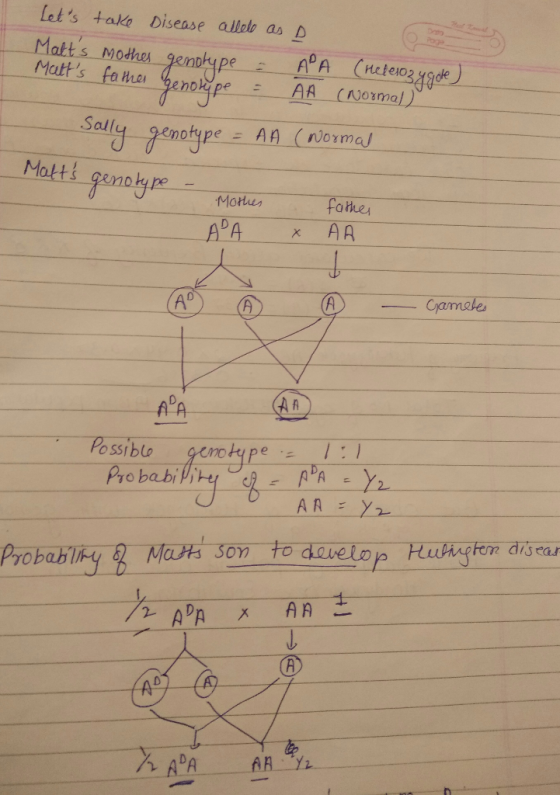
 plz
upvote my answer.Thank you
plz
upvote my answer.Thank you
Add Answer to:
7. Huntington disease is an autosomal dominant trait that causes
neurodegeneration later in life. Matt discovers...
Huntington disease is an autosomal dominant trait that causes neurodegeneration later in life. Matt discovers that...
Huntington disease is an autosomal dominant trait that causes neurodegeneration later in life. Matt discovers that his mother has Huntington disease (she is heterozygous). Matt’s father does not have the Huntington disease allele. Currently, Matt has no symptoms but he does not yet know what his genotype is. Matt is married to Sally, who does not have the Huntington disease allele, and they have one son. What is the probability that their son will NOT develop Huntington disease later in...
8. [12 pts total] Huntington disease is a rare degenerative autosomal disorder that determined by a...
 8. [12 pts total] Huntington disease is a rare degenerative autosomal disorder that determined by a dominant allele. The disorder is typically manifested after the age of 45. A young man has learned that his father has developed the disease; his mother does not carry the dominant allele for the condition [4 pts] A. What is the probability that the young man will later develop the disease? (4 pts] B. If the young man has a child with a woman...
Genetics Problems #4 1) Janet and her siblings have attached earlobes (recessive trait). However, her mother...
 Genetics Problems #4 1) Janet and her siblings have attached earlobes (recessive trait). However, her mother has free earlobes (dominant trait). What is the genotype of her mother? - 2) Charlie has a straight little finger (recessive trait), but his parents don't. What is the phenotypic ratio among the parent's children? 3-4) Abraham is adopted. He has hair on the back of his hand (dominant trait). Could both of his biological parents have had hair on the back of their...
with work shown and concepts and formulas explained, please! Huntington disease is an autosomal dominant condition...
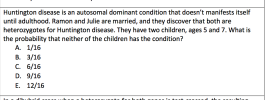 with work shown and concepts
and formulas explained, please!
Huntington disease is an autosomal dominant condition that doesn't manifests itself until adulthood. Ramon and Julie are married, and they discover that both are heterozygotes for Huntington disease. They have two children, ages 5 and 7. What is the probability that neither of the children has the condition? A. 1/16 B. 3/16 C. 6/16 D. 9/16 E. 12/16 Jilbid
with work shown and concepts
and formulas explained, please!
Huntington disease is an autosomal dominant condition that doesn't manifests itself until adulthood. Ramon and Julie are married, and they discover that both are heterozygotes for Huntington disease. They have two children, ages 5 and 7. What is the probability that neither of the children has the condition? A. 1/16 B. 3/16 C. 6/16 D. 9/16 E. 12/16 Jilbid
10. Red green colorblindness is an X-linked recessive disease. That means that it is carried on...
 10. Red green colorblindness is an X-linked recessive disease. That means that it is carried on the X chromosome, so men have just one copy of the gene while women have two. In women, both copies must be the recessive disease allele in order to show the disease phenotype, but because men only have one allele, just one recessive allele causes the disease phenotype. Matt and Kate both have normal vision, but Kate's father is colorblind. Use X for the...
1. Nystagmus, a condition causing oscillations in eye movement, is inherited with the dominant al...
 1. Nystagmus, a condition causing oscillations in eye movement, is inherited with the dominant allele N on the X chromosome. The X-linked recessive allele n does not cause Nystagmus. An immunodeficiency disorder called Chronic Granulomatous Disease (CGD) is inherited with the autosomal recessive allele g. Individuals with the autosomal dominant allele G do not have Chronic Granulomatous Disease. a. Tiffany has both Nystagmus and CGD. Her husband Todd has neither condition. Tiffany's father does not have Nystagmus. Todd's mother has...
3. Cystic fibrosis (CF) is an autosomal recessive disorder (cc) and is one of the most...
 3. Cystic fibrosis (CF) is an autosomal recessive disorder (cc) and is one of the most common life-shortening genetic diseases. In the United States, 1 in 4,000 children are born with CF. Symptoms of cystic fibrous include the production of salty sweat and thickened mucus in the lining of the lungs and air passages. The thickened mucus obstructs airways and promotes the growth of disease-causing bacteria in the lungs. Most individuals with cystic fibrous die in their 20s and 30s...
6 A human trait that is caused by an autosomal dominant mutant allele has a penetrance...
 6
A human trait that is caused by an autosomal dominant mutant allele has a penetrance of 50%. A man who is heterozygous for this mutant allele marries a woman who is homozygous recessive for the normal allele. If they have two children then what is the probability that both children will show the normal phenotype? O 1/4 o 1/2 03/16 0 7/8 09/16
6
A human trait that is caused by an autosomal dominant mutant allele has a penetrance of 50%. A man who is heterozygous for this mutant allele marries a woman who is homozygous recessive for the normal allele. If they have two children then what is the probability that both children will show the normal phenotype? O 1/4 o 1/2 03/16 0 7/8 09/16
Question 2 1 pts Congenital analgesia is a rare disease in which patients' body is unable...
 Question 2 1 pts Congenital analgesia is a rare disease in which patients' body is unable to perceive and respond to pain. This genetic disease is controlled by recessive genes. We use 'P' to represent normal allele, 'p' represent disease allele. Individuals with 'PP' and 'Pp' genotypes are phenotypically normal, while individuals with 'pp' genotype is diseased. A married couple, in which the mother is heterozygous with a genotype 'Pp' and the father is diseased (pp), are planning to have...
1. (2 pts) Attached ear lobes (f) are inherited as an autosomal recessive trait. The dominant...
 1. (2 pts) Attached ear lobes (f) are inherited as an autosomal recessive trait. The dominant allele, F, produces free hanging ear lobes. Sam and Beth both have free earlobes, but their first child has attached earlobes. a. What are the likely genotypes of Sam and Beth with respect to the ear lobe locus? Sam: F Beth: FF b. With respect to the earlobe locus, Sam's genotype is homozygous,/(heterozygous or hemizygous? (Circle the correct answer). c. If Sam and Beth...
 8. [12 pts total] Huntington disease is a rare degenerative autosomal disorder that determined by a dominant allele. The disorder is typically manifested after the age of 45. A young man has learned that his father has developed the disease; his mother does not carry the dominant allele for the condition [4 pts] A. What is the probability that the young man will later develop the disease? (4 pts] B. If the young man has a child with a woman...
 Genetics Problems #4 1) Janet and her siblings have attached earlobes (recessive trait). However, her mother has free earlobes (dominant trait). What is the genotype of her mother? - 2) Charlie has a straight little finger (recessive trait), but his parents don't. What is the phenotypic ratio among the parent's children? 3-4) Abraham is adopted. He has hair on the back of his hand (dominant trait). Could both of his biological parents have had hair on the back of their...
 with work shown and concepts
and formulas explained, please!
Huntington disease is an autosomal dominant condition that doesn't manifests itself until adulthood. Ramon and Julie are married, and they discover that both are heterozygotes for Huntington disease. They have two children, ages 5 and 7. What is the probability that neither of the children has the condition? A. 1/16 B. 3/16 C. 6/16 D. 9/16 E. 12/16 Jilbid
with work shown and concepts
and formulas explained, please!
Huntington disease is an autosomal dominant condition that doesn't manifests itself until adulthood. Ramon and Julie are married, and they discover that both are heterozygotes for Huntington disease. They have two children, ages 5 and 7. What is the probability that neither of the children has the condition? A. 1/16 B. 3/16 C. 6/16 D. 9/16 E. 12/16 Jilbid
 10. Red green colorblindness is an X-linked recessive disease. That means that it is carried on the X chromosome, so men have just one copy of the gene while women have two. In women, both copies must be the recessive disease allele in order to show the disease phenotype, but because men only have one allele, just one recessive allele causes the disease phenotype. Matt and Kate both have normal vision, but Kate's father is colorblind. Use X for the...
 1. Nystagmus, a condition causing oscillations in eye movement, is inherited with the dominant allele N on the X chromosome. The X-linked recessive allele n does not cause Nystagmus. An immunodeficiency disorder called Chronic Granulomatous Disease (CGD) is inherited with the autosomal recessive allele g. Individuals with the autosomal dominant allele G do not have Chronic Granulomatous Disease. a. Tiffany has both Nystagmus and CGD. Her husband Todd has neither condition. Tiffany's father does not have Nystagmus. Todd's mother has...
 3. Cystic fibrosis (CF) is an autosomal recessive disorder (cc) and is one of the most common life-shortening genetic diseases. In the United States, 1 in 4,000 children are born with CF. Symptoms of cystic fibrous include the production of salty sweat and thickened mucus in the lining of the lungs and air passages. The thickened mucus obstructs airways and promotes the growth of disease-causing bacteria in the lungs. Most individuals with cystic fibrous die in their 20s and 30s...
 6
A human trait that is caused by an autosomal dominant mutant allele has a penetrance of 50%. A man who is heterozygous for this mutant allele marries a woman who is homozygous recessive for the normal allele. If they have two children then what is the probability that both children will show the normal phenotype? O 1/4 o 1/2 03/16 0 7/8 09/16
6
A human trait that is caused by an autosomal dominant mutant allele has a penetrance of 50%. A man who is heterozygous for this mutant allele marries a woman who is homozygous recessive for the normal allele. If they have two children then what is the probability that both children will show the normal phenotype? O 1/4 o 1/2 03/16 0 7/8 09/16
 Question 2 1 pts Congenital analgesia is a rare disease in which patients' body is unable to perceive and respond to pain. This genetic disease is controlled by recessive genes. We use 'P' to represent normal allele, 'p' represent disease allele. Individuals with 'PP' and 'Pp' genotypes are phenotypically normal, while individuals with 'pp' genotype is diseased. A married couple, in which the mother is heterozygous with a genotype 'Pp' and the father is diseased (pp), are planning to have...
 1. (2 pts) Attached ear lobes (f) are inherited as an autosomal recessive trait. The dominant allele, F, produces free hanging ear lobes. Sam and Beth both have free earlobes, but their first child has attached earlobes. a. What are the likely genotypes of Sam and Beth with respect to the ear lobe locus? Sam: F Beth: FF b. With respect to the earlobe locus, Sam's genotype is homozygous,/(heterozygous or hemizygous? (Circle the correct answer). c. If Sam and Beth...
Most questions answered within 3 hours.
-
Where is the error in this code sequence?
String s1 = "Hello";
String s2 = "ello";...
asked 11 months ago -
Financial data for Joel de Paris, Inc., for last year
follow:
Joel de Paris, Inc.
Balance...
asked 11 months ago -
Consider this reaction:
Al2(SO4)3 (aq)+ BaCl3
(aq) Al2Cl6 (aq)- +
3BaSO4(s) . What is the...
asked 11 months ago -
Suppose that Savneet is considering increasing her
recent random sample from 20 car rentals to 40...
asked 11 months ago -
Trucks arrive at an unloading terminal at an average rate of 120
per hour.
Trucks arrive...
asked 11 months ago -
Why are methanol and ethanol completely soluble in water while
octanol is not very little soluble....
asked 11 months ago -
A facilities manager at a university reads in a research report
that the mean amount of...
asked 11 months ago -
When the CuSO4 is rehydrated by adding water to the anhydrous
compound, is this an endothermic...
asked 11 months ago -
A ray of sunlight is passing from diamond into crown glass; the
angle of incidence is...
asked 11 months ago -
A block of mass 0.249 kg is placed on top of a light, vertical
spring of...
asked 11 months ago -
how do the kidneys compensate in the presences of acidosis
a) trigger hyperventilate
b) reserve acid...
asked 11 months ago -
Question 501 pts
The rental rate of capital to the firm increases. Which of the
following...
asked 11 months ago