A sample of iron ore weighing 0.2962 g was dissolved in an excess of a dilute...
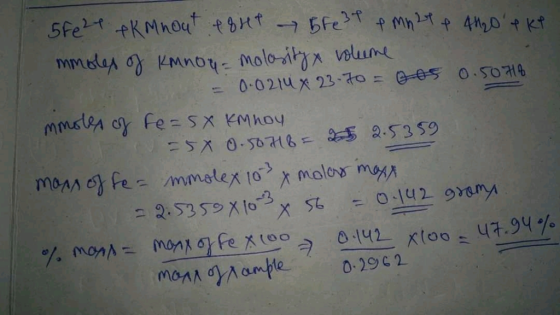
A sample of iron ore weighing 0.2962 g was dissolved in an excess of a dilute acid solution. All the iron was first converted to Fe(II) ions. The solution then required 23.70 mL of 0.0214 M KMnO4 for oxidation to Fe(III) ions. Calculate the percent by mass of iron in the ore.
___% by mass of Fe
Homework Answers
If you have any query please comment
If you satisfied with the solution please like it thankxx
Add Answer to:
A sample of iron ore weighing 0.2962 g was dissolved in an
excess of a dilute...
A 0.1362g iron ore sample was dissolved in hydrochloric acid and the iron was obtained as...
 A
0.1362g iron ore sample was dissolved in hydrochloric acid and the
iron was obtained as Fe^2+(aq). The iron solution was titrated with
Ce4+ solution according to the balanced chemical reaction shown
below. After calculation, it was found that 0.0238g of iron from
the ore reacted with the cerium solution.
Ce^4+(aq) + Fe 2+(aq) -> Ce^3+(aq) + Fe^3+(aq).
Calculate the mass percent of iron in the original ore sample.
Please round your answer to the tenths place.
Question 7 (2...
A
0.1362g iron ore sample was dissolved in hydrochloric acid and the
iron was obtained as Fe^2+(aq). The iron solution was titrated with
Ce4+ solution according to the balanced chemical reaction shown
below. After calculation, it was found that 0.0238g of iron from
the ore reacted with the cerium solution.
Ce^4+(aq) + Fe 2+(aq) -> Ce^3+(aq) + Fe^3+(aq).
Calculate the mass percent of iron in the original ore sample.
Please round your answer to the tenths place.
Question 7 (2...
The iron content of iron ore can be determined by titration with a standard KMnO4 solution....
 The iron content of iron ore can be determined by titration with a standard KMnO4 solution. The iron ore is dissolved in HCl, and all the iron is reduced to Fe2+ ions. This solution is then titrated with KMnO4 solution, producing Fe3+ and Mn2+ ions in acidic solution. If it required 29.83 mL of 0.0447 M KMnO4 to titrate a solution made from 1.128 g of iron ore, what is the mass percent of iron in the iron ore? Mass...
A sample of iron ore weighing 0.6428g is dissolved in acid, the iron is reduced to...
A sample of iron ore weighing 0.6428g is dissolved in acid, the iron is reduced to Fe2+, and the solution is titrated with 36.30 mL of 0.01753 M K2Cr2O7 solution. The reaction is 6Fe2+ + Cr2O72- +14H+ à 6Fe3+ + 2Cr3+ + 7H2O What is the Percentage of iron (55.85g/mol) in the sample?
An iron ore sample weighing 0.5562 g is dissolved HCl (aq), and the iron is obtained...
An iron ore sample weighing 0.5562 g is dissolved HCl (aq), and the iron is obtained as Fe2+ in solution. This solution is then titrated with 28.72 mL of 0.04021 M K2Cr2O7 (aq). What is the percent by mass iron in the ore sample? How do I get to the equation 6Fe^2+ + 14H^+ + Cr2O7^2- ----> 6Fe^3+ + 2Cr^3+ + 7H2O ??? I am just generally confused on how to start this and how to do this step by...
A solution of iron (II) sulfate was prepared by dissolving 10.00g of FeSO4-7H20 (FW= 277.9) in...
A solution of iron (II) sulfate was prepared by dissolving 10.00g of FeSO4-7H20 (FW= 277.9) in water and diluting up to a total volume of 250 ml. The solution was left to stand, exposed to air, and some of the iron (II) ions became oxidized to Iron (III) ions. a 25.0 ml sample of this partially oxidized solution required 23.70 ml of 0.0100M potassium dichromate K2Cr2O7 solution for complete reaction in the presence of dilute sulfuric acid. Calculate the percentage...
The Fe2+ (55.845 g/mol) content of a 2.264 g steel sample dissolved in 50.00 mL of...
 The Fe2+ (55.845 g/mol) content of a 2.264 g steel sample dissolved in 50.00 mL of an acidic solution was determined by tiration with a standardized 0.120 M potassium permanganate (KMnO4, 158.034 g/mol) solution. The titration required 44.82 mL to reach the end point. What is the concentration of iron in the steel sample? Express your answer as grams of Fe per gram of steel Mn2+5 Fe34 H20 + 5 Fe2+ MnO8 H concentration g Fe/g steel A 1.969 g...
Iron tablets may be used in the treatment of anaemia. To analyse the iron(II) content of...
Iron tablets may be used in the treatment of anaemia. To analyse the iron(II) content of commercially available iron tablets, a student used four tablets, each of mass 0.360 g to make up 250 mL of solution in a volumetric flask using dilute sulfuric acid and deionized water. About 15.0 mL of dilute sulfuric acid was added to a 25.0 mL portion of this iron(II) solution and the mixture then titrated with a 0.01025 M solution of potassium manganite(VII), KMnO4....
Chromel is an alloy composed of nickel, iron, and chromium. A 0.6445-g sample was dissolved and...
Chromel is an alloy composed of nickel, iron, and chromium. A 0.6445-g sample was dissolved and diluted to 250.0 mL. When a 50.00-mL aliquot of 0.05173 M EDTA was mixed with an equal volume of the diluted sample, all three ions were chelated, and a 5.23-mL back-titration with 0.06139 M copper(II) was required. The chromium in a second 50.0-mL aliquot was masked through the addition of hexamethylenetetramine; titration of the Fe and Ni required 38.95 mL of 0.05173 M EDTA....
2. A 0.1000 g sample of KBrO3 was dissolved in dilute acid and treated with an...
 2. A 0.1000 g sample of KBrO3 was dissolved in dilute acid and treated with an excess of KI. BrO3 +91 +6H+ → Brº+ 313 + 3H20 The generated 13. required 11.92 mL of a Na2S2O3 solution to reduce it to 1. Use the above balanced equation and those found in the introduction to determine the molarity of the Na2S2O3 solution. 3. The following data was obtained for an iodometric titration of an ascorbic acid tablet. Mass of tablet: 1.2191...
3 attempts left Check my work Enter your answer in the provided box. A chemical engineer...
 3 attempts left Check my work Enter your answer in the provided box. A chemical engineer determines the mass percent of iron in an ore sample by converting the Fe to Feat in acid and then titrating the Fe?* with MnO4 A 1.0986-g sample was dissolved in acid and then titrated with 31.36 mL of 0.04891 M KMnO4. The balanced equation is 8 H*(aq) + 5 Fe2+ (aq)+ Mno, (aq) → 5 Fe3+(aq) + Mn²+(aq) + 4 H20(1) Calculate the...
 A
0.1362g iron ore sample was dissolved in hydrochloric acid and the
iron was obtained as Fe^2+(aq). The iron solution was titrated with
Ce4+ solution according to the balanced chemical reaction shown
below. After calculation, it was found that 0.0238g of iron from
the ore reacted with the cerium solution.
Ce^4+(aq) + Fe 2+(aq) -> Ce^3+(aq) + Fe^3+(aq).
Calculate the mass percent of iron in the original ore sample.
Please round your answer to the tenths place.
Question 7 (2...
A
0.1362g iron ore sample was dissolved in hydrochloric acid and the
iron was obtained as Fe^2+(aq). The iron solution was titrated with
Ce4+ solution according to the balanced chemical reaction shown
below. After calculation, it was found that 0.0238g of iron from
the ore reacted with the cerium solution.
Ce^4+(aq) + Fe 2+(aq) -> Ce^3+(aq) + Fe^3+(aq).
Calculate the mass percent of iron in the original ore sample.
Please round your answer to the tenths place.
Question 7 (2...
 The iron content of iron ore can be determined by titration with a standard KMnO4 solution. The iron ore is dissolved in HCl, and all the iron is reduced to Fe2+ ions. This solution is then titrated with KMnO4 solution, producing Fe3+ and Mn2+ ions in acidic solution. If it required 29.83 mL of 0.0447 M KMnO4 to titrate a solution made from 1.128 g of iron ore, what is the mass percent of iron in the iron ore? Mass...
 The Fe2+ (55.845 g/mol) content of a 2.264 g steel sample dissolved in 50.00 mL of an acidic solution was determined by tiration with a standardized 0.120 M potassium permanganate (KMnO4, 158.034 g/mol) solution. The titration required 44.82 mL to reach the end point. What is the concentration of iron in the steel sample? Express your answer as grams of Fe per gram of steel Mn2+5 Fe34 H20 + 5 Fe2+ MnO8 H concentration g Fe/g steel A 1.969 g...
 2. A 0.1000 g sample of KBrO3 was dissolved in dilute acid and treated with an excess of KI. BrO3 +91 +6H+ → Brº+ 313 + 3H20 The generated 13. required 11.92 mL of a Na2S2O3 solution to reduce it to 1. Use the above balanced equation and those found in the introduction to determine the molarity of the Na2S2O3 solution. 3. The following data was obtained for an iodometric titration of an ascorbic acid tablet. Mass of tablet: 1.2191...
 3 attempts left Check my work Enter your answer in the provided box. A chemical engineer determines the mass percent of iron in an ore sample by converting the Fe to Feat in acid and then titrating the Fe?* with MnO4 A 1.0986-g sample was dissolved in acid and then titrated with 31.36 mL of 0.04891 M KMnO4. The balanced equation is 8 H*(aq) + 5 Fe2+ (aq)+ Mno, (aq) → 5 Fe3+(aq) + Mn²+(aq) + 4 H20(1) Calculate the...
Most questions answered within 3 hours.
-
Where is the error in this code sequence?
String s1 = "Hello";
String s2 = "ello";...
asked 11 months ago -
Financial data for Joel de Paris, Inc., for last year
follow:
Joel de Paris, Inc.
Balance...
asked 11 months ago -
Consider this reaction:
Al2(SO4)3 (aq)+ BaCl3
(aq) Al2Cl6 (aq)- +
3BaSO4(s) . What is the...
asked 11 months ago -
Suppose that Savneet is considering increasing her
recent random sample from 20 car rentals to 40...
asked 11 months ago -
Trucks arrive at an unloading terminal at an average rate of 120
per hour.
Trucks arrive...
asked 11 months ago -
Why are methanol and ethanol completely soluble in water while
octanol is not very little soluble....
asked 11 months ago -
A facilities manager at a university reads in a research report
that the mean amount of...
asked 11 months ago -
When the CuSO4 is rehydrated by adding water to the anhydrous
compound, is this an endothermic...
asked 11 months ago -
A ray of sunlight is passing from diamond into crown glass; the
angle of incidence is...
asked 11 months ago -
A block of mass 0.249 kg is placed on top of a light, vertical
spring of...
asked 11 months ago -
how do the kidneys compensate in the presences of acidosis
a) trigger hyperventilate
b) reserve acid...
asked 11 months ago -
Question 501 pts
The rental rate of capital to the firm increases. Which of the
following...
asked 11 months ago