How is DNA configured into chromatin, compacted to heterochromatin and reversed to chromatin? How are genes...
How is DNA configured into
chromatin, compacted to heterochromatin and
reversed to chromatin?
How are genes organized on a DNA molecule? Consider prokaryotes and
eukaryotes for gene organization strategies at the DNA level.
please answer both
Homework Answers
:DNA configured into chromatin:
Cells contain a nucleus surrounded by a nuclear membrane in
eukaryotic cells,and a nuclear region in the prokaryotic cells.
In a non-dividing cell the nucleus is filled with a thread-like material known as"chromatin".
Chromatin is made up of DNA and proteins (mainly histones and
some non-histone acidic proteins).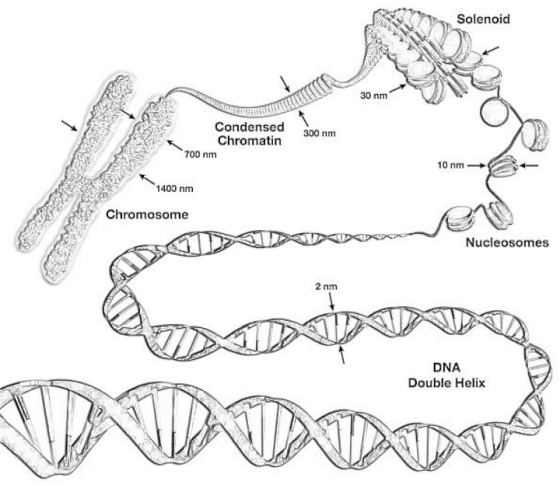
The chromosomes themselves are macromolecular entities that must be
synthesized, packaged, protected, and properly distributed to
daughter cells at cell division.
•:The large amounts of DNA are
packed into a cell:•
The packaging of tremendous amount of genetic information into
the small space within a cell has been called the ultimate storage
problem.
Chromosomal DNA exist in the form of very long molecules, which
must be tightly packed to fit into the small confines of a
cell.
The structure of DNA can be considered at three hierarchical
levels:
a.
The primary structure of DNA is its nucleotide sequence
b.
The secondary structure is the double stranded helix
c.
The tertiary structure refers to higher order folding that allow DNA to be packed into the confined space of a cell.
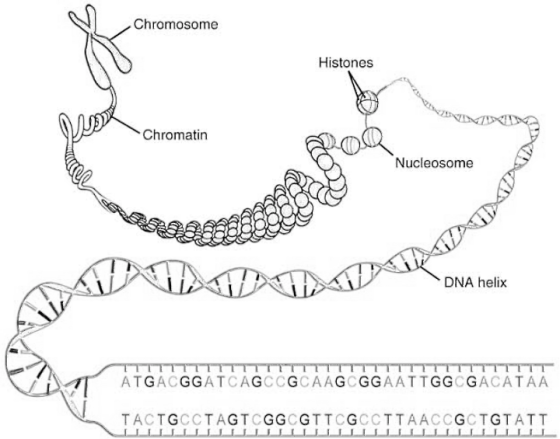
•Supercoiling•
• One type of DNA tertiary structure is supercoiling which takes place when the DNA helix is subjected to strain by being over wound or under wound.
• Energy is used to add or remove any tums, strains is placed on the molecule,causing the helix to super coil, or twist on itself.
• Molecule that are over rotated exhibit positive
supercoiling.
• Under rotated molecules exhibit negative supercoiling.
• Supercoiling is a partial solution to the cells DNA packing
problem because super coiled DNA occupies less space than relaxed
DNA.
• Supercoiling relies on topoisomerases enzymes that add or remove rotation from the DNA helix by temporarly breaking the nucleotide strand, rotating the ends around each other, the rejoining the broken ends.
• Overrotation or underrotation of a DNA double helix places strain on the molecule, causing it to supercoil.
• Supercoiling is controled by topoisomerase enzymes.
• Most cellular DNA is negetively supercoiled, which eases the
seperation of nucleotide strands during replication and
transcription and allow DNA to be packed into small spaces.
:-EUKARYOTIC CHROMOSOME-:
• Individual eukaryotic chromosome
contain enormous amounts of DNA.
• Chromosome are in an elongated
relatively uncondensed state during
interphase of the cell cycle.
•Chromatin •
• Walther Flemming first used the term Chromatin in 1882. At that time, Flemming assumed that within the nucleus there was some kind of a nuclear-scaffold.
Chromatin, which consists of DNA complexed to proteins, is the material that makes up eukaryotic chromosomes.
The most abundant of these proteins are the five types of positively charged histone proteins H1, H2A, H2B, H3, and H4.
Variant histones may at times be incorporated into chromatin in place of the normal histones.
In non-dividing cells there are two types of chromatin: euchromatin and heterochromatin.
•Histones protein•
The histone octamer and associated DNA that form the nucleosome combine with histone H1 to form the chromatosome.
The addition of H1 to a nucleosome results in protection of an additional 20 to 22 bp of linker DNA adjacent to the nucleosome, and thus H1 is often referred to as the linker histone.
Only one Hl subunit is present per chromatosome, unlike the core histones,which are present in two copies each.
DNA binding in H1 is intrinsic to the central globular region, which contains two DNA-binding sites.
• Hi binds only one of the linker DNA strands, and the second DNA site in histone H1 binds to the central region of the DNA supercoil in the nucleosome.
Histones are rich in the basic amino acids arginine and lysine, which together make up about 25% of the amino acid residues in any given histone protein.
•
Histone proteins are highly conserved among eukaryotic cells.
Histones H3 and H4 are nearly identical in all eukaryotes,
suggesting strict conservation of
their functions.
Histones H1, H2A, and H2B show less sequence similarity, but on the whole, they are more conserved than other types of proteins.
Salt bridges between positively charged histones and negatively
charges DNA play a major
role in stabilizing DNA-histone complex.
•Why packaging is needed•
o DNA is roughly 3 meter long and it has to be packed in nucleus
which is few
micrometres in diameter, hence higher order of packaging is
required.
•There are various order of packaging
a. First order of packaging - Nucleosome
b. Second order of packaging - Solenoid fibre
c. Scaffold loop Chromatids Chromosome are third order of
packaging.
•First level of packing: Nucleosome•
Nucleosome = DNA + core
histones
DNA wrapped twice around
an octamer of core histones
consisting of:
2 of each core histone: H2A,
H2B, H3, H4
Note: Hi is not part of the
nucleosome, but is attached to
the DNA near the nucleosome
10 nm in diameter
Core of eight
histone molecules
•Nucleosome •
The nucleosome consists of a core particle of eight histone
proteins and DNA that wraps around the core.Chromatosome, which are
nucleosomes bound to an H1 histone, are separated by linker
DNA.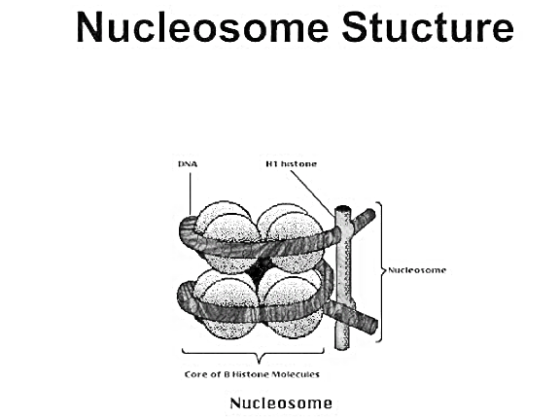
• Nucleosmes fold to form a 30-nm chromatin fiber, which appears as a series of loops that pack to create a 250 nm wide fiber.
• Helical coiling of the 250 nm fiber produces a chromatid.
•DNA compacted to heterochromatin•
DNA wraps around histone proteins, forming nucleosomes and the
so-called "beads on a string" structure (euchromatin). Multiple
histones wrap into a 30-nanometer fibre consisting of nucleosome
arrays in their most compact form (heterochromatin).
•Heterochromatin vs. Euchromatin•
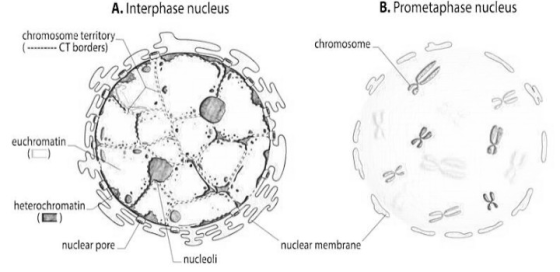
Compaction level of interphase chromosomes is not uniform Euchromatin
Less condensed regions of chromosomes
b. Transcriptionally active
c. Regions where 30 nm fiber forms radial loop domains
» Heterochromatin
2 Tightly compacted regions of chromosomes
Transcriptionally inactive (in general)
Radial loop domains compacted even further
heterochromatin is in such a condensed structure that it does not
enable DNA and RNA polymerases to access the DNA, therefore
preventing DNA replication and transcription. There are two main
types of heterochromatin: constructive heterochromatin and
facultative heterochromatin. Heterochromatin represents less than
10% of the human chromatin, with euchromatin accounting for most of
it—over 90%.
•prokaryotes and eukaryotes for gene organization strategies at the
DNA level •
When comparing prokaryotic cells to eukaryotic cells, prokaryotes
are much simpler than eukaryotes in many of their features. Most
prokaryotes contain a single, circular chromosome that is found in
an area of the cytoplasm called the nucleoid.
The size of the genome in one of the most well-studied prokaryotes,
E.coli, is 4.6 million base pairs (approximately 1.1 mm, if cut and
stretched out). So how does this fit inside a small bacterial cell?
The DNA is twisted by what is known as supercoiling. Supercoiling
means that DNA is either under-wound (less than one turn of the
helix per 10 base pairs) or over-wound (more than 1 turn per 10
base pairs) from its normal relaxed state. Some proteins are known
to be involved in the supercoiling; other proteins and enzymes such
as DNA gyrase help in maintaining the supercoiled structure.
Eukaryotes, whose chromosomes each consist of a linear DNA molecule, employ a different type of packing strategy to fit their DNA inside the nucleus (Figure 2). At the most basic level, DNA is wrapped around proteins known as histones to form structures called nucleosomes. The histones are evolutionarily conserved proteins that are rich in basic amino acids and form an octamer. The DNA (which is negatively charged because of the phosphate groups) is wrapped tightly around the histone core. This nucleosome is linked to the next one with the help of a linker DNA. This is also known as the “beads on a string” structure. This is further compacted into a 30 nm fiber, which is the diameter of the structure. At the metaphase stage, the chromosomes are at their most compact, are approximately 700 nm in width, and are found in association with scaffold proteins.
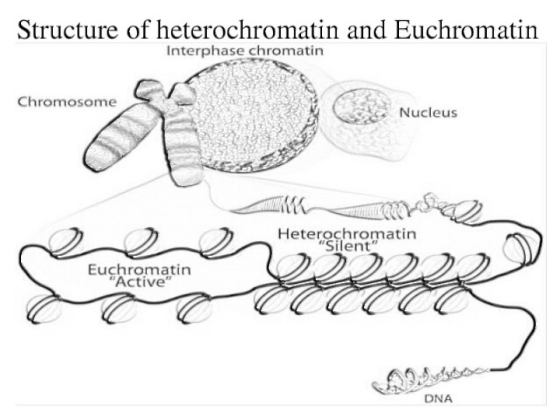
In interphase, eukaryotic chromosomes have two distinct regions that can be distinguished by staining. The tightly packaged region is known as heterochromatin, and the less dense region is known as euchromatin. Heterochromatin usually contains genes that are not expressed, and is found in the regions of the centromere and telomeres. The euchromatin usually contains genes that are transcribed, with DNA packaged around nucleosomes but not further compacted.
Add Answer to:
How is DNA configured into
chromatin, compacted to heterochromatin and
reversed to chromatin?
How are genes...
If the two genes are unlinked, an organism with the genotype of AaBb can produce gametes...
If the two genes are unlinked, an organism with the genotype of AaBb can produce gametes containing either Aa or Bb. AB, Ab, aB, or ab. AaBb. AB or ab. none of the abov Which of the following is NOT correct about miRNA? It is involved with posttranscriptional regulation in eukaryotes. It leads to one type of RNA interference. Its name is derived from “mitochondrial RNA.” It binds to a complementary mRNA sequence. It is found in many different organisms,...
Question 2a If the DNA template 5′- ATGGATGC -3′ is transcribed to RNA, the RNA would...
Question 2a If the DNA template 5′- ATGGATGC -3′ is transcribed to RNA, the RNA would be best described as... a. 3′- TACCTACG -5′. b. 5′- ATGGATGC -3′. c. 5′- AUGGAUGC -3′. d. 5′- UACCUACG -5′. e. 3′- UACCUACG -5′. Question 2b Which answer best summarizes how eukaryotic and bacterial RNA polymerases are different? a. Eukaryotes have several types of multimeric RNA polymerases, whereas bacteria only have one monomeric RNA polymerase. b. Eukaryotes have several types of RNA polymerases, one...
The observation that in any DNA sample, A T and G C A. DNase sequencing An...
 The observation that in any DNA sample, A T and G C A. DNase sequencing An analytical method that determines which segments of DNA are bound by a particular B. Chargaff's rule protein factor, such as a transcription factor C. ChIP sequencing D. Euchromatin E. Histone acetylation F. major groove - # Areas associated with a eukaryotic gene that are where most DNA methylation occurs. # An analytical technique that involves a small slide or chip with many segments of...
28 29 30 31 32 33 28. Genes found in segments of chromosome called heterochromatin would...
 28
29
30
31
32
33
28. Genes found in segments of chromosome called heterochromatin would likely be expressed at high levels. expressed at low levels, or not at all. deleted before replication. maternally inherited only. none of these 29. (Use this representation to answer the following question.) DNA template strand 5 3' DNA complementary strand 3' 5' Using the double-stranded molecule above, in which direction does the RNA polymerase enzyme move? 3' → 5' along the template strand 5'...
28
29
30
31
32
33
28. Genes found in segments of chromosome called heterochromatin would likely be expressed at high levels. expressed at low levels, or not at all. deleted before replication. maternally inherited only. none of these 29. (Use this representation to answer the following question.) DNA template strand 5 3' DNA complementary strand 3' 5' Using the double-stranded molecule above, in which direction does the RNA polymerase enzyme move? 3' → 5' along the template strand 5'...
please answer all the questions Question 8 0 / 1 pts Our understanding of RNA ...
 please answer all the questions
Question 8
0 / 1 pts
Our understanding of RNA
was non-existent until 2000
started with the identification of a tRNA which suggested a
method of converting DNA to protein
began to identify that DNA-->protein--> RNA
stopped growing after it's original discovery in the 70s
IncorrectQuestion 10
0 / 1 pts
Enzymes allow for chemical reactions to occur in the cell that
may not naturally occur at the right place at...
please answer all the questions
Question 8
0 / 1 pts
Our understanding of RNA
was non-existent until 2000
started with the identification of a tRNA which suggested a
method of converting DNA to protein
began to identify that DNA-->protein--> RNA
stopped growing after it's original discovery in the 70s
IncorrectQuestion 10
0 / 1 pts
Enzymes allow for chemical reactions to occur in the cell that
may not naturally occur at the right place at...
The individual subunits making up each strand of DNA are called1 Inherited traits are determined by...
 The individual subunits making up each strand of DNA are called1 Inherited traits are determined by elements of heredity called__2 . 3 __ in the base sequence to a DNA Transcription is a production of an RNA strand that is_ strand. In eukaryotes RNA_ 4 synthesizes mRNA, located in the The main concept in the 6 of molecular biology is that DNA does not code for protein directly but rather acts through an intermediary molecule of ribonucleic acid (RNA). An...
"In one model/diagram, show how transciption factors, histone modifiers, chromatin remodelers, DNA methylation all cooperate to...
"In one model/diagram, show how transciption factors, histone modifiers, chromatin remodelers, DNA methylation all cooperate to regulate the thermostat for an individual gene (how much mRNA is transcribed)." Lets say you've discovered a gene tht codes for a protein that interferes with your ability to scratch-off quiz cards. Clearly you need to shut this gene off. You can name your gene and its regulatory transciption factor(s) whatever you want, but the rest of your model should be accurate. Make sure...
How are organisms biologically organized? Describe the anatomy of the eukaryotic cell (animal and plant). Major...
How are organisms biologically organized? Describe the anatomy of the eukaryotic cell (animal and plant). Major difference between eukaryotes and prokaryotes. Describe the different types of chemical bonds. How do they affect the organization of biomacromolecules? Differentiate between a peptide bond, a phosphodiester, a phosphoanhydride bond. What are disulfide bridges? Amino-acids participating in this bonding? Describe the function of enzymes. Understand the forces by which substrates bind to enzymes. Distinguish between redox reactions and activated energy carriers. Distinguish between anabolism...
OLU Ucues Assignment 4c. In eukaryotes, genes are composed of exons and introns, with only exons...
 OLU Ucues Assignment 4c. In eukaryotes, genes are composed of exons and introns, with only exons included in the mRNA. Each gene also has its own adjacent promoter, to which the transcribing enzyme RNA polymerase binds. Related genes may be clustered together on the same chromosome as a “gene family." Answer each of the following questions in the answer box of the assignment. You may also write the answers directly into the assignment document and then upload your answers. Number...
Genes in eukaryotes are often organized into exons and intrans, which require splicing to produce an...
Genes in eukaryotes are often organized into exons and intrans, which require splicing to produce an mRNA that can be translated. The gene organization is the order of the DNA segments that comprise the gene starting with the promoter, the first exon, the first intron, the second exon, and so on. The interspersed intrans can make gene identification difficult in eukaryotesparticularly in higher eukaryotes with many introns and alternative spliced mRNAs. Prediction of many genes and their organization has been...
 The observation that in any DNA sample, A T and G C A. DNase sequencing An analytical method that determines which segments of DNA are bound by a particular B. Chargaff's rule protein factor, such as a transcription factor C. ChIP sequencing D. Euchromatin E. Histone acetylation F. major groove - # Areas associated with a eukaryotic gene that are where most DNA methylation occurs. # An analytical technique that involves a small slide or chip with many segments of...
 28
29
30
31
32
33
28. Genes found in segments of chromosome called heterochromatin would likely be expressed at high levels. expressed at low levels, or not at all. deleted before replication. maternally inherited only. none of these 29. (Use this representation to answer the following question.) DNA template strand 5 3' DNA complementary strand 3' 5' Using the double-stranded molecule above, in which direction does the RNA polymerase enzyme move? 3' → 5' along the template strand 5'...
28
29
30
31
32
33
28. Genes found in segments of chromosome called heterochromatin would likely be expressed at high levels. expressed at low levels, or not at all. deleted before replication. maternally inherited only. none of these 29. (Use this representation to answer the following question.) DNA template strand 5 3' DNA complementary strand 3' 5' Using the double-stranded molecule above, in which direction does the RNA polymerase enzyme move? 3' → 5' along the template strand 5'...
 please answer all the questions
Question 8
0 / 1 pts
Our understanding of RNA
was non-existent until 2000
started with the identification of a tRNA which suggested a
method of converting DNA to protein
began to identify that DNA-->protein--> RNA
stopped growing after it's original discovery in the 70s
IncorrectQuestion 10
0 / 1 pts
Enzymes allow for chemical reactions to occur in the cell that
may not naturally occur at the right place at...
please answer all the questions
Question 8
0 / 1 pts
Our understanding of RNA
was non-existent until 2000
started with the identification of a tRNA which suggested a
method of converting DNA to protein
began to identify that DNA-->protein--> RNA
stopped growing after it's original discovery in the 70s
IncorrectQuestion 10
0 / 1 pts
Enzymes allow for chemical reactions to occur in the cell that
may not naturally occur at the right place at...
 The individual subunits making up each strand of DNA are called1 Inherited traits are determined by elements of heredity called__2 . 3 __ in the base sequence to a DNA Transcription is a production of an RNA strand that is_ strand. In eukaryotes RNA_ 4 synthesizes mRNA, located in the The main concept in the 6 of molecular biology is that DNA does not code for protein directly but rather acts through an intermediary molecule of ribonucleic acid (RNA). An...
 OLU Ucues Assignment 4c. In eukaryotes, genes are composed of exons and introns, with only exons included in the mRNA. Each gene also has its own adjacent promoter, to which the transcribing enzyme RNA polymerase binds. Related genes may be clustered together on the same chromosome as a “gene family." Answer each of the following questions in the answer box of the assignment. You may also write the answers directly into the assignment document and then upload your answers. Number...
Most questions answered within 3 hours.
-
Where is the error in this code sequence?
String s1 = "Hello";
String s2 = "ello";...
asked 10 months ago -
Financial data for Joel de Paris, Inc., for last year
follow:
Joel de Paris, Inc.
Balance...
asked 10 months ago -
Consider this reaction:
Al2(SO4)3 (aq)+ BaCl3
(aq) Al2Cl6 (aq)- +
3BaSO4(s) . What is the...
asked 10 months ago -
Suppose that Savneet is considering increasing her
recent random sample from 20 car rentals to 40...
asked 10 months ago -
Trucks arrive at an unloading terminal at an average rate of 120
per hour.
Trucks arrive...
asked 10 months ago -
Why are methanol and ethanol completely soluble in water while
octanol is not very little soluble....
asked 10 months ago -
A facilities manager at a university reads in a research report
that the mean amount of...
asked 10 months ago -
When the CuSO4 is rehydrated by adding water to the anhydrous
compound, is this an endothermic...
asked 10 months ago -
A ray of sunlight is passing from diamond into crown glass; the
angle of incidence is...
asked 10 months ago -
A block of mass 0.249 kg is placed on top of a light, vertical
spring of...
asked 10 months ago -
how do the kidneys compensate in the presences of acidosis
a) trigger hyperventilate
b) reserve acid...
asked 10 months ago -
Question 501 pts
The rental rate of capital to the firm increases. Which of the
following...
asked 10 months ago