1. Jane has a mass of 40kg. She pushes a 50kg rock with a roce of...
Homework Answers
1, from the third law of Newton, we can say that every action has equal & opposite reaction.
And in this scenario action is 100N applied by jane on rock, hence reaction by rock on jane will also be 100N
2. Using second law of Newton, that is net force on object will be equal to the product of mass and acceleration of the object.
Since the acceleration of the crate is zero. (Given that you are pulling with constant velocity)
Hence net force on crate is zero. Now if you are pulling with 350N then there must be friction acting in the opposite direction on the crate with equal magnitude in order to cancel out your force. Hence the magnitude of friction force on crate will be equal to 350N.
Add Answer to:
1.
Jane has a mass of 40kg. She pushes a 50kg rock with a roce of...
two children push horizontally on a crate. Child A pushes with 200N while child B pushes...
two children push horizontally on a crate. Child A pushes with 200N while child B pushes with 350N. IF the crate does not move, what is the force of friction between the crate and the floor?
You have a crate full of books with a total mass of 32 kg that you...
 You have a crate full of books with a total mass of 32 kg that you have to move from your bedroom to the door of your apartment using a rope attached to the crate. The coefficient of static friction between the crate and the floor is 0.65, and the coefficient of kinetic friction is 0.45 (a) Pulling the rope horizontally, what is the minimum force you have to pull with to get the crate to start moving? (b) Once...
a worker in a warehouse attempts to move a crate of mass 100 kg by pulling...
a worker in a warehouse attempts to move a crate of mass 100 kg by pulling it with a force directed at an angle of 25.8 above the horizontal. He finds that for any pull force below 610 N the crate does not move. What is the coefficient of static friction between floor and crate?
1. You want to move a 500-N crate across a level floor. To start the crate...
1. You want to move a 500-N crate across a level floor. To start the crate moving, you have to pull with a 230-N horizontal force. Once the crate breaks loose and starts to move, you can keep it moving at constant velocity with only 200 N. What are the coefficients of static and kinetic friction? 2. In the previous example, suppose you move the crate by pulling upward on the rope at an angle of 30.0◦ above the horizontal....
Jane pushes a box loaded with penguins, which is initially at rest, across the floor with...
 Jane pushes a box loaded with penguins, which is initially at rest, across the floor with a constant force of 500 N. A frictional force of 150 N acts on the box. The total mass of the box and penguins is 100kg. What is the acceleration of the box? 1.5 m/s2 5 m/s2 3.5 m/s^2 0.3 m/s2 0.2 m/s2 Jane pushes a box loaded with penguins, which is initially at rest, across the floor with a constant force of 500...
A factory worker pushes a crate of mass 32.0 kg a distance of 4.20 m along...
A factory worker pushes a crate of mass 32.0 kg a distance of 4.20 m along a level floor at constant velocity by pushing horizontally on it. The coefficient of kinetic friction between the crate and floor is 0.25. What magnitude of force must the worker apply? Express your answer using two significant figures. F = N Part B How much work is done on the crate by this force? Express your answer using two significant figures. W = J ...
A nurse pushes a cart by exerting a force on the handle at a downward angle...
A nurse pushes a cart by exerting a force on the handle at a downward angle 38° below the horizontal. The loaded cart has a mass of 28 kg, and the force of friction is 61 N. Randomized Variables f = 61 N a = 38 ° What is the magnitude of the force the nurse must exert to move at a constant velocity in Newtons?
Use components to calculate the magnitude R and direction of the vector sum (the resultant) R=...
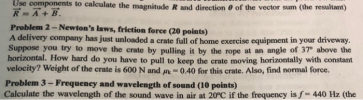 Use components to calculate the magnitude R and direction of the vector sum (the resultant) R= A + B. Problem 2-Newton's laws, friction force (20 points) A delivery company has just unloaded a crate full of home exercise equipment in your driveway. Suppose you try to move the crate by pulling it by the rope at an angle of 37° above the horizontal. How hard do you have to pull to keep the crate moving horizontally with constant velocity? Weight...
Question 5 A spinning wheel initially has an angular velocity of 50rad/s east: 20s later its angu...
 Question 5 A spinning wheel initially has an angular velocity of 50rad/s east: 20s later its angular velocity is 50rad/s west. If the angular acceleration is constant, what are (a) the magnitude and direction of angular acceleration, (b) the angular displacement over 20 s and (c) the angular speed? Question 6 Use Calculus to derive the Work- Energy Theorem and use the equation to solve the following questions Question 7. A crate of Mass 50kg slides down a 30o incline....
1) Starting from a free body diagram, algebraically derive mass hanging mass hanging mass of box...
 1) Starting from a free body diagram, algebraically derive mass hanging mass hanging mass of box massof box Pulley box Mass 2) Starting from a free body diagram, algebraically derive equation μ-tan(0) box man pushes a crate massing 50 kg at a constant speed up a ramp inclined at an angle of 30 to the horizontal. The coefficient of kinetic friction between the crate and the ramp is .40. What force must the man exert on the crate?
 You have a crate full of books with a total mass of 32 kg that you have to move from your bedroom to the door of your apartment using a rope attached to the crate. The coefficient of static friction between the crate and the floor is 0.65, and the coefficient of kinetic friction is 0.45 (a) Pulling the rope horizontally, what is the minimum force you have to pull with to get the crate to start moving? (b) Once...
 Jane pushes a box loaded with penguins, which is initially at rest, across the floor with a constant force of 500 N. A frictional force of 150 N acts on the box. The total mass of the box and penguins is 100kg. What is the acceleration of the box? 1.5 m/s2 5 m/s2 3.5 m/s^2 0.3 m/s2 0.2 m/s2 Jane pushes a box loaded with penguins, which is initially at rest, across the floor with a constant force of 500...
 Use components to calculate the magnitude R and direction of the vector sum (the resultant) R= A + B. Problem 2-Newton's laws, friction force (20 points) A delivery company has just unloaded a crate full of home exercise equipment in your driveway. Suppose you try to move the crate by pulling it by the rope at an angle of 37° above the horizontal. How hard do you have to pull to keep the crate moving horizontally with constant velocity? Weight...
 Question 5 A spinning wheel initially has an angular velocity of 50rad/s east: 20s later its angular velocity is 50rad/s west. If the angular acceleration is constant, what are (a) the magnitude and direction of angular acceleration, (b) the angular displacement over 20 s and (c) the angular speed? Question 6 Use Calculus to derive the Work- Energy Theorem and use the equation to solve the following questions Question 7. A crate of Mass 50kg slides down a 30o incline....
 1) Starting from a free body diagram, algebraically derive mass hanging mass hanging mass of box massof box Pulley box Mass 2) Starting from a free body diagram, algebraically derive equation μ-tan(0) box man pushes a crate massing 50 kg at a constant speed up a ramp inclined at an angle of 30 to the horizontal. The coefficient of kinetic friction between the crate and the ramp is .40. What force must the man exert on the crate?
Most questions answered within 3 hours.
-
Where is the error in this code sequence?
String s1 = "Hello";
String s2 = "ello";...
asked 11 months ago -
Financial data for Joel de Paris, Inc., for last year
follow:
Joel de Paris, Inc.
Balance...
asked 11 months ago -
Consider this reaction:
Al2(SO4)3 (aq)+ BaCl3
(aq) Al2Cl6 (aq)- +
3BaSO4(s) . What is the...
asked 11 months ago -
Suppose that Savneet is considering increasing her
recent random sample from 20 car rentals to 40...
asked 11 months ago -
Trucks arrive at an unloading terminal at an average rate of 120
per hour.
Trucks arrive...
asked 11 months ago -
Why are methanol and ethanol completely soluble in water while
octanol is not very little soluble....
asked 11 months ago -
A facilities manager at a university reads in a research report
that the mean amount of...
asked 11 months ago -
When the CuSO4 is rehydrated by adding water to the anhydrous
compound, is this an endothermic...
asked 11 months ago -
A ray of sunlight is passing from diamond into crown glass; the
angle of incidence is...
asked 11 months ago -
A block of mass 0.249 kg is placed on top of a light, vertical
spring of...
asked 11 months ago -
how do the kidneys compensate in the presences of acidosis
a) trigger hyperventilate
b) reserve acid...
asked 11 months ago -
Question 501 pts
The rental rate of capital to the firm increases. Which of the
following...
asked 11 months ago