Each iteration of the Ford-Fulkerson Method finds some augmenting path and increases the flow on each...
Each iteration of the Ford-Fulkerson Method finds some augmenting path and increases the flow on each edge of that path. 1) True 2) False
Homework Answers
Ans: False
Explanation: Flow on an edge does not exceed the given capacity of the edge
Add Answer to:
Each iteration of the Ford-Fulkerson Method finds some
augmenting path and increases the flow on each...
We will look at how the Ford-Fulkerson Algorithm operates on the following network.
 We will look at how the Ford-Fulkerson Algorithm operates on the following network.Each edge is annotated with the current flow (initially zero) and the edge's capacity. In general, a flow of x along an edge with capacity y is shown as x / y.(a) Show the residual graph that will be created from this network with the given (empty) flow. In drawing a residual graph, to show a forward edge with capacity x and a backward edge with capacity y,...
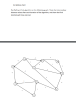
QUESTION Use the Augmenting Paths method to find the maximum flow from the source node s...
 QUESTION Use the Augmenting Paths method to find the maximum flow from the source node s to sink node tin the flow network represented by the graph below. In your solution show the algorithm iterations, and for each iteration show the augmenting path and that path's flow. Attach File Browse My Computer
Java b) Bellman-Ford distance valuesaer each iteration of the algorithm, and show the final shortest path tree and cost...
 Java
b) Bellman-Ford distance valuesaer each iteration of the algorithm, and show the final shortest path tree and cost. 3. .2
b) Bellman-Ford distance valuesaer each iteration of the algorithm, and show the final shortest path tree and cost. 3. .2
Java
b) Bellman-Ford distance valuesaer each iteration of the algorithm, and show the final shortest path tree and cost. 3. .2
b) Bellman-Ford distance valuesaer each iteration of the algorithm, and show the final shortest path tree and cost. 3. .2
P/G method finds an equivalent cash flow one period prior to first non-zero gradient amount True...
 P/G method finds an equivalent cash flow one period prior to first non-zero gradient amount True False
Question 3. Below is the result of the 1st and 2nd iteration of the Bellman-Ford single...
 Question 3. Below is the result of the 1st and 2nd iteration of the Bellman-Ford single source shortest path algorithm starting at node A A B C D E B 2 000 0-14 E 0000 DO (D Please note the above table does not contain the pi or previous node values. Please provide the changes to the tables that occure during the third iteration only for distance(shortest path estimation) when processing only the edges: edges (D,C), (B,C),(D,B), (B,D) (B,E) and...
4) Consider the network flow graph below, where each arc is labeled with the maximum capacity...
 4) Consider the network flow graph below, where each arc is labeled with the maximum capacity of that link in the flow network. A 25C 15 - 10,- -* YD 15 35 20 40 10 X 2 (a) Use the Ford-Fulkerson Algorithm to determine the maximum total flow from source to sink in this network. Start with the path s B DA Ct and list (in order) the remaining paths added and the total flow after each path is added....
Problem E: For each of the following parts, state True or False. If true, give a short proof. If ...
 Problem E: For each of the following parts, state True or False. If true, give a short proof. If false, givera counterexample: (1). Using Kruskal's algorithm, edges are (always) inserted into the MST in the same order as using Prim's (2). If an edge e is part of a TSP tour found by the quick TSP method then it must also be part of the (3). If an edge e is part of a Shortest Path Tree rooted at A...
Use the exhaustion of path method to solve the following problem Show all your working by listing each path and wei...
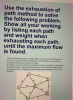 Use the exhaustion of path method to solve the following problem Show all your working by listing each path and weight when exhausting each path, until the maximum flow is found. Solve the following problem using the path of exhaustion method. Make sure you choose the paths from top to bottom to avoid deadlocks. Show all your working by stating each path and its weight An engineer was given the task to study the rainwater drainage in a certain area....
in c++ The Bellman-Ford Algorithm In this assignment, you are asked to implement the Bellman-Ford Algorithm...
 in c++
The Bellman-Ford Algorithm In this assignment, you are asked to implement the Bellman-Ford Algorithm which solves the single-source shortest-paths problem. Specifically, you are given as input a directed graph G = (V. E) with weight w(u, v) on each edge (u, v) E E along with a source vertex s EV. Edges may have negative weights. Input The input has the following format. There are two integers on the first line. The first integer represents the number of...
in c++
The Bellman-Ford Algorithm In this assignment, you are asked to implement the Bellman-Ford Algorithm which solves the single-source shortest-paths problem. Specifically, you are given as input a directed graph G = (V. E) with weight w(u, v) on each edge (u, v) E E along with a source vertex s EV. Edges may have negative weights. Input The input has the following format. There are two integers on the first line. The first integer represents the number of...
Please help me with this answer. Performance Comparison for Dijkstra Algorithm and Bellman-Ford Algorithm Problem Description...
Please help me with this answer. Performance Comparison for Dijkstra Algorithm and Bellman-Ford Algorithm Problem Description The shortest path problem is one of most important problems in graph theory and computer science in general. Shortest path problem is one of typical optimization problems. Given a graph G = (V,E), the goal is to nd a minimum cost path from s → t, s,t ∈ V . This variant is called one-to-one shortest path problem. Other variants are one-to-all (compute shortest...
 We will look at how the Ford-Fulkerson Algorithm operates on the following network.Each edge is annotated with the current flow (initially zero) and the edge's capacity. In general, a flow of x along an edge with capacity y is shown as x / y.(a) Show the residual graph that will be created from this network with the given (empty) flow. In drawing a residual graph, to show a forward edge with capacity x and a backward edge with capacity y,...
 QUESTION Use the Augmenting Paths method to find the maximum flow from the source node s to sink node tin the flow network represented by the graph below. In your solution show the algorithm iterations, and for each iteration show the augmenting path and that path's flow. Attach File Browse My Computer
 Java
b) Bellman-Ford distance valuesaer each iteration of the algorithm, and show the final shortest path tree and cost. 3. .2
b) Bellman-Ford distance valuesaer each iteration of the algorithm, and show the final shortest path tree and cost. 3. .2
Java
b) Bellman-Ford distance valuesaer each iteration of the algorithm, and show the final shortest path tree and cost. 3. .2
b) Bellman-Ford distance valuesaer each iteration of the algorithm, and show the final shortest path tree and cost. 3. .2
 P/G method finds an equivalent cash flow one period prior to first non-zero gradient amount True False
 Question 3. Below is the result of the 1st and 2nd iteration of the Bellman-Ford single source shortest path algorithm starting at node A A B C D E B 2 000 0-14 E 0000 DO (D Please note the above table does not contain the pi or previous node values. Please provide the changes to the tables that occure during the third iteration only for distance(shortest path estimation) when processing only the edges: edges (D,C), (B,C),(D,B), (B,D) (B,E) and...
 4) Consider the network flow graph below, where each arc is labeled with the maximum capacity of that link in the flow network. A 25C 15 - 10,- -* YD 15 35 20 40 10 X 2 (a) Use the Ford-Fulkerson Algorithm to determine the maximum total flow from source to sink in this network. Start with the path s B DA Ct and list (in order) the remaining paths added and the total flow after each path is added....
 Problem E: For each of the following parts, state True or False. If true, give a short proof. If false, givera counterexample: (1). Using Kruskal's algorithm, edges are (always) inserted into the MST in the same order as using Prim's (2). If an edge e is part of a TSP tour found by the quick TSP method then it must also be part of the (3). If an edge e is part of a Shortest Path Tree rooted at A...
 Use the exhaustion of path method to solve the following problem Show all your working by listing each path and weight when exhausting each path, until the maximum flow is found. Solve the following problem using the path of exhaustion method. Make sure you choose the paths from top to bottom to avoid deadlocks. Show all your working by stating each path and its weight An engineer was given the task to study the rainwater drainage in a certain area....
 in c++
The Bellman-Ford Algorithm In this assignment, you are asked to implement the Bellman-Ford Algorithm which solves the single-source shortest-paths problem. Specifically, you are given as input a directed graph G = (V. E) with weight w(u, v) on each edge (u, v) E E along with a source vertex s EV. Edges may have negative weights. Input The input has the following format. There are two integers on the first line. The first integer represents the number of...
in c++
The Bellman-Ford Algorithm In this assignment, you are asked to implement the Bellman-Ford Algorithm which solves the single-source shortest-paths problem. Specifically, you are given as input a directed graph G = (V. E) with weight w(u, v) on each edge (u, v) E E along with a source vertex s EV. Edges may have negative weights. Input The input has the following format. There are two integers on the first line. The first integer represents the number of...
Most questions answered within 3 hours.
-
Where is the error in this code sequence?
String s1 = "Hello";
String s2 = "ello";...
asked 10 months ago -
Financial data for Joel de Paris, Inc., for last year
follow:
Joel de Paris, Inc.
Balance...
asked 10 months ago -
Consider this reaction:
Al2(SO4)3 (aq)+ BaCl3
(aq) Al2Cl6 (aq)- +
3BaSO4(s) . What is the...
asked 10 months ago -
Suppose that Savneet is considering increasing her
recent random sample from 20 car rentals to 40...
asked 10 months ago -
Trucks arrive at an unloading terminal at an average rate of 120
per hour.
Trucks arrive...
asked 10 months ago -
Why are methanol and ethanol completely soluble in water while
octanol is not very little soluble....
asked 10 months ago -
A facilities manager at a university reads in a research report
that the mean amount of...
asked 10 months ago -
When the CuSO4 is rehydrated by adding water to the anhydrous
compound, is this an endothermic...
asked 10 months ago -
A ray of sunlight is passing from diamond into crown glass; the
angle of incidence is...
asked 10 months ago -
A block of mass 0.249 kg is placed on top of a light, vertical
spring of...
asked 10 months ago -
how do the kidneys compensate in the presences of acidosis
a) trigger hyperventilate
b) reserve acid...
asked 10 months ago -
Question 501 pts
The rental rate of capital to the firm increases. Which of the
following...
asked 10 months ago