Go to the page in the study guide that shows the entire glycolysis pathway. If you...
Go to the page in the study guide that shows the entire glycolysis pathway. If you haven't already done so, go through and indicate every reaction that consumes an ATP (ATP → ADP) and every reaction that creates an ATP (ADP → ATP). Look at the entire pathway (ie. from glucose to 2 molecules of pyruvate) and fill in the correct numbers for:
How many total ATP are consumed:
How many total ATP are produced:
How many net ATP are produced:
Homework Answers
A.preparatory phase
First priming reaction
Glucose to glucose 6 phosphate
one ATP used
Second priming reaction fructose 6 phosphate is converted to fructose 1,6 biphosphate
One ATP used
B. Pay-off phase
1,3 biphosphoglycerate is concerned to 3 phospho glycerate
First ATP forming reaction
Substrate level phosphorylation
Two molecules of ATP formed
Then phospho enol.pyruvate is converted to pyruvate
Substrate level phosphorylation
Two molecules of ATP formed
Total ATP production = 4 ATP
Net yield of ATP= 4-2= 2 ATP
In addition 2 NADH MOLECULES are formed
= 2*3= 6 ATP
Net energy yield = 2+6= 8 ATP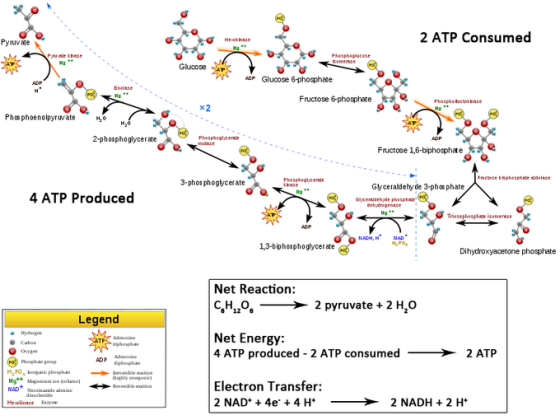
Add Answer to:
Go to the page in the study guide that shows the entire
glycolysis pathway. If you...
Glycolysis activity 1: Metabolic pathway puzzle Try to complete the activity without using the textbook. 1....
 Glycolysis activity 1: Metabolic pathway puzzle Try to complete the activity without using the textbook. 1. Slides 4 and 5 show the 10 reactions for glycolysis, but some of the molecules are missing. Draw the missing molecules in the proper place (on the handout). The missing molecules are shown on the next slide, you have to use the clues on the handout and your organic chemistry knowledge to figure out where each molecule belongs. 3. In the red dotted boxes...
The Warburg effect refers to the seemingly paradoxical preference for glycolysis over oxidative phosphorylation in many...
The Warburg effect refers to the seemingly paradoxical preference for glycolysis over oxidative phosphorylation in many cancer tissues. After reading the incomplete statement shown below that reflects this paradox, fill in the blanks with appropriate numbers of ATP molecules and explain how you came up with the numbers by identifying glycolytic reactions that are key consuming or generating ATP. “Glycolysis consumes __ ATP (per one glucose molecule) early in the pathway, produces __ ATP later, and the net of ___...
Please help fill in the blanks ! The end product of glycolysis is ____________________ . For...
Please help fill in the blanks ! The end product of glycolysis is ____________________ . For every molecule of glucose, (how many?) _________ molecules of (A) is/are produced. For every molecule of glucose, (how many?) _________ molecules of ATP is/are produced (total, by substrate level phosphorylation)? (A) then enters an organelle known as a ____________________ . Once inside (B), (A) is converted into ___________________ which is a molecule composed of (how many?) _________ carbon atoms. (C) can then enter the ___________________ Cycle...
6. Below is a reaction pathway. Place an asterisk (*) by steps that may be the...
 6. Below is a reaction pathway. Place an asterisk (*) by steps that may be the best control points: F GHI A →B D 7. Phosphorylated serine can enter glycolysis/ gluconeogenesis as 3-phosphoglycerate. a) How many net ATP are made or consumed for each 3-phosphoglycerate that enters glycolysis? A total of are (choose one: made consumed) b) How many net ATP are made or consumed when TWO 3-phosphoglycerates are used to make ONE glucose molecule via gluconeogenesis? A total of...
12/25 answered Click on glycolysis if would like to review it in details. Glucose Preparatory phase...
 12/25 answered Click on glycolysis if would like to review it in details. Glucose Preparatory phase first ATP Phosphorylation of glucos and its conversion to glyceraldehyde 3-phosphat Priming © > ADP Glucose 6-phosphate 1-0 Hz Hexokinase ΝΟΗ Η e Phosphohexose isomerase Fructose 6-phosphate ATP (8 Phospho- fructokinase-1 primins и он -OCH, CH-OH HOH он и ©--CH, CH-0- Кинон Aldolase ADP Fructose 1,6-bisphosphate (6) Triose phosphate somerase eleava oferte suar phosphate to two carbon sur phosphate Glyceraldehyde 3-phosphate udehyde a phosphate...
please help me answer questions 27 to 30. thank you 27) Glycolysis converts A) polysaccharides to...
 please help me answer questions 27 to 30. thank
you
27) Glycolysis converts A) polysaccharides to glucose B) glucose to pyruvate, which is the metabolized to acetyl Co C) fatty acids to thioesters, which are the metabolized to acetyl COA D) amino acids to ren 20) How much ATP results from the transformation of one glucose molecule to two (2) molecules of acetyl COA? Al 2 ATP molecules B) SATP molecules C) 12 ATP molecules D) 20 ATP molecules 29)...
please help me answer questions 27 to 30. thank
you
27) Glycolysis converts A) polysaccharides to glucose B) glucose to pyruvate, which is the metabolized to acetyl Co C) fatty acids to thioesters, which are the metabolized to acetyl COA D) amino acids to ren 20) How much ATP results from the transformation of one glucose molecule to two (2) molecules of acetyl COA? Al 2 ATP molecules B) SATP molecules C) 12 ATP molecules D) 20 ATP molecules 29)...
5. Glycolysis a. The hydroxyl group on the sixth carbon on a glucose molecule is radiolabeled...
 5. Glycolysis a. The hydroxyl group on the sixth carbon on a glucose molecule is radiolabeled using O. Please draw out the pathway showing where this radiolabel is in each step of the pathway, b. In glycolysis, ATP molecules are produced. Please write out the reactions that utilize ATP as well as the ones that create ATP, and explain how many molecules of ATP are made in glycolysis. c. A reaction is set up with 3-phosphoglycerate, where the phosphate atom...
a. The metabolism of glucose by glycolysis to acetyl-coenzyme A, followed by the TCA cycle, releases...
a. The metabolism of glucose by glycolysis to acetyl-coenzyme A, followed by the TCA cycle, releases CO2 molecules by oxidative decarboxylation reactions. Write down the oxidative decarboxylation reactions that result in CO2 production. Name the enzyme involved in each reaction and give the names and complete structures of all reactants and products. Only abbreviated names of enzyme cofactors are required. (b) From the steps drawn in part (a) above, how many total ATP molecules would be produced from oxidative phosphorylation?
Do expect the cell to produce more ATP from one glucose molecule or from one fatty...
 Do expect the cell to produce more ATP from one glucose molecule or from one fatty acid molecule? Explain your answer. Indicate whether the following statements are true or false. If a statement is false, explain why it is false The proteins of the electron-transport chain remove a pair of high-energy electrons from the cofactors, NADH and FADH_2, after which the electrons move across the inner mitochondrial membrane to maintain the voltage gradient. Gluconeogenesis is a linear reaction pathway that...
4. For each of the following sentences, fill in the blanks with the best word or...
 4. For each of the following sentences, fill in the blanks with the best word or phrase selected from the list below. Not all words or phrases will be used; each word or phrase can be used more than once. (2 point each; 34 points total) ADP lysosome oxidation phosphorylation NAD pyruvate plasma membrane oxidative phosphorylation acetyl CoA cytosol carbon dioxide nucleus NADH sucrose ubiquitination GTP electrons FADH2 reduction B-sheets matrix ATP FAD kinase vacuole H* mitochondria NADH inner membrane...
 Glycolysis activity 1: Metabolic pathway puzzle Try to complete the activity without using the textbook. 1. Slides 4 and 5 show the 10 reactions for glycolysis, but some of the molecules are missing. Draw the missing molecules in the proper place (on the handout). The missing molecules are shown on the next slide, you have to use the clues on the handout and your organic chemistry knowledge to figure out where each molecule belongs. 3. In the red dotted boxes...
 6. Below is a reaction pathway. Place an asterisk (*) by steps that may be the best control points: F GHI A →B D 7. Phosphorylated serine can enter glycolysis/ gluconeogenesis as 3-phosphoglycerate. a) How many net ATP are made or consumed for each 3-phosphoglycerate that enters glycolysis? A total of are (choose one: made consumed) b) How many net ATP are made or consumed when TWO 3-phosphoglycerates are used to make ONE glucose molecule via gluconeogenesis? A total of...
 12/25 answered Click on glycolysis if would like to review it in details. Glucose Preparatory phase first ATP Phosphorylation of glucos and its conversion to glyceraldehyde 3-phosphat Priming © > ADP Glucose 6-phosphate 1-0 Hz Hexokinase ΝΟΗ Η e Phosphohexose isomerase Fructose 6-phosphate ATP (8 Phospho- fructokinase-1 primins и он -OCH, CH-OH HOH он и ©--CH, CH-0- Кинон Aldolase ADP Fructose 1,6-bisphosphate (6) Triose phosphate somerase eleava oferte suar phosphate to two carbon sur phosphate Glyceraldehyde 3-phosphate udehyde a phosphate...
 please help me answer questions 27 to 30. thank
you
27) Glycolysis converts A) polysaccharides to glucose B) glucose to pyruvate, which is the metabolized to acetyl Co C) fatty acids to thioesters, which are the metabolized to acetyl COA D) amino acids to ren 20) How much ATP results from the transformation of one glucose molecule to two (2) molecules of acetyl COA? Al 2 ATP molecules B) SATP molecules C) 12 ATP molecules D) 20 ATP molecules 29)...
please help me answer questions 27 to 30. thank
you
27) Glycolysis converts A) polysaccharides to glucose B) glucose to pyruvate, which is the metabolized to acetyl Co C) fatty acids to thioesters, which are the metabolized to acetyl COA D) amino acids to ren 20) How much ATP results from the transformation of one glucose molecule to two (2) molecules of acetyl COA? Al 2 ATP molecules B) SATP molecules C) 12 ATP molecules D) 20 ATP molecules 29)...
 5. Glycolysis a. The hydroxyl group on the sixth carbon on a glucose molecule is radiolabeled using O. Please draw out the pathway showing where this radiolabel is in each step of the pathway, b. In glycolysis, ATP molecules are produced. Please write out the reactions that utilize ATP as well as the ones that create ATP, and explain how many molecules of ATP are made in glycolysis. c. A reaction is set up with 3-phosphoglycerate, where the phosphate atom...
 Do expect the cell to produce more ATP from one glucose molecule or from one fatty acid molecule? Explain your answer. Indicate whether the following statements are true or false. If a statement is false, explain why it is false The proteins of the electron-transport chain remove a pair of high-energy electrons from the cofactors, NADH and FADH_2, after which the electrons move across the inner mitochondrial membrane to maintain the voltage gradient. Gluconeogenesis is a linear reaction pathway that...
 4. For each of the following sentences, fill in the blanks with the best word or phrase selected from the list below. Not all words or phrases will be used; each word or phrase can be used more than once. (2 point each; 34 points total) ADP lysosome oxidation phosphorylation NAD pyruvate plasma membrane oxidative phosphorylation acetyl CoA cytosol carbon dioxide nucleus NADH sucrose ubiquitination GTP electrons FADH2 reduction B-sheets matrix ATP FAD kinase vacuole H* mitochondria NADH inner membrane...
Most questions answered within 3 hours.
-
Where is the error in this code sequence?
String s1 = "Hello";
String s2 = "ello";...
asked 10 months ago -
Financial data for Joel de Paris, Inc., for last year
follow:
Joel de Paris, Inc.
Balance...
asked 10 months ago -
Consider this reaction:
Al2(SO4)3 (aq)+ BaCl3
(aq) Al2Cl6 (aq)- +
3BaSO4(s) . What is the...
asked 10 months ago -
Suppose that Savneet is considering increasing her
recent random sample from 20 car rentals to 40...
asked 10 months ago -
Trucks arrive at an unloading terminal at an average rate of 120
per hour.
Trucks arrive...
asked 10 months ago -
Why are methanol and ethanol completely soluble in water while
octanol is not very little soluble....
asked 10 months ago -
A facilities manager at a university reads in a research report
that the mean amount of...
asked 10 months ago -
When the CuSO4 is rehydrated by adding water to the anhydrous
compound, is this an endothermic...
asked 10 months ago -
A ray of sunlight is passing from diamond into crown glass; the
angle of incidence is...
asked 10 months ago -
A block of mass 0.249 kg is placed on top of a light, vertical
spring of...
asked 10 months ago -
how do the kidneys compensate in the presences of acidosis
a) trigger hyperventilate
b) reserve acid...
asked 10 months ago -
Question 501 pts
The rental rate of capital to the firm increases. Which of the
following...
asked 10 months ago