Defects of Plasma Clotting Factors If you could please answer the following to help me with...
Defects of Plasma Clotting Factors
If you could please answer the following to help me with my review
1. The APTT is sensitive to a deficiency of which clotting factor?
2. Which clotting factor is associated with a prolonged PT and APTT?
3. Describe the role of vitamin K with regard to maintaining hemostasis.
4. What laboratory test are performed when diagnosing hemophilia patients?
5. What are the three levels of clotting factor activity in hemophilia?
Homework Answers
Bleeding disorders are characterized by defects in hemostasis
that lead to an increased susceptibility to bleeding. They are
caused either by platelet disorders (primary hemostasis defect),
coagulation defects (secondary hemostasis defect), or, in some
cases, a combination of both. Coagulation defects may be general or
further divided into either intrinsic or extrinsic defects
according to the specific pathway of the coagulation cascade that
is affected. Bleeding disorders may be inherited or acquired.
Although clinical features of inherited and acquired disorders may
overlap, mucocutaneous bleeding (e.g., epistaxis, petechiae,
gastrointestinal bleeding) is associated more with platelet
disorders, while bleeding into potential spaces (e.g.,
hemarthrosis, muscular bleeding) is more characteristic of
coagulation defects. A basic understanding of hemostasis is
necessary for properly interpreting laboratory studies in order to
accurately diagnose the disorder and ensure appropriate treatment.
Coagulation factors may be measured by methods assessing both their
presence as antigens and their ability to function as an activity.
Inherited coagulation factor deficiencies may be of two types. Type
I defects (quantitative) have decreased absolute amounts of the
factor, resulting in both decreased activity and antigen levels.
Type I defects result from a lack of production or increased
clearance of the gene product. Type II defects (qualitative) have a
defective gene product, resulting in decreased activity but normal
or slightly decreased levels of antigen. Type II defects result
from a mutation in the gene or altered post-translational
modification. Acquired defects may mimic either type by decreased
or faulty production, increased clearance or inactivation, or the
presence of a circulating inhibitor, usually an antibody, which
reacts with the factor to mask its activity or remove it from the
circulation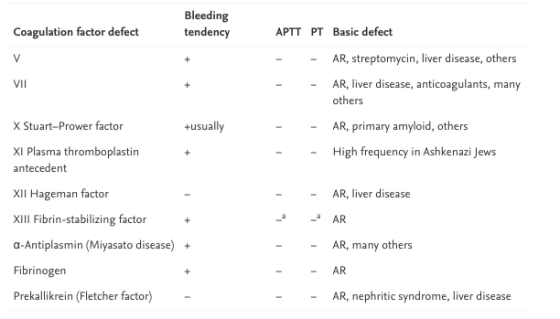
Clotting factors (II, VII, IX, and X) are dependent on vitamin K which is a fat-soluble vitamin. Vitamin K deficiency, therefore, causes prolongation of the prothrombin time (PT) and activated partial thromboplastin time (aPTT) and will respond to intravenous vitamin K. It should be noted that the PT and aPTT are not good predictors of the bleeding risk of a patient, as some clotting disorders associated with thrombosis (e.g. antiphospholipid antibodies) will cause a prolongation of the aPTT.
Activated partial thromboplastin time (PTT) is a routine coagulation screening test that is sensitive to declines of activities of factors II, V, VIII, IX, XI, XII
Vitamin K helps to regulate the process of blood coagulation by assisting in the conversion certain coagulation factors into their mature forms. Without vitamin K, our bodies would be unable to control clot formation.
Now, to understand the regulation of clot formation, briefly about hemostasis--hemo referring to blood, and stasis meaning to halt or stop.
Hemostasis is divided into two phases: primary and secondary hemostasis.
Primary hemostasis involves the formation of a platelet plug around the site of an injured blood vessel, and secondary hemostasis reinforces the platelet plug with the creation of a protein mesh called fibrin. To get to fibrin, a set of coagulation factors, each of which is enzymes, needs to be activated. These enzymes are activated via a process called proteolysis- which is where a portion of the protein is clipped off. In total, there are twelve coagulation factors numbered factors I-XIII, there’s no factor VI. Most of these factors are produced by liver cells, and it turns out that producing coagulation factors II, VII, IX, and X requires an enzyme that uses vitamin K.
Hemophilia screening tests
Blood tests that are used to determine if the blood is clotting properly are called screening tests. Types of screening tests are complete blood count (CBC), activated partial thromboplastin time (APTT) test, prothrombin time (PT) test, and fibrinogen test.
Complete blood count (CBC)
This test measures the amount of hemoglobin (the red pigment that carries oxygen within the red blood cells), the size and number of red blood cells (RBCs), and the number of white blood cells and platelets in the blood. CBC results are normal in people with hemophilia, but there is a decrease in hemoglobin and RBCs in the case of heavy or prolonged bleeding.
Activated partial thromboplastin time (APTT) test
This test measures the delay in blood clot formation and the clotting ability of factors VIII, IX, XI and XII. If any of the clotting factors are too low, it takes longer for the blood to clot. Patients with hemophilia A or hemophilia B show a longer clotting time in this test.
Prothrombin time (PT) test
This test also measures the time it takes for the blood clot to form. It measures the clotting ability of factors I, II, V, VII, and X. If any of these factors are too low, it takes longer than normal for the blood to clot. The results of this test will be normal for patients with hemophilia A or hemophilia B since these conditions are caused by defects in factors VIII and IX, respectively.
Fibrinogen test
Fibrinogen (also known as clotting factor I) test assesses the patient’s ability to form a blood clot. This test is performed along with other blood clotting tests or when a patient has an abnormal PT or APTT test result.
Clotting factor tests
Clotting factor tests, also called factor assays, are needed to diagnose a bleeding disorder. This blood test is used to identify the type and severity of hemophilia, which is important to create the best treatment plan.
Depending on the levels of clotting factors VIII or IX, hemophilia A and B are classified as mild, moderate or severe. The level of clotting factor is between 50 and 100 percent in healthy people, but it is between 5 and 50 percent in people with mild hemophilia, between 1 and 5 percent in people with moderate hemophilia, and at less than 1 percent in people with severe hemophilia.
The severity of symptoms may sometimes overlap between the categories. For example, patients with mild hemophilia may have bleeding problems similar to those with moderate hemophilia.
Depending on the severity level, hemophilia is classified as mild, moderate or severe.
Mild hemophilia
The clotting factor level in the blood of a patient with mild hemophilia is between 5% and 40% (0.05-0.40 IU/ml). In these cases, bleeding typically occurs only after a trauma, such as surgery or major injury. Otherwise, patients either bleed rarely or may never have a bleeding problem. About 25% of people with hemophilia have the mild form of the disease.
Moderate hemophilia
Patients with moderate hemophilia have between 1% and 5% (0.01-0.05 IU/ml) of clotting factor activity in their blood. They bleed infrequently (perhaps once a month). Prolonged bleeding tends to occur following trauma such as minor surgery or injury, and dental treatment, for example. Spontaneous bleeding episodes, although rare, may occur in patients with this type of hemophilia. About 15% of people with hemophilia have the moderate form of the disease.
Severe hemophilia
Patients with severe hemophilia have less than 1% (0.01 IU/ml) clotting factor activity in their blood. They bleed frequently (sometimes once or twice a week). Bleeding may occur spontaneously into their muscles and joints. Prolonged bleeding occurs following trauma, injury, or surgery, but also may occur spontaneously for no obvious reason.
Variations within severity levels of hemophilia
Regardless of the severity level, the frequency and type of bleeds may vary from one patient to the other. For instance, 10% to 15% of patients with severe hemophilia A have less frequent spontaneous bleeding episodes. This variation in bleeding symptoms within the same severity level may arise due to various reasons, such as the type of mutation within the blood clotting factor genes, mutations in other clotting factor genes, inaccurate clotting factor measurement relative to overall clot formation, variations in the immune system, and environmental factors such as physical activity.
Add Answer to:
Defects of Plasma Clotting Factors
If you could please answer the following to help me with...
this is a review ungraded assignment please help me to understand the answers Megaloblastic Anemias due...
 this is a review ungraded assignment please help me to
understand the answers
Megaloblastic Anemias due to cobalamin deficiency are most often caused by: Select one: a. Decreased dietary intake of Vitamin B12 o b. Drug inhibition O c. Lack of intrinsic factor O d. Increased requirements O CIFAR MV CHOICE Match the following globin chain pairings to the appropriate hemoglobin type: a2B2 Choose... 4282 Choose... d2Y2 Choose... < PREVIOUS NEXT Σ. Choose... Hemoglobin A Hemoglobin F Hemoglobin A2 Match...
this is a review ungraded assignment please help me to
understand the answers
Megaloblastic Anemias due to cobalamin deficiency are most often caused by: Select one: a. Decreased dietary intake of Vitamin B12 o b. Drug inhibition O c. Lack of intrinsic factor O d. Increased requirements O CIFAR MV CHOICE Match the following globin chain pairings to the appropriate hemoglobin type: a2B2 Choose... 4282 Choose... d2Y2 Choose... < PREVIOUS NEXT Σ. Choose... Hemoglobin A Hemoglobin F Hemoglobin A2 Match...
Please help Look through the questions, answer and research. You will provide a word doc that...
Please help Look through the questions, answer and research. You will provide a word doc that wil lprovide what you believe is the correct answer. Along with your answer you will give a rationale that is cited with a reference. The rationale you submit is your interpretation of what you think and believe supports your chosen answer. Yoost: Fundamentals of Nursing Chapter 01: Nursing, Theory, and Professional Practice Review Questions 1. In comparing the American Nurses Association (ANA) and International...
can you please help me understand this passage and what they did in there experiment please...
 can you please help me understand this passage and
what they did in there experiment please ...I need I short
explanation
doi.org/10.1016/j.jmoldx.2019.01.C. Irritable bowel syndrome (IBS) is a functional gastrointestinal (GI) tract disorder affecting up to 20% of the world's popu- lation. IBS symptoms include bloating, altered bowel habits, and abdominal pain, with pain being the most debili- tating. The etiologies of IBS are multifactorial,8 and increasing evidence supports the involvement of gut microbes in IBS onset and symptoms. (HCs),...
can you please help me understand this passage and
what they did in there experiment please ...I need I short
explanation
doi.org/10.1016/j.jmoldx.2019.01.C. Irritable bowel syndrome (IBS) is a functional gastrointestinal (GI) tract disorder affecting up to 20% of the world's popu- lation. IBS symptoms include bloating, altered bowel habits, and abdominal pain, with pain being the most debili- tating. The etiologies of IBS are multifactorial,8 and increasing evidence supports the involvement of gut microbes in IBS onset and symptoms. (HCs),...
biochemistry if you could please help me answer the following questions! * 1. (5 pts) Which...
 biochemistry
if you could please help me answer the following questions!
* 1. (5 pts) Which of the following is a catalytic mechanism utilize by enzymes? Multiple answers may be correct. Select all that are correct. 1. Acid-base a) acid-base catalysis d. metal-ion catalysis 12. Covalent b covalent catalysis e. transition state binding c. heterogeneou 3. Metalion . Proximin onentation, E 2. 76 pts) What is the "steady-state" assumption in the derivation of the s.clectrosch? Tynsin Michaelis-Menten equation? Sie binding...
biochemistry
if you could please help me answer the following questions!
* 1. (5 pts) Which of the following is a catalytic mechanism utilize by enzymes? Multiple answers may be correct. Select all that are correct. 1. Acid-base a) acid-base catalysis d. metal-ion catalysis 12. Covalent b covalent catalysis e. transition state binding c. heterogeneou 3. Metalion . Proximin onentation, E 2. 76 pts) What is the "steady-state" assumption in the derivation of the s.clectrosch? Tynsin Michaelis-Menten equation? Sie binding...
biochemistry if you could please help me answer the following questions! 741) (5 pts) Transition state theory relate...
 biochemistry
if you could please help me answer the following questions!
741) (5 pts) Transition state theory relates the rate constant to the free energy of activation, AG. How can enzymes reduce the activation energy barrier? a) decrease the free energy of the product b) high affinity binding to the transition state c) increase the free energy of the substrate d) increase entropy upon release of product e) bind to the substrate with high affinity 2) (5 pts) Which is...
biochemistry
if you could please help me answer the following questions!
741) (5 pts) Transition state theory relates the rate constant to the free energy of activation, AG. How can enzymes reduce the activation energy barrier? a) decrease the free energy of the product b) high affinity binding to the transition state c) increase the free energy of the substrate d) increase entropy upon release of product e) bind to the substrate with high affinity 2) (5 pts) Which is...
Hi, please help me with my homework and please do not answer if you intend to...
 Hi, please help me with my homework and please do not answer
if you intend to answers all the questions. Thank you
The Central Nervous System, endocrine system B. Figure 1 Use the diagram above to answer the following question 1) Which letter indicates the primary visual cortex, which receives information from neurons in the retina of the eye? A) A B) B C) C D) D E) E Figure 2 Use the diagram above to answer the following questions....
Hi, please help me with my homework and please do not answer
if you intend to answers all the questions. Thank you
The Central Nervous System, endocrine system B. Figure 1 Use the diagram above to answer the following question 1) Which letter indicates the primary visual cortex, which receives information from neurons in the retina of the eye? A) A B) B C) C D) D E) E Figure 2 Use the diagram above to answer the following questions....
23. A client is being administered heparin IV and has been started on warfarin. The client...
 23. A client is being administered heparin IV and has been started on warfarin. The client asks the nurse why she is taking both medications. What is the nurse's most accurate response? a. "After a certain period of time, you must start warfarin and heparin together. days." effects, and you still need heparin. amount of clotting you need." b. "You will need both warfarin and heparin for several c."Warfarin takes 3 to 5 days to develop anticoagulant d."Warfarin cannot be...
All of the following questions are in relation to the following journal article which is available...
 All of the following questions are in relation to the following journal article which is available on Moodle: Parr CL, Magnus MC, Karlstad O, Holvik K, Lund-Blix NA, Jaugen M, et al. Vitamin A and D intake in pregnancy, infant supplementation and asthma development: the Norwegian Mother and Child Cohort. Am J Clin Nutr 2018:107:789-798 QUESTIONS: 1. State one hypothesis the author's proposed in the manuscript. 2. There is previous research that shows that adequate Vitamin A intake is required...
Case Study, Chapter 64, Introduction to the Integumentary System Alice Bixby, an 83-year-old female client js...
 Case Study, Chapter 64, Introduction to the Integumentary System Alice Bixby, an 83-year-old female client js admifted with a cerebral vascular accident with the aphasia and hemiparesis (paralysis of the right side of the body). The client has global a has difficulty speaking or understanding what is said. The client is incontinent of urine and stool and wears adult incontinent briefs. The client has a thickened diet to nectar consistency because of dysphagia (difficulty swallowing). The client has been turned...
Need answers. thank you VOCABULARY BUILDER Misspelled Words Find the words below that are misspelled; circle...
 Need answers. thank you
VOCABULARY BUILDER Misspelled Words Find the words below that are misspelled; circle them, and then correctly spell them in the spaces provided. Then fill in the blanks below with the correct vocabulary terms from the following list. amino acids digestion clectrolytes nutrients antioxident nutrition basal metabolic rate extracellulare oxydation calories fat-soluble presearvatives catalist glycogen processed foods cellulose homeostasis saturated fats major mineral coenzyeme trace minerals diaretics metabolism water-soluable 1. Artificial flavors, colors, and commonly added to...
Need answers. thank you
VOCABULARY BUILDER Misspelled Words Find the words below that are misspelled; circle them, and then correctly spell them in the spaces provided. Then fill in the blanks below with the correct vocabulary terms from the following list. amino acids digestion clectrolytes nutrients antioxident nutrition basal metabolic rate extracellulare oxydation calories fat-soluble presearvatives catalist glycogen processed foods cellulose homeostasis saturated fats major mineral coenzyeme trace minerals diaretics metabolism water-soluable 1. Artificial flavors, colors, and commonly added to...
 this is a review ungraded assignment please help me to
understand the answers
Megaloblastic Anemias due to cobalamin deficiency are most often caused by: Select one: a. Decreased dietary intake of Vitamin B12 o b. Drug inhibition O c. Lack of intrinsic factor O d. Increased requirements O CIFAR MV CHOICE Match the following globin chain pairings to the appropriate hemoglobin type: a2B2 Choose... 4282 Choose... d2Y2 Choose... < PREVIOUS NEXT Σ. Choose... Hemoglobin A Hemoglobin F Hemoglobin A2 Match...
this is a review ungraded assignment please help me to
understand the answers
Megaloblastic Anemias due to cobalamin deficiency are most often caused by: Select one: a. Decreased dietary intake of Vitamin B12 o b. Drug inhibition O c. Lack of intrinsic factor O d. Increased requirements O CIFAR MV CHOICE Match the following globin chain pairings to the appropriate hemoglobin type: a2B2 Choose... 4282 Choose... d2Y2 Choose... < PREVIOUS NEXT Σ. Choose... Hemoglobin A Hemoglobin F Hemoglobin A2 Match...
 can you please help me understand this passage and
what they did in there experiment please ...I need I short
explanation
doi.org/10.1016/j.jmoldx.2019.01.C. Irritable bowel syndrome (IBS) is a functional gastrointestinal (GI) tract disorder affecting up to 20% of the world's popu- lation. IBS symptoms include bloating, altered bowel habits, and abdominal pain, with pain being the most debili- tating. The etiologies of IBS are multifactorial,8 and increasing evidence supports the involvement of gut microbes in IBS onset and symptoms. (HCs),...
can you please help me understand this passage and
what they did in there experiment please ...I need I short
explanation
doi.org/10.1016/j.jmoldx.2019.01.C. Irritable bowel syndrome (IBS) is a functional gastrointestinal (GI) tract disorder affecting up to 20% of the world's popu- lation. IBS symptoms include bloating, altered bowel habits, and abdominal pain, with pain being the most debili- tating. The etiologies of IBS are multifactorial,8 and increasing evidence supports the involvement of gut microbes in IBS onset and symptoms. (HCs),...
 biochemistry
if you could please help me answer the following questions!
* 1. (5 pts) Which of the following is a catalytic mechanism utilize by enzymes? Multiple answers may be correct. Select all that are correct. 1. Acid-base a) acid-base catalysis d. metal-ion catalysis 12. Covalent b covalent catalysis e. transition state binding c. heterogeneou 3. Metalion . Proximin onentation, E 2. 76 pts) What is the "steady-state" assumption in the derivation of the s.clectrosch? Tynsin Michaelis-Menten equation? Sie binding...
biochemistry
if you could please help me answer the following questions!
* 1. (5 pts) Which of the following is a catalytic mechanism utilize by enzymes? Multiple answers may be correct. Select all that are correct. 1. Acid-base a) acid-base catalysis d. metal-ion catalysis 12. Covalent b covalent catalysis e. transition state binding c. heterogeneou 3. Metalion . Proximin onentation, E 2. 76 pts) What is the "steady-state" assumption in the derivation of the s.clectrosch? Tynsin Michaelis-Menten equation? Sie binding...
 biochemistry
if you could please help me answer the following questions!
741) (5 pts) Transition state theory relates the rate constant to the free energy of activation, AG. How can enzymes reduce the activation energy barrier? a) decrease the free energy of the product b) high affinity binding to the transition state c) increase the free energy of the substrate d) increase entropy upon release of product e) bind to the substrate with high affinity 2) (5 pts) Which is...
biochemistry
if you could please help me answer the following questions!
741) (5 pts) Transition state theory relates the rate constant to the free energy of activation, AG. How can enzymes reduce the activation energy barrier? a) decrease the free energy of the product b) high affinity binding to the transition state c) increase the free energy of the substrate d) increase entropy upon release of product e) bind to the substrate with high affinity 2) (5 pts) Which is...
 Hi, please help me with my homework and please do not answer
if you intend to answers all the questions. Thank you
The Central Nervous System, endocrine system B. Figure 1 Use the diagram above to answer the following question 1) Which letter indicates the primary visual cortex, which receives information from neurons in the retina of the eye? A) A B) B C) C D) D E) E Figure 2 Use the diagram above to answer the following questions....
Hi, please help me with my homework and please do not answer
if you intend to answers all the questions. Thank you
The Central Nervous System, endocrine system B. Figure 1 Use the diagram above to answer the following question 1) Which letter indicates the primary visual cortex, which receives information from neurons in the retina of the eye? A) A B) B C) C D) D E) E Figure 2 Use the diagram above to answer the following questions....
 23. A client is being administered heparin IV and has been started on warfarin. The client asks the nurse why she is taking both medications. What is the nurse's most accurate response? a. "After a certain period of time, you must start warfarin and heparin together. days." effects, and you still need heparin. amount of clotting you need." b. "You will need both warfarin and heparin for several c."Warfarin takes 3 to 5 days to develop anticoagulant d."Warfarin cannot be...
 All of the following questions are in relation to the following journal article which is available on Moodle: Parr CL, Magnus MC, Karlstad O, Holvik K, Lund-Blix NA, Jaugen M, et al. Vitamin A and D intake in pregnancy, infant supplementation and asthma development: the Norwegian Mother and Child Cohort. Am J Clin Nutr 2018:107:789-798 QUESTIONS: 1. State one hypothesis the author's proposed in the manuscript. 2. There is previous research that shows that adequate Vitamin A intake is required...
 Case Study, Chapter 64, Introduction to the Integumentary System Alice Bixby, an 83-year-old female client js admifted with a cerebral vascular accident with the aphasia and hemiparesis (paralysis of the right side of the body). The client has global a has difficulty speaking or understanding what is said. The client is incontinent of urine and stool and wears adult incontinent briefs. The client has a thickened diet to nectar consistency because of dysphagia (difficulty swallowing). The client has been turned...
 Need answers. thank you
VOCABULARY BUILDER Misspelled Words Find the words below that are misspelled; circle them, and then correctly spell them in the spaces provided. Then fill in the blanks below with the correct vocabulary terms from the following list. amino acids digestion clectrolytes nutrients antioxident nutrition basal metabolic rate extracellulare oxydation calories fat-soluble presearvatives catalist glycogen processed foods cellulose homeostasis saturated fats major mineral coenzyeme trace minerals diaretics metabolism water-soluable 1. Artificial flavors, colors, and commonly added to...
Need answers. thank you
VOCABULARY BUILDER Misspelled Words Find the words below that are misspelled; circle them, and then correctly spell them in the spaces provided. Then fill in the blanks below with the correct vocabulary terms from the following list. amino acids digestion clectrolytes nutrients antioxident nutrition basal metabolic rate extracellulare oxydation calories fat-soluble presearvatives catalist glycogen processed foods cellulose homeostasis saturated fats major mineral coenzyeme trace minerals diaretics metabolism water-soluable 1. Artificial flavors, colors, and commonly added to...
Most questions answered within 3 hours.
-
Where is the error in this code sequence?
String s1 = "Hello";
String s2 = "ello";...
asked 11 months ago -
Financial data for Joel de Paris, Inc., for last year
follow:
Joel de Paris, Inc.
Balance...
asked 11 months ago -
Consider this reaction:
Al2(SO4)3 (aq)+ BaCl3
(aq) Al2Cl6 (aq)- +
3BaSO4(s) . What is the...
asked 11 months ago -
Suppose that Savneet is considering increasing her
recent random sample from 20 car rentals to 40...
asked 11 months ago -
Trucks arrive at an unloading terminal at an average rate of 120
per hour.
Trucks arrive...
asked 11 months ago -
Why are methanol and ethanol completely soluble in water while
octanol is not very little soluble....
asked 11 months ago -
A facilities manager at a university reads in a research report
that the mean amount of...
asked 11 months ago -
When the CuSO4 is rehydrated by adding water to the anhydrous
compound, is this an endothermic...
asked 11 months ago -
A ray of sunlight is passing from diamond into crown glass; the
angle of incidence is...
asked 11 months ago -
A block of mass 0.249 kg is placed on top of a light, vertical
spring of...
asked 11 months ago -
how do the kidneys compensate in the presences of acidosis
a) trigger hyperventilate
b) reserve acid...
asked 11 months ago -
Question 501 pts
The rental rate of capital to the firm increases. Which of the
following...
asked 11 months ago