Which of the following diseases of the kidney is usually associated with ascending movement of infection...
Which of the following diseases of the kidney is usually associated with ascending movement of infection from the urinary tract resulting in infection of the kidney parenchyma and renal pelvis, and is often associated with flank pain, fever and urinary frequency?
Select one:
a. Renal calculi
b. Pyelonephritis
c. Glomerulonephritis
d. Cystitis
e. Urethritis
Homework Answers
b) Pyelonephritis
Pyelonephritis is a bacterial infection causing inflammation of the kidneys. Pyelonephritis occurs with the ascending urinary tract infection, which spreads from bladder to the kidneys and other parts. The two most common symptoms are flank pain and fever. Other symptoms include nausea, vomiting, increased frequency and urgency, burning sensation etc. Acute inflammatory response causes scarring of renal parenchyma.
Add Answer to:
Which of the following diseases of the kidney is usually
associated with ascending movement of infection...
Which of the following urinary tract infection signs likely indicate the presence of infection in the...
 Which of the following urinary tract infection signs likely indicate the presence of infection in the kidney? Selected Answer: white blood cells in the urine (leukocyturia) fever with microscopic finding of red blood cells in the urine polyuria and polydipsia flank pain, fever and hematuria white blood cells i the urine (leukogyturia) Answers:
is a hormone disorder associated with decreased neuroexcitability, muscle weakness, fatigue, hypertension, renal insufficiency and calculi....
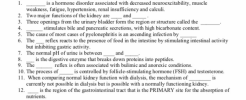 is a hormone disorder associated with decreased neuroexcitability, muscle weakness, fatigue, hypertension, renal insufficiency and calculi. 2. Two major functions of the kidney are and 3. Thre e openings from the urinary bladder form the region or structure called the stimulates bile and pancreatic secretions, with high bicarbonate content. 5. The cause of most cases of pyelonephritis is an ascending infection by 6. The reflex reacts to the presence of food in the intestine by stimulating intestinal activity but inhibiting...
Urinary System Diseases and Disorders 395 VIEW QUESTIONS Warching following by placing the correct letter in...
 Urinary System Diseases and Disorders 395 VIEW QUESTIONS Warching following by placing the correct letter in the Multiple Choice Place a checkmark next to the correct answer. 1. What is the main function of the kidneys? 2. They regulate body fluids, blood pressure. and filter wastes. les the following by Nocturia 2. APSGN 3. Ascites 4 Uremia 5. Micturition 6. Pruritus 7. Pyuria 8. Oliguria 9. Hematuria a. Acute poststreptococcal glomerulonephritis b. Accumulation of serous fluid in abdominal cavity c....
Which of the following is NOT true regarding renal calculi (kidney stones)? Question 1 options: Take...
Which of the following is NOT true regarding renal calculi (kidney stones)? Question 1 options: Take vitamin D and calcium tablets to strengthen bones and kidneys Limit foods high in dietary oxalate such as spinach, cocoa, and peanuts to prevent calcium oxalate stones Lower pH of the urine to acidify the urine and reduce stone formation Provide and encourage adequate fluids to reduce risk of crystals forming Question 2 (1 point) Which of the following is true regarding Polycystic Kidney...
To increase thirst 48) Angiotensin II increases blood pressure by A) causing the hypothalamus B) ...
 to increase thirst 48) Angiotensin II increases blood pressure by A) causing the hypothalamus B) stimulating the adrenal cortex to secrete aldosterone C) stimulating the release of ADH D) all of these E) none of these which increases sodium absorption 49) When the kidney does not perform its filtration function, the person will develop A) septicemia B) bulimia C) uremia D) toxemia E) none of these 50) The major calyces feed into A) the minor calyces B) the pyramids C)...
Which of the following is true regarding Polycystic Kidney Disease (PKD)? Question 2 options: PKD is...
Which of the following is true regarding Polycystic Kidney Disease (PKD)? Question 2 options: PKD is the result of a direct injury to the tissues of the kidney by infection or a decrease in blood flow/perfusion Earliest clinical manifestations include renal calculi formation and back pain, urinary tract infection, and hypotension Fluid filled cysts form causing the surrounding normal renal tissue to compress, become damaged, and enlarge the kidney PKD individuals will need to take antibiotics for the rest of...
2019 PATH370 - causes of AKI - prerenal-injury locations, causes, signs/symptoms, GFR changes, effects of prolonged...
 2019 PATH370 - causes of AKI - prerenal-injury locations, causes, signs/symptoms, GFR changes, effects of prolonged injury - postrenal-injury locations, causes, GFR changes, effects of prolonged injury intrinsic/intrarenal-injury locations, causes, vascular and tubular process changes, effects of prolonged injury - acute tubular necrosis - differentiate prodromal, oliguric, and post-oliguric phases Chronic Kidney Disease - reversible or irreversible? why? - describe progressive process - acute vs chronic kidney disease comparison money disease comparison - risk factors - amount of damage kidneys...
Choose the correct answer • Indicate a rational for the answer IIII. A 26-year-old female presents to the emergency...
Choose the correct answer • Indicate a rational for the answer IIII. A 26-year-old female presents to the emergency department with complaints of fever, chills, and flank pain. After an initial assessment, she is admitted to the medical-surgical unit with a diagnosis of acute pyelonephritis. The patient reports she had a UTI the previous month. 20) When assessing this patient, what additional findings support this diagnosis? a) Weight gain, general malaise, and urinary urgency b) Costovertebral tenderness, vomiting, and painful...
O cystitis urinary bladder infection pyelonephritis leptospirosis trichomoniasis gonorrhea O nongonococcal urethritis syphilis Olymphogranuloma venereum chancroid...
 O cystitis urinary bladder infection pyelonephritis leptospirosis trichomoniasis gonorrhea O nongonococcal urethritis syphilis Olymphogranuloma venereum chancroid genital herpes genital warts O AIDS There is not enough information to select six or fewer diseases at this time. MEDICAL HISTORY (Hx) 1 Review Part B Given your current information, which of the following diseases do you think could be responsible for your patient's symptoms? Select no more than six answers. View Available Hint(s) Hint 1. Interpreting your patient's symptoms The patient is...
1. In the following list a positive result in which parameter requires a urine microscopic. pH...
1. In the following list a positive result in which parameter requires a urine microscopic. pH Blood Bilirubin Leukocyte esterase Nitrite Glucose Ketone ANSWER? Initial screening of the urine sediment is performed using an objective power of: A. 4X B. 10X C. 40X D. 100X Which of the following are reported as number per HPF? RBCs WBCs Crystals Casts A. None - all are reported on LPF B. 1,3, and 4 C. 1,2, and 3 D. All are reported on...
 Which of the following urinary tract infection signs likely indicate the presence of infection in the kidney? Selected Answer: white blood cells in the urine (leukocyturia) fever with microscopic finding of red blood cells in the urine polyuria and polydipsia flank pain, fever and hematuria white blood cells i the urine (leukogyturia) Answers:
 is a hormone disorder associated with decreased neuroexcitability, muscle weakness, fatigue, hypertension, renal insufficiency and calculi. 2. Two major functions of the kidney are and 3. Thre e openings from the urinary bladder form the region or structure called the stimulates bile and pancreatic secretions, with high bicarbonate content. 5. The cause of most cases of pyelonephritis is an ascending infection by 6. The reflex reacts to the presence of food in the intestine by stimulating intestinal activity but inhibiting...
 Urinary System Diseases and Disorders 395 VIEW QUESTIONS Warching following by placing the correct letter in the Multiple Choice Place a checkmark next to the correct answer. 1. What is the main function of the kidneys? 2. They regulate body fluids, blood pressure. and filter wastes. les the following by Nocturia 2. APSGN 3. Ascites 4 Uremia 5. Micturition 6. Pruritus 7. Pyuria 8. Oliguria 9. Hematuria a. Acute poststreptococcal glomerulonephritis b. Accumulation of serous fluid in abdominal cavity c....
 to increase thirst 48) Angiotensin II increases blood pressure by A) causing the hypothalamus B) stimulating the adrenal cortex to secrete aldosterone C) stimulating the release of ADH D) all of these E) none of these which increases sodium absorption 49) When the kidney does not perform its filtration function, the person will develop A) septicemia B) bulimia C) uremia D) toxemia E) none of these 50) The major calyces feed into A) the minor calyces B) the pyramids C)...
 2019 PATH370 - causes of AKI - prerenal-injury locations, causes, signs/symptoms, GFR changes, effects of prolonged injury - postrenal-injury locations, causes, GFR changes, effects of prolonged injury intrinsic/intrarenal-injury locations, causes, vascular and tubular process changes, effects of prolonged injury - acute tubular necrosis - differentiate prodromal, oliguric, and post-oliguric phases Chronic Kidney Disease - reversible or irreversible? why? - describe progressive process - acute vs chronic kidney disease comparison money disease comparison - risk factors - amount of damage kidneys...
 O cystitis urinary bladder infection pyelonephritis leptospirosis trichomoniasis gonorrhea O nongonococcal urethritis syphilis Olymphogranuloma venereum chancroid genital herpes genital warts O AIDS There is not enough information to select six or fewer diseases at this time. MEDICAL HISTORY (Hx) 1 Review Part B Given your current information, which of the following diseases do you think could be responsible for your patient's symptoms? Select no more than six answers. View Available Hint(s) Hint 1. Interpreting your patient's symptoms The patient is...
Most questions answered within 3 hours.
-
Where is the error in this code sequence?
String s1 = "Hello";
String s2 = "ello";...
asked 11 months ago -
Financial data for Joel de Paris, Inc., for last year
follow:
Joel de Paris, Inc.
Balance...
asked 11 months ago -
Consider this reaction:
Al2(SO4)3 (aq)+ BaCl3
(aq) Al2Cl6 (aq)- +
3BaSO4(s) . What is the...
asked 11 months ago -
Suppose that Savneet is considering increasing her
recent random sample from 20 car rentals to 40...
asked 11 months ago -
Trucks arrive at an unloading terminal at an average rate of 120
per hour.
Trucks arrive...
asked 11 months ago -
Why are methanol and ethanol completely soluble in water while
octanol is not very little soluble....
asked 11 months ago -
A facilities manager at a university reads in a research report
that the mean amount of...
asked 11 months ago -
When the CuSO4 is rehydrated by adding water to the anhydrous
compound, is this an endothermic...
asked 11 months ago -
A ray of sunlight is passing from diamond into crown glass; the
angle of incidence is...
asked 11 months ago -
A block of mass 0.249 kg is placed on top of a light, vertical
spring of...
asked 11 months ago -
how do the kidneys compensate in the presences of acidosis
a) trigger hyperventilate
b) reserve acid...
asked 11 months ago -
Question 501 pts
The rental rate of capital to the firm increases. Which of the
following...
asked 11 months ago