To write the percent concentration as a conversion factor and to use the percent concentration as...
To write the percent concentration as a conversion factor and to use the percent concentration as a conversion factor. The percent concentration of a solution can be written in several different ways, including the mass percent, the volume percent, and the mass/volume percent. The percent concentration of a solution can be used as a conversion factor to determine information such as the amount of solute or amount of solution. For example, a 4% (m/m) solution means that there are 4 g of solute in 100 g of solution. Therefore, a 4% solution (m/m) could be written as the following conversion factors: 4 g solute100 g solution and 100 g solution4 g solute
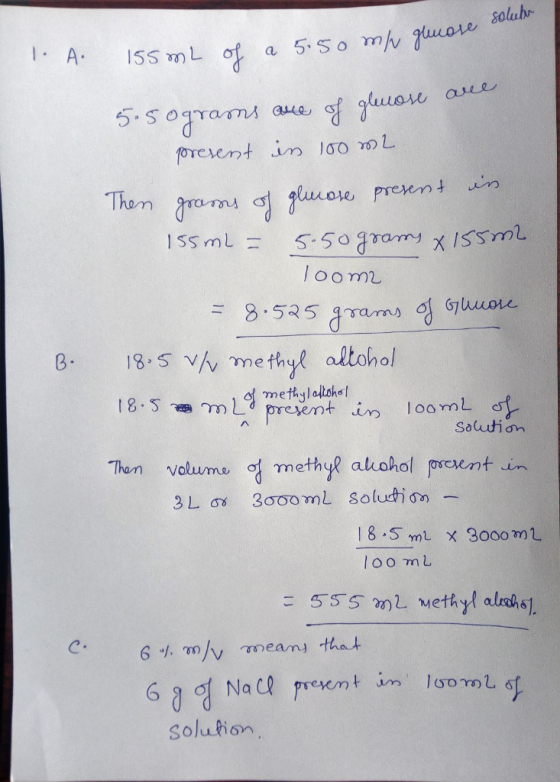
A.
How many grams (of mass m) of glucose are in 155 mL of a 5.50% (m/v) glucose solution?
Express your answer with the appropriate units.
B.
You have a solution that is 18.5% (v/v) methyl alcohol. If the bottle contains 3.00 L of solution, what is the volume (V) in milliliters of methyl alcohol?
Express your answer with the appropriate units.
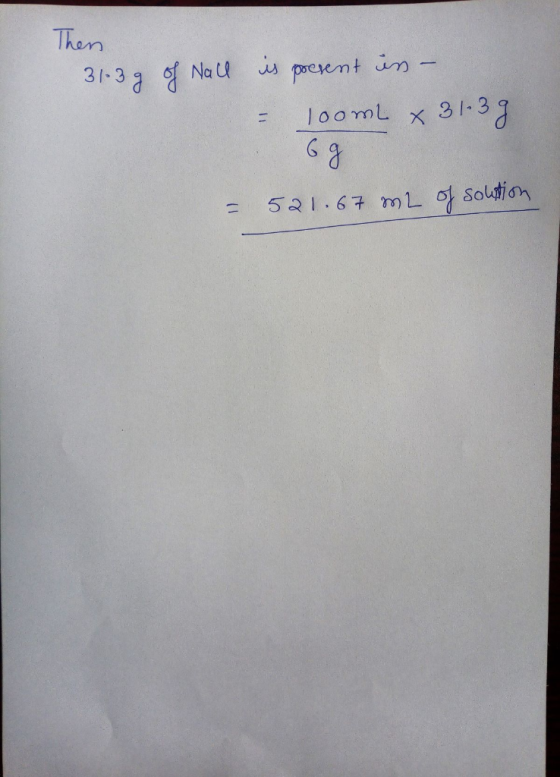
C.
A 6.00 % (m/v) NaCl solution contains 31.3 g of NaCl. What is the total volume (V) of the solution in milliliters?
Express your answer with the appropriate units.
Calculate the final concentration of each of the following diluted solutions.
A.
4.0 L of a 4.0 M HNO3 solution is added to water so that the final volume is 8.0 L .
Express your answer using two significant figures.
B.
Water is added to 0.35 L of a 6.0 M KOH solution to make 2.0 L of a diluted KOH solution.
Express your answer using two significant figures.
C.
A 95.0 mL sample of 8.0 % (m/v) NaOH is diluted with water so that the final volume is 200.0 mL .
Express your answer using two significant figures.
D.
A 7.0 mL sample of 50.0 % (m/v) acetic acid (HC2H3O2) solution is added to water to give a final volume of 25 mL .
Express your answer using two significant figures.
Determine the initial volume, in milliliters, required to prepare each of the following:
A.
21.0 mL of a 0.250 MKNO3 solution from a 6.20 M KNO3 solution
Express your answer with the appropriate units.
B.
21.0 mL of 2.50 MH2SO4 solution using a 11.4 M H2SO4 solution
Express your answer with the appropriate units.
C.
0.700 L of a 1.50 MNH4Cl solution using a 11.0 M NH4Cl solution
Express your answer with the appropriate units.
Homework Answers
Since you have not mentioned about which problem you have doubt in, I am solving 1st question on this sheet as per the HomeworkLib policy
Add Answer to:
To write the percent concentration as a conversion
factor and to use the percent concentration as...
1. What is the final volume in milliliters when 0.653 L of a 45.4 % (m/v)...
1. What is the final volume in milliliters when 0.653 L of a 45.4 % (m/v) solution is diluted to 24.0 % (m/v)? Express your answer with the appropriate units. 2. A 751 mL NaCl solution is diluted to a volume of 1.06 L and a concentration of 8.00 M . What was the initial concentration? Express your answer with the appropriate units. 3. What volume of 1.00 M HCl in liters is needed to react completely (with nothing left...
Calculating Concentration a) Calculate the mass percent (m/m) of a solution prepared by dissolving 49.78 g...
Calculating Concentration a) Calculate the mass percent (m/m) of a solution prepared by dissolving 49.78 g of NaCl in 170.1 g of H2O. Express your answer to four significant figures. b) Vinegar is a solution of acetic acid in water. If a 205 mL bottle of distilled vinegar contains 31.5 mL of acetic acid, what is the volume percent (v/v) of the solution? Express your answer to three significant figures. c) Calculate the mass/volume percent (m/v) of 13.0 g NaCl...
Part A What is the final volume in milliliters when 0.934 L of a 42.2 %...
Part A What is the final volume in milliliters when 0.934 L of a 42.2 % (m/v) solution is diluted to 20.4 % (m/v)? Express your answer with the appropriate units. Part B A 679 mL NaCl solution is diluted to a volume of 1.11 L and a concentration of 6.00 M . What was the initial concentration? Express your answer with the appropriate units.
Part B What is the final volume in milliliters when 0.934 L of a 42.2 %...
Part B What is the final volume in milliliters when 0.934 L of a 42.2 % (m/v) solution is diluted to 20.4 % (m/v)? Express your answer with the appropriate units. Part C A 679 mL NaCl solution is diluted to a volume of 1.11 L and a concentration of 6.00 M . What was the initial concentration? Express your answer with the appropriate units.
Calculate the final concentration of each of the following diluted solutions. Part A A 50.6 mL...
 Calculate the final concentration of each of the following diluted solutions. Part A A 50.6 mL sample of 4. aOH is diluted with water so that the final volume is 104.0 mL Express your answer using two significant figures. PO AQ R O 2 ? Chimal = Cfinal = % (m/v) Submit Request Answer Part B A 13.0 mL sample of 40 % (m/v) acetic acid (CH3 COOH) solution is added to water to give final volume of 25 mL....
<MC 8b Calculating Concentration: Four Common Units < 9 of 32 > Concentration is the amount...
 <MC 8b Calculating Concentration: Four Common Units < 9 of 32 > Concentration is the amount of solute dissolved in a certain amount of solution: concentration of a solution = amount of solute amount of solution Solution concentrations are usually given as one of the following: • Mass percent (m/m)-the mass of the solute in grams for exactly 100 g of solution • Volume percent (v/v)-the volume of solute in exactly 100 mL of solution • Mass/volume percent (m/v)-the mass...
To understand how to prepare a dilute solution and determine the concentration or volume of the...
 To understand how to prepare a dilute solution and determine the concentration or volume of the initial or dilute solution. what is the final volume in milliters when 0.644 L of a 31.5% (m/v) solution is diluted to 248% (m/v)? Express your answer with the appropriate units. A 510 mL NaCI solution is diluted to a volume of 1, 34 L and a concentration of 6.00 M. What was the initial confrontation? Express your answer with the appropriate units.
0 Ulub 9.4 while completing this problem. Part A Ет Calculate the number of grams of...
 0 Ulub 9.4 while completing this problem. Part A Ет Calculate the number of grams of 3.6 % (m/m) NaCl solution that contains 7.70 g of N Express your answer to two significant figures and include the appropriate units. ANSWER: Part B Calculate the volume in milliliters of 35 % (m/v) NaF solution that contains 4.3 g of NaF Express your answer to two significant figures and include the appropriate units. ANSWER: Part Calculate the volume in milliliters of 9.0...
Four SFS Thre Concentr decreas When the final volu (concentration factor volume (V) as predic STUDY...
 Four SFS Thre Concentr decreas When the final volu (concentration factor volume (V) as predic STUDY CHECK 9.13 What initial volume of a 3.0% (m/v) mannose sol TEST Try Practice Problems 9.57 to 9.62|| ANSWER 25 mL of a 15% (m/v) PRACTICE PROBLEMS -5 Dilution of Solutions EARNING GOAL Describe the dilution of a solution; calculate the known concentration or volume when a solution is diluted. 55 Calculate the final concentration of each of the following: a. 2.0 L of...
Chemists often use molarity M, in moles/liter, to measure the concentration of solutions. Molarity is a...
Chemists often use molarity M, in moles/liter, to measure the concentration of solutions. Molarity is a common unit of concentration because the volume of a liquid is very easy to measure. However, the drawback of using molarity is that volume is a temperature-dependent quantity. As temperature changes, density changes, which affects volume. Volume markings for most laboratory glassware are calibrated for room temperature, about 20∘C. A 2.500×10⁻²M solution of NaCl in water is at 20.0∘C. The sample was created by...
 Calculate the final concentration of each of the following diluted solutions. Part A A 50.6 mL sample of 4. aOH is diluted with water so that the final volume is 104.0 mL Express your answer using two significant figures. PO AQ R O 2 ? Chimal = Cfinal = % (m/v) Submit Request Answer Part B A 13.0 mL sample of 40 % (m/v) acetic acid (CH3 COOH) solution is added to water to give final volume of 25 mL....
 <MC 8b Calculating Concentration: Four Common Units < 9 of 32 > Concentration is the amount of solute dissolved in a certain amount of solution: concentration of a solution = amount of solute amount of solution Solution concentrations are usually given as one of the following: • Mass percent (m/m)-the mass of the solute in grams for exactly 100 g of solution • Volume percent (v/v)-the volume of solute in exactly 100 mL of solution • Mass/volume percent (m/v)-the mass...
 To understand how to prepare a dilute solution and determine the concentration or volume of the initial or dilute solution. what is the final volume in milliters when 0.644 L of a 31.5% (m/v) solution is diluted to 248% (m/v)? Express your answer with the appropriate units. A 510 mL NaCI solution is diluted to a volume of 1, 34 L and a concentration of 6.00 M. What was the initial confrontation? Express your answer with the appropriate units.
 0 Ulub 9.4 while completing this problem. Part A Ет Calculate the number of grams of 3.6 % (m/m) NaCl solution that contains 7.70 g of N Express your answer to two significant figures and include the appropriate units. ANSWER: Part B Calculate the volume in milliliters of 35 % (m/v) NaF solution that contains 4.3 g of NaF Express your answer to two significant figures and include the appropriate units. ANSWER: Part Calculate the volume in milliliters of 9.0...
 Four SFS Thre Concentr decreas When the final volu (concentration factor volume (V) as predic STUDY CHECK 9.13 What initial volume of a 3.0% (m/v) mannose sol TEST Try Practice Problems 9.57 to 9.62|| ANSWER 25 mL of a 15% (m/v) PRACTICE PROBLEMS -5 Dilution of Solutions EARNING GOAL Describe the dilution of a solution; calculate the known concentration or volume when a solution is diluted. 55 Calculate the final concentration of each of the following: a. 2.0 L of...
Most questions answered within 3 hours.
-
Where is the error in this code sequence?
String s1 = "Hello";
String s2 = "ello";...
asked 10 months ago -
Financial data for Joel de Paris, Inc., for last year
follow:
Joel de Paris, Inc.
Balance...
asked 10 months ago -
Consider this reaction:
Al2(SO4)3 (aq)+ BaCl3
(aq) Al2Cl6 (aq)- +
3BaSO4(s) . What is the...
asked 10 months ago -
Suppose that Savneet is considering increasing her
recent random sample from 20 car rentals to 40...
asked 10 months ago -
Trucks arrive at an unloading terminal at an average rate of 120
per hour.
Trucks arrive...
asked 10 months ago -
Why are methanol and ethanol completely soluble in water while
octanol is not very little soluble....
asked 10 months ago -
A facilities manager at a university reads in a research report
that the mean amount of...
asked 10 months ago -
When the CuSO4 is rehydrated by adding water to the anhydrous
compound, is this an endothermic...
asked 10 months ago -
A ray of sunlight is passing from diamond into crown glass; the
angle of incidence is...
asked 10 months ago -
A block of mass 0.249 kg is placed on top of a light, vertical
spring of...
asked 10 months ago -
how do the kidneys compensate in the presences of acidosis
a) trigger hyperventilate
b) reserve acid...
asked 10 months ago -
Question 501 pts
The rental rate of capital to the firm increases. Which of the
following...
asked 10 months ago