Today’s problem: You perform a Northern blot to detect a particular mRNA from total RNA, and...
Today’s problem:
You perform a Northern blot to detect a particular mRNA from total
RNA, and you notice two bands instead of one that you expected. The
second, unexpected band migrates faster, and you deduce that it is
a shorter version of the long mRNA, by approximately 50
nucleotides. You know the entire sequence of the gene, so you can
design new probes to characterize the newly observed mRNA. You
suspect that the short mRNA is missing a sequence either from its 5
́ or 3 ́ end.
1. Describe how you would design radioactive probes to perform new
Northern blots that could verify from what end, the 5 ́ or the 3 ́,
the new mRNA is shorter than the long mRNA. Draw a schematic of
where on the mRNA the probes should hybridize.
2. You find that it is the 5 ́ end that is missing from the short
mRNA, and you want to determine the exact length of the short
version at nucleotide resolution. Describe how the method Primer
Extension can address this question (Our textbook, Chapter 5, page
102).
3.
YoualreadyhaveclonedthelongmRNAinaeukaryoticexpressionvector,andyou
want to delete the sequence missing from the short version to
create a new vector to test how the short mRNA is expressed in the
cells. Your colleague tells you that you can use PCR based Site
Directed Mutagenesis to do that. (Site Directed Mutagenesis is
described in our textbook on pages 97-99 but only for creating
point mutations). How you will design the Site Directed Mutagenesis
primers to generate a deletion in the cloned gene? Draw a schematic
of the original vector and where the two new primers will
hybridize.
Homework Answers
1. The total RNA pool contains many types of RNAs. The three major types being mRNAs, rRNAs, and tRNAs. The mRNAs have a distinct structure consisting of 5' Methyl Guanosine cap, the main sequence comprising of exons and introns and a 3' Poly adenosine tail. Thus, in order to select a particular mRNA from this huge pool of mRNA, probes are designed specifically for the exon+intron sequence.
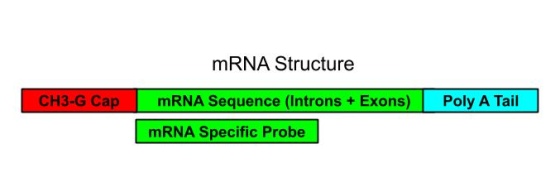
However, the Nothern blot with this probe has given another band
that is smaller, and we have to find out whether it lacks either a
sequence from 5' or 3' end. To find this, we can design probes that
are complementary to both the sequence and the 5' cap or the
sequence and 3' tail.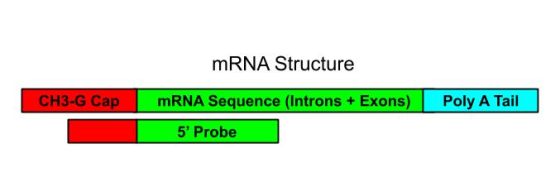
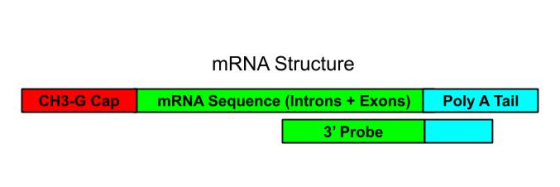
This will help to pull out the specific mRNA along with the tail portion. If the second band lacks 3'end, upon probing with the 3' probe, northern blot will give a single band and probing with the 5' probe will give two bands. However, if the second band lacks 5' end, upon probing with the 5' probe, northern blot will give a single band and probing with the 3' probe will give two bands.
2. Primer walking refers to the use of overlapping primers to
determine the sequence of the segment. Probe for the 3'end can be
used to pull ou the sequence. Once the sequence has been
concentrated, the primer for the 3' end can be used. An overlapping
primer with this primer can then be designed to find the next few
base pairs. Then a new primer overlapping with this primer can be
designed to determine the sequence of the next few base pairs. This
can be continued until the entire sequence is unraveled.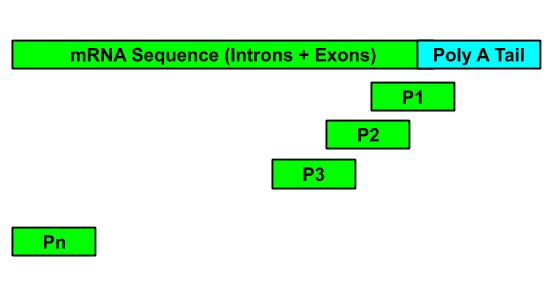
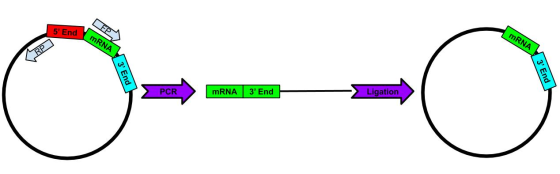
3. The long mRNA has been already cloned into the vector. Thus it will have the 5'end as well. The goal is now to create a new vector with the short mRNA i.e. the one that lacks the 5'end. This can be done by Site-Directed Mutagenesis.
i. Design a forward primer for the first 20-25 nucleotides of the start site of the short fragment. Design a reverse primer for the last 20-25 nucleotides preceding the 5'end of the long mRNA and the part of the vector backbone.
ii. Carry out PCR, the resultant product will be a linear DNA segment.
iii. Circularize it using the Ligation mixture and ligase.
Add Answer to:
Today’s problem:
You perform a Northern blot to detect a particular mRNA from total
RNA, and...
QUESTION 6 Assume you are studying a protein-coding gene, ACEX, which includes 4 exons as illustrated...
 QUESTION 6 Assume you are studying a protein-coding gene, ACEX, which includes 4 exons as illustrated in the gene map below. The 5' UTR and 3' UTR segments are each 25 bp long. Exons 1 thru 4 are 100, 200, 300, 400 bp long, respectively. Each intron is 200 bp each. The locations of the relevant EcoRI sites within the ACEX locus are indicated, but the location of other restriction enzyme sites (like BamHI) are not shown." EcoRI probe EcoRI...
NEED HELP WITH THESE QUESTIONS. PLEASE ANSWER ALL AND EXPLAIN AS WELL. THANKSSSSSSS 1. You want...
 NEED HELP WITH THESE QUESTIONS. PLEASE ANSWER ALL AND EXPLAIN AS
WELL. THANKSSSSSSS
1. You want to clone a gene from a donor vector to a host vector. List the correct order of events in the process of cloning a. Perform ligation reaction of cloned gene and host vector. b. Perform double digestion of both donor and host vectors with the 2 restriction enzymes c. Examine donor and host vectors for restriction sites d. Purify cloned gene from donor vector...
NEED HELP WITH THESE QUESTIONS. PLEASE ANSWER ALL AND EXPLAIN AS
WELL. THANKSSSSSSS
1. You want to clone a gene from a donor vector to a host vector. List the correct order of events in the process of cloning a. Perform ligation reaction of cloned gene and host vector. b. Perform double digestion of both donor and host vectors with the 2 restriction enzymes c. Examine donor and host vectors for restriction sites d. Purify cloned gene from donor vector...
Now. you should be able to answer the following questions: • How the amplification will be...
 Now. you should be able to answer the following questions: • How the amplification will be done? - How you will determine your target sequence? How the amplification will be specific for certain segment? What are the requirements to carry PCR? • Suppose you perform a PCR that begins with one double-strand of the following DNA template: +5'-CTACCTGCGGGTTGACTGCTACCTTCCCGGGATGCCCAAAATTCTCGAG-3+ +3'-GATGGACGCCCAACTGACGATGGAAGGGCCCTACGGGTTTTAAGAGCTC-5'+ A. Draw one cycle of PCR reaction below the following diagram. B. Label the template DNA, the primers, and what is...
2. A dominant allele H reduces the number of body bristles that Drosophila flies have, giving...
2. A dominant allele H reduces the number of body bristles that Drosophila flies have, giving rise to a “hairless” phenotype. In the homozygous condition, H is lethal. An independently assorting dominant allele S has no effect on bristle number except in the presence of H, in which case a single dose of S suppresses the hairless phenotype, thus restoring the "hairy" phenotype. However, S also is lethal in the homozygous (S/S) condition. What ratio of hairy to hairless flies...
How can we assess whether a project is a success or a failure? This case presents...
 How can we assess whether a project is a success or a
failure?
This case presents two phases of a large business transformation project involving the implementation of an ERP system with the aim of creating an integrated company. The case illustrates some of the challenges associated with integration. It also presents the obstacles facing companies that undertake projects involving large information technology projects. Bombardier and Its Environment Joseph-Armand Bombardier was 15 years old when he built his first snowmobile...
How can we assess whether a project is a success or a
failure?
This case presents two phases of a large business transformation project involving the implementation of an ERP system with the aim of creating an integrated company. The case illustrates some of the challenges associated with integration. It also presents the obstacles facing companies that undertake projects involving large information technology projects. Bombardier and Its Environment Joseph-Armand Bombardier was 15 years old when he built his first snowmobile...
 QUESTION 6 Assume you are studying a protein-coding gene, ACEX, which includes 4 exons as illustrated in the gene map below. The 5' UTR and 3' UTR segments are each 25 bp long. Exons 1 thru 4 are 100, 200, 300, 400 bp long, respectively. Each intron is 200 bp each. The locations of the relevant EcoRI sites within the ACEX locus are indicated, but the location of other restriction enzyme sites (like BamHI) are not shown." EcoRI probe EcoRI...
 NEED HELP WITH THESE QUESTIONS. PLEASE ANSWER ALL AND EXPLAIN AS
WELL. THANKSSSSSSS
1. You want to clone a gene from a donor vector to a host vector. List the correct order of events in the process of cloning a. Perform ligation reaction of cloned gene and host vector. b. Perform double digestion of both donor and host vectors with the 2 restriction enzymes c. Examine donor and host vectors for restriction sites d. Purify cloned gene from donor vector...
NEED HELP WITH THESE QUESTIONS. PLEASE ANSWER ALL AND EXPLAIN AS
WELL. THANKSSSSSSS
1. You want to clone a gene from a donor vector to a host vector. List the correct order of events in the process of cloning a. Perform ligation reaction of cloned gene and host vector. b. Perform double digestion of both donor and host vectors with the 2 restriction enzymes c. Examine donor and host vectors for restriction sites d. Purify cloned gene from donor vector...
 Now. you should be able to answer the following questions: • How the amplification will be done? - How you will determine your target sequence? How the amplification will be specific for certain segment? What are the requirements to carry PCR? • Suppose you perform a PCR that begins with one double-strand of the following DNA template: +5'-CTACCTGCGGGTTGACTGCTACCTTCCCGGGATGCCCAAAATTCTCGAG-3+ +3'-GATGGACGCCCAACTGACGATGGAAGGGCCCTACGGGTTTTAAGAGCTC-5'+ A. Draw one cycle of PCR reaction below the following diagram. B. Label the template DNA, the primers, and what is...
 How can we assess whether a project is a success or a
failure?
This case presents two phases of a large business transformation project involving the implementation of an ERP system with the aim of creating an integrated company. The case illustrates some of the challenges associated with integration. It also presents the obstacles facing companies that undertake projects involving large information technology projects. Bombardier and Its Environment Joseph-Armand Bombardier was 15 years old when he built his first snowmobile...
How can we assess whether a project is a success or a
failure?
This case presents two phases of a large business transformation project involving the implementation of an ERP system with the aim of creating an integrated company. The case illustrates some of the challenges associated with integration. It also presents the obstacles facing companies that undertake projects involving large information technology projects. Bombardier and Its Environment Joseph-Armand Bombardier was 15 years old when he built his first snowmobile...
Most questions answered within 3 hours.
-
Where is the error in this code sequence?
String s1 = "Hello";
String s2 = "ello";...
asked 10 months ago -
Financial data for Joel de Paris, Inc., for last year
follow:
Joel de Paris, Inc.
Balance...
asked 10 months ago -
Consider this reaction:
Al2(SO4)3 (aq)+ BaCl3
(aq) Al2Cl6 (aq)- +
3BaSO4(s) . What is the...
asked 10 months ago -
Suppose that Savneet is considering increasing her
recent random sample from 20 car rentals to 40...
asked 10 months ago -
Trucks arrive at an unloading terminal at an average rate of 120
per hour.
Trucks arrive...
asked 10 months ago -
Why are methanol and ethanol completely soluble in water while
octanol is not very little soluble....
asked 10 months ago -
A facilities manager at a university reads in a research report
that the mean amount of...
asked 10 months ago -
When the CuSO4 is rehydrated by adding water to the anhydrous
compound, is this an endothermic...
asked 10 months ago -
A ray of sunlight is passing from diamond into crown glass; the
angle of incidence is...
asked 10 months ago -
A block of mass 0.249 kg is placed on top of a light, vertical
spring of...
asked 10 months ago -
how do the kidneys compensate in the presences of acidosis
a) trigger hyperventilate
b) reserve acid...
asked 10 months ago -
Question 501 pts
The rental rate of capital to the firm increases. Which of the
following...
asked 10 months ago