Write the effects of water on slope stability
Write the effects of water on slope stability
Homework Answers
Soft, saturated foundation soils or ground water seepage plays a very important role in geotechnical failures. They act as a major factor affecting stability of slopes. The effect of water on slope stability is discussed below.
Effect on Cohesionless Soils - In case of Cohesionless soils, water does not affect the angle of internal friction. The effect of water on cohesionless soils below the water table is to decrease the intergranular stress between soil grains, which in turn decreases the frictional shearing resistance.
Effect on Cohesive Soils - Routine seasonal fluctuations in the G.W.T. (Ground Water Table) do not usually influence either the amount of water in the pore spaces between soil grains or cohesion. The forces of attraction between soil particles prevent water absorption unless external forces such as pile driving, disrupt the structure.
If absorbed moisture increases, it causes decrease in strength of cohesive soils. Water absorbed by clay minerals causes increased water content that decrease the cohesion of clayey soils.
Clay Fills - Excess pore water pressure are created when fills are placed on clay. As pore water pressure increases excessively, consolidation occurs and shear strength of clay increases being directly proportional to time, unless applied loads do not cause undrained shear strength. Simultaneously, the factor of safety increases as well.
Slaking - It's a process where sudden increase of moisture in rocks can produce pore pressure increase in trapped pore air.It is accompanied by local expansion and strength decrease. This mechanism causes disintegration of hard shales or claystones.
Cuts in clay - Cuts in clay reduces effective stress. This allows the clay to expand and absorb water, which leads to the decrease of the strength of the clay directly proportional to tine. As a result, the factor of safety of a cut slope decreases with time.
Q2: Write a short critical note (5-8 pages) on design philosophy of earthen dams that consists of 2.1 Introduction 2.2 Design aspects (including slope stability check) 2.3 Seepage analysis 2.4 Seepag...
 Q2: Write a short critical note (5-8 pages) on design philosophy of earthen dams that consists of 2.1 Introduction 2.2 Design aspects (including slope stability check) 2.3 Seepage analysis 2.4 Seepage management
Q2: Write a short critical note (5-8 pages) on design philosophy of earthen dams that consists of 2.1 Introduction 2.2 Design aspects (including slope stability check) 2.3 Seepage analysis 2.4 Seepage management
Q2: Write a short critical note (5-8 pages) on design philosophy of earthen dams that consists of 2.1 Introduction 2.2 Design aspects (including slope stability check) 2.3 Seepage analysis 2.4 Seepage management
Show the complete derivations of the equations of the following INFINITE SLOPE STABILITY ANALYSIS (A) Factor...
Show the complete derivations of the equations of the following INFINITE SLOPE STABILITY ANALYSIS (A) Factor of safety against sliding without seepage (B) Maximum height critical for equilibrium (C) Factor of safety against sliding with seepage FINITE SLOPE STABILITY ANALYSIS – CULMANN’S METHOD (D) Factor of safety against sliding (E) Cohesion at the plane of potential shear failure (F) Maximum height critical for equilibrium
Determine the stability of a quad on a 20° slope in pull condition. The mass of...
Determine the stability of a quad on a 20° slope in pull condition. The mass of the quad is 1,000 kg. The distance between the front and the rear axis is 400 cm, and the overall force of gravity for this quad is located 150.0 cm from the rear axis and 100 cm from the ground (that is 100 cm perpendicular distance from the slope). The drawbar is located 60 cm from the ground.
The following figure shows a slope stability analysis undertaken on a clay slope using the method...
 The following figure shows a slope stability analysis undertaken on a clay slope using the method of slices. The table gives some details of the analysis. Fill in the spaces of the table and compute the factor of safety for the slope. Use the equation for Ordinary (Swedish) method given by + (W cosa - ul) tang') (W sin a) Y=20kNm c' = 20KN/m 6' = 29° (=b/cos Note: W should be equal to bhy Solution: W Wcos | Wsin...
Considering the problem of slope stability: the figure below indicates a section through a slope that...
 Considering the problem of slope stability: the figure below indicates a section through a slope that is liable to a rotational or slip circle failure. Using the soil parameters given together with the details supplied in the table below, determine the factor of safety against failure, assuming that no tension cracks will form. 8m 8m o O = 90° R= 17.9m 8m Surcharge 5kPa SkPa THT Slice No Base slope 8m Soil data: y = 19kN/m3 C'=10kN/m² '= 35° Area...
Problem 4 What is the factor of safety of the slope below according to the Stability...
 Problem 4 What is the factor of safety of the slope below according to the Stability Number Method? 110 Ib/ft 20 ft c800 b/ft? no stiff material or bedrock found during subsurface investigations
Homework 811 (Due: Friday Nov. 22 5:00PM The stability of the slope is to be analyzed...
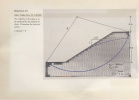 Homework 811 (Due: Friday Nov. 22 5:00PM The stability of the slope is to be analyzed by the method of slices. Determine the factor of safety: Cohesion=0 F FUENT % - 18kN/m = 33 Scale A4 m
A 6 m deep slope is going to be excavated in a deep soil deposit. The geometry of the slope is shown in the following fi...
 A 6 m deep slope is going to be excavated in a deep soil
deposit. The geometry of the slope is shown in the following
figure. Assume. The soil has the following
properties:
yt = 19
kN/m3,
cu = 20
kPa,
u = 0o
R = 10
m,
AB = 2 m
Water table is well below the toe of the embankment. Note:
only a is a variable input.
Find the net area and the centroid of this net area...
A 6 m deep slope is going to be excavated in a deep soil
deposit. The geometry of the slope is shown in the following
figure. Assume. The soil has the following
properties:
yt = 19
kN/m3,
cu = 20
kPa,
u = 0o
R = 10
m,
AB = 2 m
Water table is well below the toe of the embankment. Note:
only a is a variable input.
Find the net area and the centroid of this net area...
a. What is the slope angle and what is the slope ratio for the slope shown...
 a. What is the slope angle and what is the slope ratio for the slope shown for Problem 12 Show all calculations. b. Assume the slope in Problem 1 is a cut slope with a calculated factor of safety for the critical slip surface of 1.3, which has been judged too low for the proposed development. What is the best method to improve stability, i.e., increase the calculated factor of safety, and why? Provide your answer in just one or...
2. A 200-ft high slope in a quarry is to be developed with a dip angle...
 2. A 200-ft high slope in a quarry is to be developed with a dip angle a-60°. A join angle ?-34°, is dipping in the same direction as the slope. The pro perties of the joint are: average rock density 160 Ibs/ft internal frictional angle of joints cohesion of joints 1440 psf 31° is a tension crack on the upper surface of the slope 120 ft from the crest and filled e is to be carried out to increase the...
 Q2: Write a short critical note (5-8 pages) on design philosophy of earthen dams that consists of 2.1 Introduction 2.2 Design aspects (including slope stability check) 2.3 Seepage analysis 2.4 Seepage management
Q2: Write a short critical note (5-8 pages) on design philosophy of earthen dams that consists of 2.1 Introduction 2.2 Design aspects (including slope stability check) 2.3 Seepage analysis 2.4 Seepage management
Q2: Write a short critical note (5-8 pages) on design philosophy of earthen dams that consists of 2.1 Introduction 2.2 Design aspects (including slope stability check) 2.3 Seepage analysis 2.4 Seepage management
 The following figure shows a slope stability analysis undertaken on a clay slope using the method of slices. The table gives some details of the analysis. Fill in the spaces of the table and compute the factor of safety for the slope. Use the equation for Ordinary (Swedish) method given by + (W cosa - ul) tang') (W sin a) Y=20kNm c' = 20KN/m 6' = 29° (=b/cos Note: W should be equal to bhy Solution: W Wcos | Wsin...
 Considering the problem of slope stability: the figure below indicates a section through a slope that is liable to a rotational or slip circle failure. Using the soil parameters given together with the details supplied in the table below, determine the factor of safety against failure, assuming that no tension cracks will form. 8m 8m o O = 90° R= 17.9m 8m Surcharge 5kPa SkPa THT Slice No Base slope 8m Soil data: y = 19kN/m3 C'=10kN/m² '= 35° Area...
 Problem 4 What is the factor of safety of the slope below according to the Stability Number Method? 110 Ib/ft 20 ft c800 b/ft? no stiff material or bedrock found during subsurface investigations
 Homework 811 (Due: Friday Nov. 22 5:00PM The stability of the slope is to be analyzed by the method of slices. Determine the factor of safety: Cohesion=0 F FUENT % - 18kN/m = 33 Scale A4 m
 A 6 m deep slope is going to be excavated in a deep soil
deposit. The geometry of the slope is shown in the following
figure. Assume. The soil has the following
properties:
yt = 19
kN/m3,
cu = 20
kPa,
u = 0o
R = 10
m,
AB = 2 m
Water table is well below the toe of the embankment. Note:
only a is a variable input.
Find the net area and the centroid of this net area...
A 6 m deep slope is going to be excavated in a deep soil
deposit. The geometry of the slope is shown in the following
figure. Assume. The soil has the following
properties:
yt = 19
kN/m3,
cu = 20
kPa,
u = 0o
R = 10
m,
AB = 2 m
Water table is well below the toe of the embankment. Note:
only a is a variable input.
Find the net area and the centroid of this net area...
 a. What is the slope angle and what is the slope ratio for the slope shown for Problem 12 Show all calculations. b. Assume the slope in Problem 1 is a cut slope with a calculated factor of safety for the critical slip surface of 1.3, which has been judged too low for the proposed development. What is the best method to improve stability, i.e., increase the calculated factor of safety, and why? Provide your answer in just one or...
 2. A 200-ft high slope in a quarry is to be developed with a dip angle a-60°. A join angle ?-34°, is dipping in the same direction as the slope. The pro perties of the joint are: average rock density 160 Ibs/ft internal frictional angle of joints cohesion of joints 1440 psf 31° is a tension crack on the upper surface of the slope 120 ft from the crest and filled e is to be carried out to increase the...
Most questions answered within 3 hours.
-
Where is the error in this code sequence?
String s1 = "Hello";
String s2 = "ello";...
asked 10 months ago -
Financial data for Joel de Paris, Inc., for last year
follow:
Joel de Paris, Inc.
Balance...
asked 10 months ago -
Consider this reaction:
Al2(SO4)3 (aq)+ BaCl3
(aq) Al2Cl6 (aq)- +
3BaSO4(s) . What is the...
asked 10 months ago -
Suppose that Savneet is considering increasing her
recent random sample from 20 car rentals to 40...
asked 10 months ago -
Trucks arrive at an unloading terminal at an average rate of 120
per hour.
Trucks arrive...
asked 10 months ago -
Why are methanol and ethanol completely soluble in water while
octanol is not very little soluble....
asked 10 months ago -
A facilities manager at a university reads in a research report
that the mean amount of...
asked 10 months ago -
When the CuSO4 is rehydrated by adding water to the anhydrous
compound, is this an endothermic...
asked 10 months ago -
A ray of sunlight is passing from diamond into crown glass; the
angle of incidence is...
asked 10 months ago -
A block of mass 0.249 kg is placed on top of a light, vertical
spring of...
asked 10 months ago -
how do the kidneys compensate in the presences of acidosis
a) trigger hyperventilate
b) reserve acid...
asked 10 months ago -
Question 501 pts
The rental rate of capital to the firm increases. Which of the
following...
asked 10 months ago