Explain three effects of the stress response, and for each, describe how they would be helpful...
Explain three effects of the stress response, and for each, describe how they would be helpful for an organism experiencing danger.
Homework Answers
The process down into three separate and chronological stages of stress response, including the alarm, resistance and exhaustion stages.
The alarm stage is also acknowledged as the fight or flight response. Throughout the alarm stage, brain drives an emergency signal to supplementary parts of body, which lets those parts know that person in a dangerous situation. As body activates itself to react, person can prefer between a fight or flight response. For example, you'd be choosing the 'fight' response if you heard gunshots on a city street and confronted the shooter. By comparison, you'd be choosing the 'flight' response if you fled the scene.
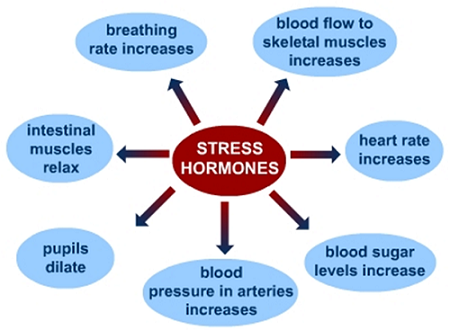
In the alarm stage, nervous system is prepared to fight or flight. Moreover, heart starts beating faster, which provides more blood and oxygen to arms and legs.
If the alarm stage does not assist in order to flee from a stressful situation body steps forward to the resistance stage where person remains in an alert stage for a longer time. During this stage, parasympathetic nervous system tries to return as many of bodily functions as possible to their pre-stress levels while focusing bodily responses on the next stressor or threat.
The hormones released during stressful times can damage cells. If person has no time to recover from next movement of stress then body remains prepared which may lead to exhaustion. During the exhaustion phase of the general adaptation syndrome, health problems and even death may occur.
The same process occurs with mental stress, not just physical stress. Mental stress from work, school, or personal life that goes on too long can also lead to exhaustion and eventual breakdown. The body reacts the same way even though the stress may not be physical.
Factors such as age and health influence the stress response, as do coping skills. Chronic stress increases the chance of illness even if it does not progress to the exhaustion stage. During the resistance phase, the body is not able to fight off colds and flu. Studies have shown an increase in chance of catching a cold after three months of chronic stress.
Add Answer to:
Explain three effects of the stress response, and for each,
describe how they would be helpful...
Define stress. Give at least three of examples. Explain the three stages of the stress response....
Define stress. Give at least three of examples. Explain the three stages of the stress response. How does stress affect our immune system? and citations for the sources.
How does Selye account for the incidence of illness in terms of stress (include stress response...
How does Selye account for the incidence of illness in terms of stress (include stress response stages)? Select one "Individual Factors that Influence the Response to Stress" and briefly describe how you can personally use it to ameliorate the effects of stress.
List three abiotic factors and describe how each of those three abiotic factors can can affect...
List three abiotic factors and describe how each of those three abiotic factors can can affect the distribution of an organism. In your description, provide a specific example of how each abiotic factor would impact the distribution of the organism and how the organism would have to adapt to the factor.
describe the effects of stress on the body.
describe the effects of stress on the body.
Stress and Disease: Describe the physiologic effects on body systems of increased cortisol levels released during...
Stress and Disease: Describe the physiologic effects on body systems of increased cortisol levels released during the stress response.
Stress and Disease: Describe the physiologic effects on body systems of increased cortisol levels released during...
Stress and Disease: Describe the physiologic effects on body systems of increased cortisol levels released during the stress response.
Describe and discuss two important ideas that have emerged from research on the effects of stress...
Describe and discuss two important ideas that have emerged from research on the effects of stress on health. Explain the research that led to each idea and why it is important.
What are the short-term and long-term effects of stress? Explain, Give specific examples of how stress...
What are the short-term and long-term effects of stress? Explain, Give specific examples of how stress can effect the immune system and nervous system.
Describe at least three characteristics of strong strategic leaders. Explain how each of the three characteristics...
Describe at least three characteristics of strong strategic leaders. Explain how each of the three characteristics would help motivate and lead an organization's personnel
Module 4: Managing Stress 1.Explain the nature of stress at work 2.Describe the health consequences of...
Module 4: Managing Stress 1.Explain the nature of stress at work 2.Describe the health consequences of stressful work 3. Explain how to use hardiness theory to reduce stress 4. List three ways to use Bandura's self-efficacy theory to reduce stress 5.Try out different stress reduction measures
Most questions answered within 3 hours.
-
Where is the error in this code sequence?
String s1 = "Hello";
String s2 = "ello";...
asked 10 months ago -
Financial data for Joel de Paris, Inc., for last year
follow:
Joel de Paris, Inc.
Balance...
asked 10 months ago -
Consider this reaction:
Al2(SO4)3 (aq)+ BaCl3
(aq) Al2Cl6 (aq)- +
3BaSO4(s) . What is the...
asked 10 months ago -
Suppose that Savneet is considering increasing her
recent random sample from 20 car rentals to 40...
asked 10 months ago -
Trucks arrive at an unloading terminal at an average rate of 120
per hour.
Trucks arrive...
asked 10 months ago -
Why are methanol and ethanol completely soluble in water while
octanol is not very little soluble....
asked 10 months ago -
A facilities manager at a university reads in a research report
that the mean amount of...
asked 10 months ago -
When the CuSO4 is rehydrated by adding water to the anhydrous
compound, is this an endothermic...
asked 10 months ago -
A ray of sunlight is passing from diamond into crown glass; the
angle of incidence is...
asked 10 months ago -
A block of mass 0.249 kg is placed on top of a light, vertical
spring of...
asked 10 months ago -
how do the kidneys compensate in the presences of acidosis
a) trigger hyperventilate
b) reserve acid...
asked 10 months ago -
Question 501 pts
The rental rate of capital to the firm increases. Which of the
following...
asked 10 months ago