if the true absorbance of a sample is 0.80 what level of stray light given an...
Homework Answers

Add Answer to:
if
the true absorbance of a sample is 0.80 what level of stray light
given an...
The true absorbance of a sample is 1.500, but 0.50% stray light reaches the detector. Find...
 The true absorbance of a sample is 1.500, but 0.50% stray light reaches the detector. Find the apparent transmittance and apparent absorbance of the sample. How much stray light can be tolerated if the absorbance error is not to exceed 0.001 at a true absorbance of 2? A research-quality spectrophotometer has a stray light level of greaterthan0.000 05% at 340 nm. What will be the maximum absorbance error for a sample with a true absorbance of 2? Of 3?
hint to question The incident intensity(lo), the emergent intensity() and the stray light intensity (Is) give...
 hint to question
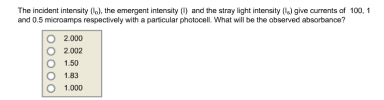
The incident intensity(lo), the emergent intensity() and the stray light intensity (Is) give currents of 100, 1 and 0.5 microamps respectively with a particular photocell. What will be the observed absorbance? O 2.000 O 2.002 O 1.50 O 1.83 O 1.000
hint to question
The incident intensity(lo), the emergent intensity() and the stray light intensity (Is) give currents of 100, 1 and 0.5 microamps respectively with a particular photocell. What will be the observed absorbance? O 2.000 O 2.002 O 1.50 O 1.83 O 1.000
10. (8 pt) The light intensity from the reference cell in a dual-beam spectrometer (Po) is...
 10. (8 pt) The light intensity from the reference cell in a dual-beam spectrometer (Po) is 0.50 W/cm2. The light intensity from the sample (P) is 0.025 W/cm. a. What is the transmittance of the sample? b. What is the absorbance of the sample? After opening the instrument, the cover is left open at a crack letting some stray light hit the detector at 0.010 W/cm2 c. What is the apparent absorbance as a result of the stray light?
If the absorbance of light through a 1cm long DNA sample with a known concentration of...
 If the absorbance of light through a 1cm long DNA sample with a known concentration of 100 mM (1mM is 10-3 molar) is A 6, what is the molar extinction coefficient for this particular DNA molecule? If another 1cm long sample with an unknown concentration of the same DNA molecule gives A = 5, what is the DNA concentration in this sample?
1. A sample gives an absorbance of 1 at a specific wavelength, what is the transmittance...
 1. A sample gives an absorbance of 1 at a specific wavelength, what is the transmittance and what is the percentage of light that was absorbed by the sample?
Please Help. Last attempt left Absorbance can also be defined in terms of incident light (lo)...
 Please Help. Last attempt left
Absorbance can also be defined in terms of incident light (lo) and transmitted light (1) Incident light (lo) is the amount of light that comes out of the light source that strikes the sample. The light that passes through the sample without getting absorbed is called the transmitted light (1). A= log (lo/l) if the 99% of the light is getting absorbed by the sample (1 = 196), find the absorbance of this sample: Hint:...
Please Help. Last attempt left
Absorbance can also be defined in terms of incident light (lo) and transmitted light (1) Incident light (lo) is the amount of light that comes out of the light source that strikes the sample. The light that passes through the sample without getting absorbed is called the transmitted light (1). A= log (lo/l) if the 99% of the light is getting absorbed by the sample (1 = 196), find the absorbance of this sample: Hint:...
a. what happens on a molecular level that allows an analyte to absorb light at a...
a. what happens on a molecular level that allows an analyte to absorb light at a certain wavelength? b. why are you using a specific wavelength of light to record absorbance measurements for the dye (i.e., why won't every wavelength of light be absorbed by the analyte)?
Another sample of KMnO4 solution has 80% of light of a given , passing through it...
 Another sample of KMnO4 solution has 80% of light of a given , passing through it was transmitted when a cell of 4 cm was used for the sample analysis and the molar absorptivity was 2. Show that the concentration is 0.05 g/L Calculate the transmittance and Absorbance if the %T is (a) 1% (b) 10% (c) 100% If 25.8 mg of Benzene is dissolved in 250 ml of solution that absorbed at 256 nm, with absorption coefficient or molar...
1: What happens in a molecular level that allows an analyze to absorb light at a...
1: What happens in a molecular level that allows an analyze to absorb light at a certain wavelength. 2: Why are you using a specific wavelength of light to record absorbance measurements for the dye (i.e., why non't every wavelength of light be absorbed by the analyte) I need this answer ASAP please. Thank you
A. A beginning scientist measures an absorbance of 3.0 at 260 nm for a DNA sample....
A. A beginning scientist measures an absorbance of 3.0 at 260 nm for a DNA sample. Is this a meaningful number and why or why not ?(Consider the amount of light passing through the sample, ie. the % transmittance). What range should values of absorbance fall in? B. A 6.0 mg/L solution of adenine in water has an absorbance of 0.59 at 261 nm in a 1 cm pathlength cell. Adenine has a molecular weight of 135.1 g/mol.What is the...
 The true absorbance of a sample is 1.500, but 0.50% stray light reaches the detector. Find the apparent transmittance and apparent absorbance of the sample. How much stray light can be tolerated if the absorbance error is not to exceed 0.001 at a true absorbance of 2? A research-quality spectrophotometer has a stray light level of greaterthan0.000 05% at 340 nm. What will be the maximum absorbance error for a sample with a true absorbance of 2? Of 3?
 hint to question
The incident intensity(lo), the emergent intensity() and the stray light intensity (Is) give currents of 100, 1 and 0.5 microamps respectively with a particular photocell. What will be the observed absorbance? O 2.000 O 2.002 O 1.50 O 1.83 O 1.000
hint to question
The incident intensity(lo), the emergent intensity() and the stray light intensity (Is) give currents of 100, 1 and 0.5 microamps respectively with a particular photocell. What will be the observed absorbance? O 2.000 O 2.002 O 1.50 O 1.83 O 1.000
 10. (8 pt) The light intensity from the reference cell in a dual-beam spectrometer (Po) is 0.50 W/cm2. The light intensity from the sample (P) is 0.025 W/cm. a. What is the transmittance of the sample? b. What is the absorbance of the sample? After opening the instrument, the cover is left open at a crack letting some stray light hit the detector at 0.010 W/cm2 c. What is the apparent absorbance as a result of the stray light?
 If the absorbance of light through a 1cm long DNA sample with a known concentration of 100 mM (1mM is 10-3 molar) is A 6, what is the molar extinction coefficient for this particular DNA molecule? If another 1cm long sample with an unknown concentration of the same DNA molecule gives A = 5, what is the DNA concentration in this sample?
 1. A sample gives an absorbance of 1 at a specific wavelength, what is the transmittance and what is the percentage of light that was absorbed by the sample?
 Please Help. Last attempt left
Absorbance can also be defined in terms of incident light (lo) and transmitted light (1) Incident light (lo) is the amount of light that comes out of the light source that strikes the sample. The light that passes through the sample without getting absorbed is called the transmitted light (1). A= log (lo/l) if the 99% of the light is getting absorbed by the sample (1 = 196), find the absorbance of this sample: Hint:...
Please Help. Last attempt left
Absorbance can also be defined in terms of incident light (lo) and transmitted light (1) Incident light (lo) is the amount of light that comes out of the light source that strikes the sample. The light that passes through the sample without getting absorbed is called the transmitted light (1). A= log (lo/l) if the 99% of the light is getting absorbed by the sample (1 = 196), find the absorbance of this sample: Hint:...
 Another sample of KMnO4 solution has 80% of light of a given , passing through it was transmitted when a cell of 4 cm was used for the sample analysis and the molar absorptivity was 2. Show that the concentration is 0.05 g/L Calculate the transmittance and Absorbance if the %T is (a) 1% (b) 10% (c) 100% If 25.8 mg of Benzene is dissolved in 250 ml of solution that absorbed at 256 nm, with absorption coefficient or molar...
Most questions answered within 3 hours.
-
Where is the error in this code sequence?
String s1 = "Hello";
String s2 = "ello";...
asked 10 months ago -
Financial data for Joel de Paris, Inc., for last year
follow:
Joel de Paris, Inc.
Balance...
asked 10 months ago -
Consider this reaction:
Al2(SO4)3 (aq)+ BaCl3
(aq) Al2Cl6 (aq)- +
3BaSO4(s) . What is the...
asked 10 months ago -
Suppose that Savneet is considering increasing her
recent random sample from 20 car rentals to 40...
asked 10 months ago -
Trucks arrive at an unloading terminal at an average rate of 120
per hour.
Trucks arrive...
asked 10 months ago -
Why are methanol and ethanol completely soluble in water while
octanol is not very little soluble....
asked 10 months ago -
A facilities manager at a university reads in a research report
that the mean amount of...
asked 10 months ago -
When the CuSO4 is rehydrated by adding water to the anhydrous
compound, is this an endothermic...
asked 10 months ago -
A ray of sunlight is passing from diamond into crown glass; the
angle of incidence is...
asked 10 months ago -
A block of mass 0.249 kg is placed on top of a light, vertical
spring of...
asked 10 months ago -
how do the kidneys compensate in the presences of acidosis
a) trigger hyperventilate
b) reserve acid...
asked 10 months ago -
Question 501 pts
The rental rate of capital to the firm increases. Which of the
following...
asked 10 months ago