Please help! Need the answers to question 2 and 4. Use 16 mL of alcohol and...
Please help! Need the answers to question 2 and 4. Use 16 mL of alcohol and 22 mL of acid.
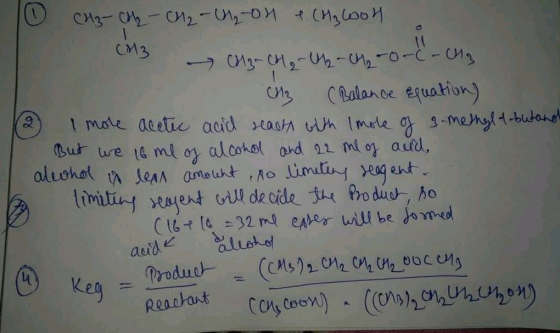
- Write the acid catalyzed esterification reaction between acetic acid, CH3COOH, and 3-methyl-1-butanol, (CH3)2CH2CH2CH2OH.
Name the organic product. (Don't answer this)
- (2 pts) Use these chemicals and the volumes given in the procedure to calculate limiting reagent and theoretical yield of the ester. (Need this one)
- (2pts) Give the Keq, equilibrium constant expression, for the above reaction. (Need this one)
Homework Answers
If you satisfied with the solution please like it thankxx
If you have any query please comment
Add Answer to:
Please help! Need the answers to question 2 and 4. Use 16 mL of
alcohol and...
You add 0.58 mL of n-propanol (0.803 g/mL, 60.1 g/mol) to an excess of acetic acid...
 You add 0.58 mL of n-propanol (0.803 g/mL, 60.1 g/mol) to an excess of acetic acid to create the pear ester propyl acetate (102.1 g/mol). If you obtain 0.53 grams of the product, what was your percent yield? You react acetic acid with an unknown alcohol, and obtain the following NMR of the product. What is the unknown alcohol? LLLLLLLL LES LL 20 1-butanol (CH3CH2CH2CH2OH) 2-propanol (CH3)2CHOH) 1-propanol (CH3CH2CH20H) 2-methyl-1-propanol (CH3)2CHCH2OH) 2 butanol (CH3CHOHCH2OHCH) 3 Mi Consider the below general...
I need help with the lab’s question below and H-NMR ASAP. Please explain and show all...
 I need help with the lab’s question below and H-NMR ASAP.
Please explain and show all the work. I have posted lab guidelines
as well for the reference.
.nl H20令 9:19 AM X Chemistry 3342 Laboratory Manual Background (Week Two) Equal molar amounts of acid (Y) and alcohol (Y) starting material will be used in the second acid-catalyzed esterification reaction we will complete. When the reaction takes place one molecule or ester and one molecule of water will form, ie.,...
I need help with the lab’s question below and H-NMR ASAP.
Please explain and show all the work. I have posted lab guidelines
as well for the reference.
.nl H20令 9:19 AM X Chemistry 3342 Laboratory Manual Background (Week Two) Equal molar amounts of acid (Y) and alcohol (Y) starting material will be used in the second acid-catalyzed esterification reaction we will complete. When the reaction takes place one molecule or ester and one molecule of water will form, ie.,...
i need help with the rest of the question 1a. Volume of isopentyl alcohol used =...
 i need help with the rest of the question
1a. Volume of isopentyl alcohol used = 5.0mL 1b. Density of isoamyl alcohol = ...0...112..... g/mL 3.96 5.0ml = 0.792 Mass of isopentyl alcohol used (show work) = 3.967 23.239.273.90 IC. Volume of glacial acetic acid used = 7.0 mL Density of acetic acid = ...1.2...... g/mL 1.68 Mass of glacial acetic acid used (calculate; show work) = 21 28-07-19.38-268 1d. Mass of the collection R.B flask_ 96.02 .......9 Mass of...
i need help with the rest of the question
1a. Volume of isopentyl alcohol used = 5.0mL 1b. Density of isoamyl alcohol = ...0...112..... g/mL 3.96 5.0ml = 0.792 Mass of isopentyl alcohol used (show work) = 3.967 23.239.273.90 IC. Volume of glacial acetic acid used = 7.0 mL Density of acetic acid = ...1.2...... g/mL 1.68 Mass of glacial acetic acid used (calculate; show work) = 21 28-07-19.38-268 1d. Mass of the collection R.B flask_ 96.02 .......9 Mass of...
1) 2) 3) question 3 answer choices. You add 0.58 mL of n-propanol (0.803 g/mL, 60.1...
 1)
2)
3)
question
3 answer choices.
You add 0.58 mL of n-propanol (0.803 g/mL, 60.1 g/mol) to an excess of acetic acid to create the pear ester propyl acetate (102.1 g/mol). If you obtain 0.53 grams of the product, what was your percent yield? You react acetic acid with an unknown alcohol, and obtain the following NMR of the product. What is the unknown alcohol? 1.0 20 3.0 4.0 ppm (t1) 1-butanol (CH3CH2CH2CH2OH) O 2-propanol ((CH3)2CHOH) O 1-propanol (CH3CH2CH2OH)...
1)
2)
3)
question
3 answer choices.
You add 0.58 mL of n-propanol (0.803 g/mL, 60.1 g/mol) to an excess of acetic acid to create the pear ester propyl acetate (102.1 g/mol). If you obtain 0.53 grams of the product, what was your percent yield? You react acetic acid with an unknown alcohol, and obtain the following NMR of the product. What is the unknown alcohol? 1.0 20 3.0 4.0 ppm (t1) 1-butanol (CH3CH2CH2CH2OH) O 2-propanol ((CH3)2CHOH) O 1-propanol (CH3CH2CH2OH)...
acetic acid is 25 ml and alcohol is 20 ml The synthesis of an ester by...
 acetic acid is 25 ml and alcohol is 20 ml
The synthesis of an ester by the reaction of a carboxylic with an alcohol is an equilibrium reaction. H - R-OH HO ROH R OR, Recall from general chemistry that, according to Le Caiclista principle, an equilibrium can be shifted toward greater product formation by using an excess of reactant or by removal of a reaction product as it forms. 1. Are any products removed during the reaction period (the...
acetic acid is 25 ml and alcohol is 20 ml
The synthesis of an ester by the reaction of a carboxylic with an alcohol is an equilibrium reaction. H - R-OH HO ROH R OR, Recall from general chemistry that, according to Le Caiclista principle, an equilibrium can be shifted toward greater product formation by using an excess of reactant or by removal of a reaction product as it forms. 1. Are any products removed during the reaction period (the...
what is my limiting reagent, theoretical yield calculated from moles , and % yield for the...
 what is my limiting reagent, theoretical yield
calculated from moles , and % yield for the synthesis of banana
oil?
Isoamyl acetate (banana oil) is made by the acid
catalyzed reaction (fischer esterification) between isoamyl alcohol
and acetic acid. sulfuric acid was used as the catalyst for the
fast conversion of product from starting alcohol and acid. the
catalyst only affects the rate of the reaction not the extent of
the reaction.
here is the data from lab:
here is...
what is my limiting reagent, theoretical yield
calculated from moles , and % yield for the synthesis of banana
oil?
Isoamyl acetate (banana oil) is made by the acid
catalyzed reaction (fischer esterification) between isoamyl alcohol
and acetic acid. sulfuric acid was used as the catalyst for the
fast conversion of product from starting alcohol and acid. the
catalyst only affects the rate of the reaction not the extent of
the reaction.
here is the data from lab:
here is...
i need help calculating the theoretical yield and limiting reagent for this experiment: biodiesel production using...
 i need help calculating the theoretical yield and limiting
reagent for this experiment: biodiesel production using
base-catalyzed trans-esterification. assume the product is 100%
methyl oleate.
we used a 6:1 mole ratio of methanol in the lab instead of 3:1
given in the equation. and we used a 1% by mass catalyst load for
the sodium methoxide catalyst
mass of total product: 28.91 g
OH o R- OH OM R + 3CH₂OH Naome 3 R40CM + catalyst R 커 (methanol) (methyl...
i need help calculating the theoretical yield and limiting
reagent for this experiment: biodiesel production using
base-catalyzed trans-esterification. assume the product is 100%
methyl oleate.
we used a 6:1 mole ratio of methanol in the lab instead of 3:1
given in the equation. and we used a 1% by mass catalyst load for
the sodium methoxide catalyst
mass of total product: 28.91 g
OH o R- OH OM R + 3CH₂OH Naome 3 R40CM + catalyst R 커 (methanol) (methyl...
EXPERIMENT 20 CSI: SMU Part 2. Synthesis of an Ester. Esters are compounds of the form...
 EXPERIMENT 20 CSI: SMU Part 2. Synthesis of an Ester. Esters are compounds of the form RCOOR'. They occur naturally in many plants and animals, and can be synthesized. They have a pleasant aroma usually described as "fruity of flowery". In a Fisher esterification an ester is formed from the reaction of a carboxylic acid and an alcohol with a strong acid as a catalyst. The OH contained in the carboxylic acid group 1s replaced with the alkoxy group (O-R")...
Help with PreLab questions 1-4 Procedure Esterification Each group will be assigned an unknown alcohol by...
 Help with PreLab questions 1-4
Procedure Esterification Each group will be assigned an unknown alcohol by the instructor. Record the unknown number and then add the contents of the vial (25 mmol of alcohol) to a 50 mL round bottom flask with a stir bar Then add 2.75 mL (approx. 50 mmol) of acetic acid followed by 0.25 mL of concentrated sulfuric acid Add a reflux condenser then reflux the mixture in a sand bath with stirring for one hour....
Help with PreLab questions 1-4
Procedure Esterification Each group will be assigned an unknown alcohol by the instructor. Record the unknown number and then add the contents of the vial (25 mmol of alcohol) to a 50 mL round bottom flask with a stir bar Then add 2.75 mL (approx. 50 mmol) of acetic acid followed by 0.25 mL of concentrated sulfuric acid Add a reflux condenser then reflux the mixture in a sand bath with stirring for one hour....
use the numbers from image 2 to help me answer all parts from image 1. I...
 use the numbers from image 2 to help me answer all
parts from image 1. I am confused how to solve. will rate well
1. The molecular weight of vanillin (a solid) is 152.15. The molecular weight of acetic anhydride (a liquid) is 102.04 and its density is 1.082 g/mL. How many mmoles of vanillin and how many mmoles of acetic anhydride are being reacted in the BASE CATALYZED reaction as described in the textbook? a. 1.97 mmol of vanillin...
use the numbers from image 2 to help me answer all
parts from image 1. I am confused how to solve. will rate well
1. The molecular weight of vanillin (a solid) is 152.15. The molecular weight of acetic anhydride (a liquid) is 102.04 and its density is 1.082 g/mL. How many mmoles of vanillin and how many mmoles of acetic anhydride are being reacted in the BASE CATALYZED reaction as described in the textbook? a. 1.97 mmol of vanillin...
 You add 0.58 mL of n-propanol (0.803 g/mL, 60.1 g/mol) to an excess of acetic acid to create the pear ester propyl acetate (102.1 g/mol). If you obtain 0.53 grams of the product, what was your percent yield? You react acetic acid with an unknown alcohol, and obtain the following NMR of the product. What is the unknown alcohol? LLLLLLLL LES LL 20 1-butanol (CH3CH2CH2CH2OH) 2-propanol (CH3)2CHOH) 1-propanol (CH3CH2CH20H) 2-methyl-1-propanol (CH3)2CHCH2OH) 2 butanol (CH3CHOHCH2OHCH) 3 Mi Consider the below general...
 I need help with the lab’s question below and H-NMR ASAP.
Please explain and show all the work. I have posted lab guidelines
as well for the reference.
.nl H20令 9:19 AM X Chemistry 3342 Laboratory Manual Background (Week Two) Equal molar amounts of acid (Y) and alcohol (Y) starting material will be used in the second acid-catalyzed esterification reaction we will complete. When the reaction takes place one molecule or ester and one molecule of water will form, ie.,...
I need help with the lab’s question below and H-NMR ASAP.
Please explain and show all the work. I have posted lab guidelines
as well for the reference.
.nl H20令 9:19 AM X Chemistry 3342 Laboratory Manual Background (Week Two) Equal molar amounts of acid (Y) and alcohol (Y) starting material will be used in the second acid-catalyzed esterification reaction we will complete. When the reaction takes place one molecule or ester and one molecule of water will form, ie.,...
 i need help with the rest of the question
1a. Volume of isopentyl alcohol used = 5.0mL 1b. Density of isoamyl alcohol = ...0...112..... g/mL 3.96 5.0ml = 0.792 Mass of isopentyl alcohol used (show work) = 3.967 23.239.273.90 IC. Volume of glacial acetic acid used = 7.0 mL Density of acetic acid = ...1.2...... g/mL 1.68 Mass of glacial acetic acid used (calculate; show work) = 21 28-07-19.38-268 1d. Mass of the collection R.B flask_ 96.02 .......9 Mass of...
i need help with the rest of the question
1a. Volume of isopentyl alcohol used = 5.0mL 1b. Density of isoamyl alcohol = ...0...112..... g/mL 3.96 5.0ml = 0.792 Mass of isopentyl alcohol used (show work) = 3.967 23.239.273.90 IC. Volume of glacial acetic acid used = 7.0 mL Density of acetic acid = ...1.2...... g/mL 1.68 Mass of glacial acetic acid used (calculate; show work) = 21 28-07-19.38-268 1d. Mass of the collection R.B flask_ 96.02 .......9 Mass of...
 1)
2)
3)
question
3 answer choices.
You add 0.58 mL of n-propanol (0.803 g/mL, 60.1 g/mol) to an excess of acetic acid to create the pear ester propyl acetate (102.1 g/mol). If you obtain 0.53 grams of the product, what was your percent yield? You react acetic acid with an unknown alcohol, and obtain the following NMR of the product. What is the unknown alcohol? 1.0 20 3.0 4.0 ppm (t1) 1-butanol (CH3CH2CH2CH2OH) O 2-propanol ((CH3)2CHOH) O 1-propanol (CH3CH2CH2OH)...
1)
2)
3)
question
3 answer choices.
You add 0.58 mL of n-propanol (0.803 g/mL, 60.1 g/mol) to an excess of acetic acid to create the pear ester propyl acetate (102.1 g/mol). If you obtain 0.53 grams of the product, what was your percent yield? You react acetic acid with an unknown alcohol, and obtain the following NMR of the product. What is the unknown alcohol? 1.0 20 3.0 4.0 ppm (t1) 1-butanol (CH3CH2CH2CH2OH) O 2-propanol ((CH3)2CHOH) O 1-propanol (CH3CH2CH2OH)...
 acetic acid is 25 ml and alcohol is 20 ml
The synthesis of an ester by the reaction of a carboxylic with an alcohol is an equilibrium reaction. H - R-OH HO ROH R OR, Recall from general chemistry that, according to Le Caiclista principle, an equilibrium can be shifted toward greater product formation by using an excess of reactant or by removal of a reaction product as it forms. 1. Are any products removed during the reaction period (the...
acetic acid is 25 ml and alcohol is 20 ml
The synthesis of an ester by the reaction of a carboxylic with an alcohol is an equilibrium reaction. H - R-OH HO ROH R OR, Recall from general chemistry that, according to Le Caiclista principle, an equilibrium can be shifted toward greater product formation by using an excess of reactant or by removal of a reaction product as it forms. 1. Are any products removed during the reaction period (the...
 what is my limiting reagent, theoretical yield
calculated from moles , and % yield for the synthesis of banana
oil?
Isoamyl acetate (banana oil) is made by the acid
catalyzed reaction (fischer esterification) between isoamyl alcohol
and acetic acid. sulfuric acid was used as the catalyst for the
fast conversion of product from starting alcohol and acid. the
catalyst only affects the rate of the reaction not the extent of
the reaction.
here is the data from lab:
here is...
what is my limiting reagent, theoretical yield
calculated from moles , and % yield for the synthesis of banana
oil?
Isoamyl acetate (banana oil) is made by the acid
catalyzed reaction (fischer esterification) between isoamyl alcohol
and acetic acid. sulfuric acid was used as the catalyst for the
fast conversion of product from starting alcohol and acid. the
catalyst only affects the rate of the reaction not the extent of
the reaction.
here is the data from lab:
here is...
 i need help calculating the theoretical yield and limiting
reagent for this experiment: biodiesel production using
base-catalyzed trans-esterification. assume the product is 100%
methyl oleate.
we used a 6:1 mole ratio of methanol in the lab instead of 3:1
given in the equation. and we used a 1% by mass catalyst load for
the sodium methoxide catalyst
mass of total product: 28.91 g
OH o R- OH OM R + 3CH₂OH Naome 3 R40CM + catalyst R 커 (methanol) (methyl...
i need help calculating the theoretical yield and limiting
reagent for this experiment: biodiesel production using
base-catalyzed trans-esterification. assume the product is 100%
methyl oleate.
we used a 6:1 mole ratio of methanol in the lab instead of 3:1
given in the equation. and we used a 1% by mass catalyst load for
the sodium methoxide catalyst
mass of total product: 28.91 g
OH o R- OH OM R + 3CH₂OH Naome 3 R40CM + catalyst R 커 (methanol) (methyl...
 EXPERIMENT 20 CSI: SMU Part 2. Synthesis of an Ester. Esters are compounds of the form RCOOR'. They occur naturally in many plants and animals, and can be synthesized. They have a pleasant aroma usually described as "fruity of flowery". In a Fisher esterification an ester is formed from the reaction of a carboxylic acid and an alcohol with a strong acid as a catalyst. The OH contained in the carboxylic acid group 1s replaced with the alkoxy group (O-R")...
 Help with PreLab questions 1-4
Procedure Esterification Each group will be assigned an unknown alcohol by the instructor. Record the unknown number and then add the contents of the vial (25 mmol of alcohol) to a 50 mL round bottom flask with a stir bar Then add 2.75 mL (approx. 50 mmol) of acetic acid followed by 0.25 mL of concentrated sulfuric acid Add a reflux condenser then reflux the mixture in a sand bath with stirring for one hour....
Help with PreLab questions 1-4
Procedure Esterification Each group will be assigned an unknown alcohol by the instructor. Record the unknown number and then add the contents of the vial (25 mmol of alcohol) to a 50 mL round bottom flask with a stir bar Then add 2.75 mL (approx. 50 mmol) of acetic acid followed by 0.25 mL of concentrated sulfuric acid Add a reflux condenser then reflux the mixture in a sand bath with stirring for one hour....
 use the numbers from image 2 to help me answer all
parts from image 1. I am confused how to solve. will rate well
1. The molecular weight of vanillin (a solid) is 152.15. The molecular weight of acetic anhydride (a liquid) is 102.04 and its density is 1.082 g/mL. How many mmoles of vanillin and how many mmoles of acetic anhydride are being reacted in the BASE CATALYZED reaction as described in the textbook? a. 1.97 mmol of vanillin...
use the numbers from image 2 to help me answer all
parts from image 1. I am confused how to solve. will rate well
1. The molecular weight of vanillin (a solid) is 152.15. The molecular weight of acetic anhydride (a liquid) is 102.04 and its density is 1.082 g/mL. How many mmoles of vanillin and how many mmoles of acetic anhydride are being reacted in the BASE CATALYZED reaction as described in the textbook? a. 1.97 mmol of vanillin...
Most questions answered within 3 hours.
-
Where is the error in this code sequence?
String s1 = "Hello";
String s2 = "ello";...
asked 10 months ago -
Financial data for Joel de Paris, Inc., for last year
follow:
Joel de Paris, Inc.
Balance...
asked 10 months ago -
Consider this reaction:
Al2(SO4)3 (aq)+ BaCl3
(aq) Al2Cl6 (aq)- +
3BaSO4(s) . What is the...
asked 10 months ago -
Suppose that Savneet is considering increasing her
recent random sample from 20 car rentals to 40...
asked 10 months ago -
Trucks arrive at an unloading terminal at an average rate of 120
per hour.
Trucks arrive...
asked 10 months ago -
Why are methanol and ethanol completely soluble in water while
octanol is not very little soluble....
asked 10 months ago -
A facilities manager at a university reads in a research report
that the mean amount of...
asked 10 months ago -
When the CuSO4 is rehydrated by adding water to the anhydrous
compound, is this an endothermic...
asked 10 months ago -
A ray of sunlight is passing from diamond into crown glass; the
angle of incidence is...
asked 10 months ago -
A block of mass 0.249 kg is placed on top of a light, vertical
spring of...
asked 10 months ago -
how do the kidneys compensate in the presences of acidosis
a) trigger hyperventilate
b) reserve acid...
asked 10 months ago -
Question 501 pts
The rental rate of capital to the firm increases. Which of the
following...
asked 10 months ago