Briefly describe why the stall penalty for a pipelined Y86 ret instruction is 3 cycles:
Briefly describe why the stall penalty for a pipelined Y86 ret instruction is 3 cycles:
Homework Answers
Answer)
The stalling penalty for a pipelined Y86 ret instruction is of 3 cycles because to handle the data hazards by forwarding, to load/use the hazards when needed by one cycle. The other cycle is for canceling of the instruction which helps in detecting the mispredicted branch while the ret passes via pipelines. The third is for control combination which is meant for analyzing the combination carefully and subtling the bug.
If you found the answer useful, hit like
Hope this answer helps.
Thanks
Add Answer to:
Briefly describe why the stall penalty for a pipelined Y86 ret
instruction is 3 cycles:
7.49. A pipelined processor has the following characteristics: - Loads 18% . Load stall (load penalty)...
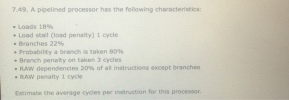 7.49. A pipelined processor has the following characteristics: - Loads 18% . Load stall (load penalty) 1 cycle Branches 2296 Probability a branch is taken 80% e Branch penalty on taken 3 cycles . RAW penalty 1 cycle Estimate the average cycles per instruction for this processor. RAW dependencies 20% of all instructions except branches
The code chain below is executed on a data forwarding, 5-stage pipelined processor. Which of the...
The code chain below is executed on a data forwarding, 5-stage pipelined processor. Which of the following instructions will encounter a stall? Write the instruction number along with the number of stall cycles that instruction experiences. (Note the data forwarding) 1. add $4, $5, $6 2. add $7, $4, $5 3. sw $8, 0($7) 4. add $8, $8, $6 5. lw $6, 0($8) 6. add $10, $9, $8
A non-pipelined processor has a clock rate of 1 GHz and an average instruction takes 9...
A non-pipelined processor has a clock rate of 1 GHz and an average instruction takes 9 cycles to execute. The manufacturer has decided to design a pipelined version of this processor. For this purpose, the instruction cycle has been divided into five stages with the following latencies: Stage 1 – 2.0 ns,Stage 2 – 1.5 ns, Stage 3 – 1.0 ns, Stage 4 – 2.6 ns, Stage 5 – 1.9 ns. Each stage will require an extra 0.4 ns for...
Part 1: A pipelined computer completes instructions more quickly by having more than one instruction at...
Part 1: A pipelined computer completes instructions more quickly by having more than one instruction at a time "in the pipeline." Explain what problem branch instructions cause with instruction pipelining. Describe one approach to overcoming this problem. Part 2: RISC computers generally execute more instructions per second than CISC computers. Describe the penalty or trade-off paid when adopting the RISC architecture. Part 3: When a cache hit to a cache on the CPU chip occurs on a memory write the...
Consider a typical MIPS pipeline with branch penalty 1 cycle (i.e. 1 stall cycle if taken.)...
Consider a typical MIPS pipeline with branch penalty 1 cycle (i.e. 1 stall cycle if taken.) For the following MIPS instruction sequence, branch not taken; BEQ R14, R12, L AND R9, R9, R1 OR R8, R12, R2 SW R12, 0x0004 (R10) L: ADD R10, R14, R12 LW R10, 0x0004(R12) 3. branch is not taken. instr CC1 CC2 CC3 beq
Assume an memory hierarchy with unified data and instruction memories, miss rate equal to 15%, miss penalty equal to 90 cycles, 25% Load/Store instructions, TLB miss ratio per TLB access equal to 6% a...
Assume an memory hierarchy with unified data and instruction memories, miss rate equal to 15%, miss penalty equal to 90 cycles, 25% Load/Store instructions, TLB miss ratio per TLB access equal to 6% and TLB miss penalty equal to 80 cycles. What is the realistic CPI of this system if the ideal CPI is 1.5? What is the speedup compared to not having TLB? What would be the speedup if the TLB could hold every entry?
Based on your work experience briefly describe how an ERP can connect and integrate the cycles...
Based on your work experience briefly describe how an ERP can connect and integrate the cycles of a business (e.g., revenue-expenditure cycles, revenue-payroll cycles, and etc)
Given 3 different instruction types, A, B and C. Each type-A, B and C instruction takes...
 Given 3 different instruction types, A, B and C. Each type-A, B and C instruction takes 30ns, 20ns and 50ns to complete, respectively. An assembly program is written with 20 type-A, 30 type-B and 40 type-C instructions. Assume a single-issue not pipelined processor, how much time (in nano-seconds) is required to complete the execution of this program? Now let us pipeline these instructions based on a cycle time of 10ns. To pipeline these instructions equally and ideally using this cycle...
Please explain briefly the stages of project life cycles and describe their relations to customer interest,...
Please explain briefly the stages of project life cycles and describe their relations to customer interest, scheduling, budgeting (resources), and risks.
A particular (fictional) CPU has the following internal units and timings: 1. IFD: Instruction fetch + decode : 160 ps...
 A particular (fictional) CPU has the following internal units and timings: 1. IFD: Instruction fetch + decode : 160 ps 2. RR: Register read 80 ps 3. ALU: 240 ps 4. MA : memory access: 160 ps (assuming cache) 5. RW : register write : 80 ps There are 5 basic instruction types: 1. LOAD : IFD+RR+ALU+MA+RW 720 ps 2. STORE: IFD+RR+ALU+MA : 640 ps 3. ARITHMETIC: IFD+RR+ALU+RW : 560 4. BRANCH: IFD+RR+ALU : 480 ps 5. MEMOP: IFD+RR+MA+ALU+MA :...
 7.49. A pipelined processor has the following characteristics: - Loads 18% . Load stall (load penalty) 1 cycle Branches 2296 Probability a branch is taken 80% e Branch penalty on taken 3 cycles . RAW penalty 1 cycle Estimate the average cycles per instruction for this processor. RAW dependencies 20% of all instructions except branches
 Given 3 different instruction types, A, B and C. Each type-A, B and C instruction takes 30ns, 20ns and 50ns to complete, respectively. An assembly program is written with 20 type-A, 30 type-B and 40 type-C instructions. Assume a single-issue not pipelined processor, how much time (in nano-seconds) is required to complete the execution of this program? Now let us pipeline these instructions based on a cycle time of 10ns. To pipeline these instructions equally and ideally using this cycle...
 A particular (fictional) CPU has the following internal units and timings: 1. IFD: Instruction fetch + decode : 160 ps 2. RR: Register read 80 ps 3. ALU: 240 ps 4. MA : memory access: 160 ps (assuming cache) 5. RW : register write : 80 ps There are 5 basic instruction types: 1. LOAD : IFD+RR+ALU+MA+RW 720 ps 2. STORE: IFD+RR+ALU+MA : 640 ps 3. ARITHMETIC: IFD+RR+ALU+RW : 560 4. BRANCH: IFD+RR+ALU : 480 ps 5. MEMOP: IFD+RR+MA+ALU+MA :...
Most questions answered within 3 hours.
-
Where is the error in this code sequence?
String s1 = "Hello";
String s2 = "ello";...
asked 10 months ago -
Financial data for Joel de Paris, Inc., for last year
follow:
Joel de Paris, Inc.
Balance...
asked 10 months ago -
Consider this reaction:
Al2(SO4)3 (aq)+ BaCl3
(aq) Al2Cl6 (aq)- +
3BaSO4(s) . What is the...
asked 10 months ago -
Suppose that Savneet is considering increasing her
recent random sample from 20 car rentals to 40...
asked 10 months ago -
Trucks arrive at an unloading terminal at an average rate of 120
per hour.
Trucks arrive...
asked 10 months ago -
Why are methanol and ethanol completely soluble in water while
octanol is not very little soluble....
asked 10 months ago -
A facilities manager at a university reads in a research report
that the mean amount of...
asked 10 months ago -
When the CuSO4 is rehydrated by adding water to the anhydrous
compound, is this an endothermic...
asked 10 months ago -
A ray of sunlight is passing from diamond into crown glass; the
angle of incidence is...
asked 10 months ago -
A block of mass 0.249 kg is placed on top of a light, vertical
spring of...
asked 10 months ago -
how do the kidneys compensate in the presences of acidosis
a) trigger hyperventilate
b) reserve acid...
asked 10 months ago -
Question 501 pts
The rental rate of capital to the firm increases. Which of the
following...
asked 10 months ago