An organism has a lag period of 30 minutes and a generation time of 20 minutes....
An organism has a lag period of 30 minutes and a generation time of 20 minutes. If the original concentration of a culture is 200 organisms/mL, what will be the concentration after 90 minutes?
Homework Answers
Lag phase: Bacterial growth during this phase usually do not increase in number.Bacteria prepares for division and cell size is increased.
Log phase/exponential phase/generation time: Organism doubles in number in this time.
CALCULATIONS:
Given, lag period= 30 minutes.
Generation time= 20 minutes.
Total time given= 90 minutes.
Time left after lag time=(total time)-(lag time)=[(90min) -(30min)]=60 min
Number of generations organism will divide in this 60min=(Total time)/(generation time)= 3 generations
given initial concentration=200 organisms/mL.
organism doubles after each generation.so after first generation ,concentration=400organisms/ml
after second generation=800organisms/ml
after third generation=1600organisms/ml.
therefore after 90 min ,total concentration of organisms=1600organisms/ml
Add Answer to:
An organism has a lag period of 30 minutes and a generation time
of 20 minutes....
A bacterial culture starts at a concentration of 1.0*103 CFU/ml. The generation time is 48 minutes....
A bacterial culture starts at a concentration of 1.0*103 CFU/ml. The generation time is 48 minutes. What is the concentration of the bacterial culture after growing for 16 hours?
A culture of 10 bacteria of Escherichia coli has a generation time of 30 minutes at...
A culture of 10 bacteria of Escherichia coli has a generation time of 30 minutes at 35 degrees Celsius. After 5 hours at this temperature, how many bacteria would you expect to see?" a. "10,240" b. 50 c. "1,000" d. 320 e. "10,000,000,000"
a culture is inoculated at noon with 1810 cfu/ml . thebacteria has one hour lag...
a culture is inoculated at noon with 1810 cfu/ml . the bacteria has one hour lag time . at 9 pm the population is determined to be 316690000 cfu/ml. what is the generation time in minutes
calculate the generation time (minutes/generation) of 4.9*10^6 CFUs/ml calculate the generation time (minutes/ generation) of 155*10^8...
 calculate the generation time (minutes/generation) of
4.9*10^6 CFUs/ml
calculate the generation time (minutes/ generation) of
155*10^8 CFUs/ml
for 3hrs 4.9*10^6
for 6hrs155*10^8
The students UR S pes at diferent times during the growth to do dilution plating and get viable plate counts. Here are the results for the samples taken at hours 3 and 6: 3 hours 10 dilution - too many to count 10"dilution - 476 CFUS 10% dilution - 49 CFUS 10 dilution = 5 CFUS 6 hours...
calculate the generation time (minutes/generation) of
4.9*10^6 CFUs/ml
calculate the generation time (minutes/ generation) of
155*10^8 CFUs/ml
for 3hrs 4.9*10^6
for 6hrs155*10^8
The students UR S pes at diferent times during the growth to do dilution plating and get viable plate counts. Here are the results for the samples taken at hours 3 and 6: 3 hours 10 dilution - too many to count 10"dilution - 476 CFUS 10% dilution - 49 CFUS 10 dilution = 5 CFUS 6 hours...
If escheria coli has a generation time of 20 minutes, will you be able to construct...
If escheria coli has a generation time of 20 minutes, will you be able to construct a growth curve from the following data ? Initial time 0 absorbance 0.05 cell number per every mL 1.0x10⁷ . Ending Time 20 minutes absorbance 0.07 cell number 1.0x10⁷ ?
Consider a culture of E. coli growing in exponential phase with a generation time of 20...
Consider a culture of E. coli growing in exponential phase with a generation time of 20 minutes. Beginning with 2 x 10⁶ cells per ml, how long will it take the culture to reach a density of about 3.2 x 10⁷ cells per ml?
The bacteria you are using grow with a generation time of 18 minutes in the medium...
The bacteria you are using grow with a generation time of 18 minutes in the medium that you are using. You inoculate the flask of medium with 8.00×10⁴ bacteria. The flask is incubated for 180 minutes. Assume there is no lag phase and the culture does not reach stationary phase during the period of incubation. Within 5%, what is final number of bacteria in the flask? (Do not use scientific notation to enter your answer. Enter 4.2 x 10⁷ as...
please answer both questions and show necessary work 4. If Bacterium X has a generation time of 60 minutes and 10 Ba...
 please answer both questions and show necessary
work
4. If Bacterium X has a generation time of 60 minutes and 10 Bacteria X cells are inoculated into broth, how many hours will it be before there are 10° Bacteria Y colls in the broth culture? You MUST SHOW YOUR WORK to get credit. (2 % pts. total) 5. Using the graph below, draw the expected growth curve for a bacterial microorganism that spends 60 minutes in the lag phase, undergoes...
please answer both questions and show necessary
work
4. If Bacterium X has a generation time of 60 minutes and 10 Bacteria X cells are inoculated into broth, how many hours will it be before there are 10° Bacteria Y colls in the broth culture? You MUST SHOW YOUR WORK to get credit. (2 % pts. total) 5. Using the graph below, draw the expected growth curve for a bacterial microorganism that spends 60 minutes in the lag phase, undergoes...
Question 4 "A culture of 10 bacteria of Escherichia coli has a generation time of 30...
 Question 4 "A culture of 10 bacteria of Escherichia coli has a generation time of 30 minutes at 35 degrees Celsius. After Shours at this temperature, how many bacteria would you expect to 10,240 50 "1.000 320 10,000,000,000 Question 5 Which of the following types of media would not be used to culture aerobes? reducing media selective media enrichment media o differential media complex media Question 6 Which is an indirect method of measuring microbial growth? metabolic activity microscopic count...
please answ these 2 Q: generation time 20 min What is the time required for 5...
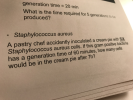 please answ these 2 Q:
generation time 20 min What is the time required for 5 generations to be produced? Staphylococcus aureus A pastry chef accidently inoculated a cream pie Staphylococcus aureus cells. If this gram positive bacteria has a generation time of 60 minutes, how many cells would be in the cream pie after 7h?
please answ these 2 Q:
generation time 20 min What is the time required for 5 generations to be produced? Staphylococcus aureus A pastry chef accidently inoculated a cream pie Staphylococcus aureus cells. If this gram positive bacteria has a generation time of 60 minutes, how many cells would be in the cream pie after 7h?
 calculate the generation time (minutes/generation) of
4.9*10^6 CFUs/ml
calculate the generation time (minutes/ generation) of
155*10^8 CFUs/ml
for 3hrs 4.9*10^6
for 6hrs155*10^8
The students UR S pes at diferent times during the growth to do dilution plating and get viable plate counts. Here are the results for the samples taken at hours 3 and 6: 3 hours 10 dilution - too many to count 10"dilution - 476 CFUS 10% dilution - 49 CFUS 10 dilution = 5 CFUS 6 hours...
calculate the generation time (minutes/generation) of
4.9*10^6 CFUs/ml
calculate the generation time (minutes/ generation) of
155*10^8 CFUs/ml
for 3hrs 4.9*10^6
for 6hrs155*10^8
The students UR S pes at diferent times during the growth to do dilution plating and get viable plate counts. Here are the results for the samples taken at hours 3 and 6: 3 hours 10 dilution - too many to count 10"dilution - 476 CFUS 10% dilution - 49 CFUS 10 dilution = 5 CFUS 6 hours...
 please answer both questions and show necessary
work
4. If Bacterium X has a generation time of 60 minutes and 10 Bacteria X cells are inoculated into broth, how many hours will it be before there are 10° Bacteria Y colls in the broth culture? You MUST SHOW YOUR WORK to get credit. (2 % pts. total) 5. Using the graph below, draw the expected growth curve for a bacterial microorganism that spends 60 minutes in the lag phase, undergoes...
please answer both questions and show necessary
work
4. If Bacterium X has a generation time of 60 minutes and 10 Bacteria X cells are inoculated into broth, how many hours will it be before there are 10° Bacteria Y colls in the broth culture? You MUST SHOW YOUR WORK to get credit. (2 % pts. total) 5. Using the graph below, draw the expected growth curve for a bacterial microorganism that spends 60 minutes in the lag phase, undergoes...
 Question 4 "A culture of 10 bacteria of Escherichia coli has a generation time of 30 minutes at 35 degrees Celsius. After Shours at this temperature, how many bacteria would you expect to 10,240 50 "1.000 320 10,000,000,000 Question 5 Which of the following types of media would not be used to culture aerobes? reducing media selective media enrichment media o differential media complex media Question 6 Which is an indirect method of measuring microbial growth? metabolic activity microscopic count...
 please answ these 2 Q:
generation time 20 min What is the time required for 5 generations to be produced? Staphylococcus aureus A pastry chef accidently inoculated a cream pie Staphylococcus aureus cells. If this gram positive bacteria has a generation time of 60 minutes, how many cells would be in the cream pie after 7h?
please answ these 2 Q:
generation time 20 min What is the time required for 5 generations to be produced? Staphylococcus aureus A pastry chef accidently inoculated a cream pie Staphylococcus aureus cells. If this gram positive bacteria has a generation time of 60 minutes, how many cells would be in the cream pie after 7h?
Most questions answered within 3 hours.
-
Where is the error in this code sequence?
String s1 = "Hello";
String s2 = "ello";...
asked 11 months ago -
Financial data for Joel de Paris, Inc., for last year
follow:
Joel de Paris, Inc.
Balance...
asked 11 months ago -
Consider this reaction:
Al2(SO4)3 (aq)+ BaCl3
(aq) Al2Cl6 (aq)- +
3BaSO4(s) . What is the...
asked 11 months ago -
Suppose that Savneet is considering increasing her
recent random sample from 20 car rentals to 40...
asked 11 months ago -
Trucks arrive at an unloading terminal at an average rate of 120
per hour.
Trucks arrive...
asked 11 months ago -
Why are methanol and ethanol completely soluble in water while
octanol is not very little soluble....
asked 11 months ago -
A facilities manager at a university reads in a research report
that the mean amount of...
asked 11 months ago -
When the CuSO4 is rehydrated by adding water to the anhydrous
compound, is this an endothermic...
asked 11 months ago -
A ray of sunlight is passing from diamond into crown glass; the
angle of incidence is...
asked 11 months ago -
A block of mass 0.249 kg is placed on top of a light, vertical
spring of...
asked 11 months ago -
how do the kidneys compensate in the presences of acidosis
a) trigger hyperventilate
b) reserve acid...
asked 11 months ago -
Question 501 pts
The rental rate of capital to the firm increases. Which of the
following...
asked 11 months ago