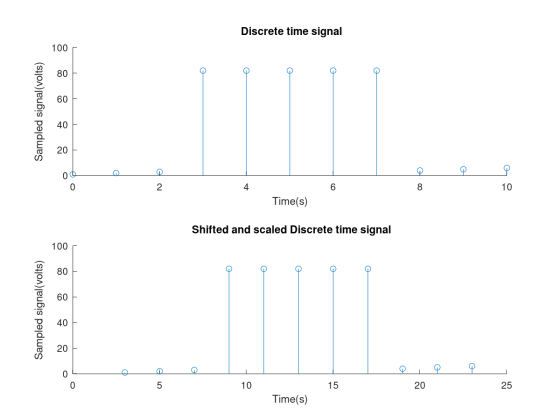
If the input signal x(n) =[1,2,3,82,82,82,82,82,4, 5,6] plot x(2n+3) in Matlab. What is the code of...
If the input signal x(n) =[1,2,3,82,82,82,82,82,4,
5,6] plot x(2n+3) in Matlab.
What is the code of the above signal?
Homework Answers
Matlab code
clc
clear all
n=0:1:10;
x=[1,2,3,82,82,82,82,82,4, 5,6];
figure(1)
subplot(2,1,1),stem(n,x);
title(' Discrete time signal');
xlabel('Time(s)');
ylabel('Sampled signal(volts)');
%shifted and scaled signal
n1=2*n+3;
subplot(2,1,2),stem(n1,x);
title(' Shifted and scaled Discrete time signal');
xlabel('Time(s)');
ylabel('Sampled signal(volts)');
Add Answer to:
If the input signal x(n) =[1,2,3,82,82,82,82,82,4,
5,6] plot x(2n+3) in Matlab.
What is the code of...
for the plot, provide the matlab code. 3. Let the input signal x[n] (defined for -<n...
 for the plot, provide the matlab code.
3. Let the input signal x[n] (defined for -<n < oo) to the system be x[n] = 3 cos( 0.05πn) + 4 cos( 0.45πn) + cos( 0.95 n) and the transfer function be 1-re-je a) Plot this signal as a function of n. b) Determine and plot the output y[n] produced by the system due to the input analyzed in part a) of this problem. Do this first with r 0.05 and then...
for the plot, provide the matlab code.
3. Let the input signal x[n] (defined for -<n < oo) to the system be x[n] = 3 cos( 0.05πn) + 4 cos( 0.45πn) + cos( 0.95 n) and the transfer function be 1-re-je a) Plot this signal as a function of n. b) Determine and plot the output y[n] produced by the system due to the input analyzed in part a) of this problem. Do this first with r 0.05 and then...
5. Consider the signal x (t) = cos (2n . 500) + cos (2n . 1...
 5. Consider the signal x (t) = cos (2n . 500) + cos (2n . 1 500). Its spectrum X1c" consists of a pair of spectral lines at positive and negative frequencies. Use the MATLAB command fft to find and plot the signal's spectrum using various values of N.
develop a matlab code to plot: fn(n)=x-x^(n+1) for different n's till solution convergence then the matlab...
develop a matlab code to plot: fn(n)=x-x^(n+1) for different n's till solution convergence then the matlab code should contain a least square approach to prove the convergence of solution.
Please provide MATLAB code and plot, about system response. Will thumbs up. Thanks. Question 1: MATLAB contains a built-...
 Please provide MATLAB code and plot, about system response. Will
thumbs up. Thanks.
Question 1: MATLAB contains a built-in function called conv which performs the convolution of two vectors: >> help conv conv Convolution and polynomial multiplication. C - conv(A, B) convolves vectors A and B. The resulting vector is length MAX ([LENGTH (A)+LENGTH (B)-1, LENGTH(A),LENGTH (B) 1) If A and B are vectors of polynomial coefficients, convolving them is equivalent to multiplying the two polynomials. Compute the system response...
Please provide MATLAB code and plot, about system response. Will
thumbs up. Thanks.
Question 1: MATLAB contains a built-in function called conv which performs the convolution of two vectors: >> help conv conv Convolution and polynomial multiplication. C - conv(A, B) convolves vectors A and B. The resulting vector is length MAX ([LENGTH (A)+LENGTH (B)-1, LENGTH(A),LENGTH (B) 1) If A and B are vectors of polynomial coefficients, convolving them is equivalent to multiplying the two polynomials. Compute the system response...
Use MATLAB to compute the convolution as a sum ofechoes of the input signal x[n] = cos () with th...
 Use MATLAB to compute the convolution as a sum ofechoes of the input signal x[n] = cos () with the impulse response h[n]1.5un un - 6]) of an LTI system S. Is the output periodic? Why or why not? Please explain.
Use MATLAB to compute the convolution as a sum ofechoes of the input signal x[n] = cos () with the impulse response h[n]1.5un un - 6]) of an LTI system S. Is the output periodic? Why or why not?...
Use MATLAB to compute the convolution as a sum ofechoes of the input signal x[n] = cos () with the impulse response h[n]1.5un un - 6]) of an LTI system S. Is the output periodic? Why or why not? Please explain.
Use MATLAB to compute the convolution as a sum ofechoes of the input signal x[n] = cos () with the impulse response h[n]1.5un un - 6]) of an LTI system S. Is the output periodic? Why or why not?...
yin]-[x, -X]. Plot the magnitude of XIK] and YK] in Problem 1. Let x[n]=cos(2n/20*n)+randn( 1, 20) for n= 1:20 Matlab. x(k) is the fft of x zero padded to 40 data points. What is the relationship bet...
 yin]-[x, -X]. Plot the magnitude of XIK] and YK] in Problem 1. Let x[n]=cos(2n/20*n)+randn( 1, 20) for n= 1:20 Matlab. x(k) is the fft of x zero padded to 40 data points. What is the relationship between X[k] and YK? data points. What is the relationship between XIK] and YIK]?
yin]-[x, -X]. Plot the magnitude of XIK] and YK] in Problem 1. Let x[n]=cos(2n/20*n)+randn( 1, 20) for n= 1:20 Matlab. x(k) is the fft of x zero padded to 40...
yin]-[x, -X]. Plot the magnitude of XIK] and YK] in Problem 1. Let x[n]=cos(2n/20*n)+randn( 1, 20) for n= 1:20 Matlab. x(k) is the fft of x zero padded to 40 data points. What is the relationship between X[k] and YK? data points. What is the relationship between XIK] and YIK]?
yin]-[x, -X]. Plot the magnitude of XIK] and YK] in Problem 1. Let x[n]=cos(2n/20*n)+randn( 1, 20) for n= 1:20 Matlab. x(k) is the fft of x zero padded to 40...
consider the signal using matlab Problem 2: Consider a signal: x[n] 3cos(n7/3) + 2sin(nt/4)+ cos(n7/5) Using...
 consider the signal using matlab
Problem 2: Consider a signal: x[n] 3cos(n7/3) + 2sin(nt/4)+ cos(n7/5) Using Matlab, (1) Plot this signal in time domain. Can you identify the various frequencies in this signal? Use n 0:1:1000 (2) Plot this signal in frequency domain using the "fft" command. Identify the individual frequencies in the plot. (3) Calculate the frequencies of these signals. In the frequency plot, 1000 2
consider the signal using matlab
Problem 2: Consider a signal: x[n] 3cos(n7/3) + 2sin(nt/4)+ cos(n7/5) Using Matlab, (1) Plot this signal in time domain. Can you identify the various frequencies in this signal? Use n 0:1:1000 (2) Plot this signal in frequency domain using the "fft" command. Identify the individual frequencies in the plot. (3) Calculate the frequencies of these signals. In the frequency plot, 1000 2
MATLAB PLEASE MATLAB PLEASE 9. Consider the following discrete-time exponential signal r(n) 75(-0.95)"u(n-3) (a)...
 MATLAB PLEASE
9. Consider the following discrete-time exponential signal r(n) 75(-0.95)"u(n-3) (a) Plot r(n) over the range (b) Find the sum of the sequence for the above range. Hence, verify the result using the n0,1,2..,20. closed form. (c) Determine the sum of the sequence r(n) over the entire range of integers, i.e. n0,1,2,.o. (d) Find the energy of the sequence x(n)
9. Consider the following discrete-time exponential signal r(n) 75(-0.95)"u(n-3) (a) Plot r(n) over the range (b) Find...
MATLAB PLEASE
MATLAB PLEASE
9. Consider the following discrete-time exponential signal r(n) 75(-0.95)"u(n-3) (a) Plot r(n) over the range (b) Find the sum of the sequence for the above range. Hence, verify the result using the n0,1,2..,20. closed form. (c) Determine the sum of the sequence r(n) over the entire range of integers, i.e. n0,1,2,.o. (d) Find the energy of the sequence x(n)
9. Consider the following discrete-time exponential signal r(n) 75(-0.95)"u(n-3) (a) Plot r(n) over the range (b) Find...
MATLAB Code Question alpha = 2.3 beta = 4.3 zeta = 9.1 PROBLEM 4 (20 points). Consider three sinusoids with the following amplitudes and phases a.cs(2n(500t)) β.cos(2n(500t) +0.5r) x1n] x2[n] rn...
 MATLAB Code Question
alpha = 2.3
beta = 4.3
zeta = 9.1
PROBLEM 4 (20 points). Consider three sinusoids with the following amplitudes and phases a.cs(2n(500t)) β.cos(2n(500t) +0.5r) x1n] x2[n] rn = cos(2(500t)0.75) Create a MATLAB program to sample each sinusoid and generate a sum of three sinusoids, that is using a sampling rate of 8,000 Hz over a range of 0.1 seconds Use the MATLAB function stem) to plot r[n] for the first 20 samples Use the MATLAB function...
MATLAB Code Question
alpha = 2.3
beta = 4.3
zeta = 9.1
PROBLEM 4 (20 points). Consider three sinusoids with the following amplitudes and phases a.cs(2n(500t)) β.cos(2n(500t) +0.5r) x1n] x2[n] rn = cos(2(500t)0.75) Create a MATLAB program to sample each sinusoid and generate a sum of three sinusoids, that is using a sampling rate of 8,000 Hz over a range of 0.1 seconds Use the MATLAB function stem) to plot r[n] for the first 20 samples Use the MATLAB function...
please write code in MATLAB as well 5. (12 points) Create the following signal in Matlab:...
 please write code in MATLAB as well
5. (12 points) Create the following signal in Matlab: x[n] = u(n) - u[n-6] a. Mathematically compute yi[n] = x[n] * x[n] where * means convolution. Now use the conv command to perform the convolution. Graph x[n) and the resulting y(n), both over the interval Osns 20. How many non-zero terms does y(n) have? Does your computational result agree with the Matlab result? b. Repeat a. but this time with yz[n] = x[n]*h[n)...
please write code in MATLAB as well
5. (12 points) Create the following signal in Matlab: x[n] = u(n) - u[n-6] a. Mathematically compute yi[n] = x[n] * x[n] where * means convolution. Now use the conv command to perform the convolution. Graph x[n) and the resulting y(n), both over the interval Osns 20. How many non-zero terms does y(n) have? Does your computational result agree with the Matlab result? b. Repeat a. but this time with yz[n] = x[n]*h[n)...
 for the plot, provide the matlab code.
3. Let the input signal x[n] (defined for -<n < oo) to the system be x[n] = 3 cos( 0.05πn) + 4 cos( 0.45πn) + cos( 0.95 n) and the transfer function be 1-re-je a) Plot this signal as a function of n. b) Determine and plot the output y[n] produced by the system due to the input analyzed in part a) of this problem. Do this first with r 0.05 and then...
for the plot, provide the matlab code.
3. Let the input signal x[n] (defined for -<n < oo) to the system be x[n] = 3 cos( 0.05πn) + 4 cos( 0.45πn) + cos( 0.95 n) and the transfer function be 1-re-je a) Plot this signal as a function of n. b) Determine and plot the output y[n] produced by the system due to the input analyzed in part a) of this problem. Do this first with r 0.05 and then...
 5. Consider the signal x (t) = cos (2n . 500) + cos (2n . 1 500). Its spectrum X1c" consists of a pair of spectral lines at positive and negative frequencies. Use the MATLAB command fft to find and plot the signal's spectrum using various values of N.
 Please provide MATLAB code and plot, about system response. Will
thumbs up. Thanks.
Question 1: MATLAB contains a built-in function called conv which performs the convolution of two vectors: >> help conv conv Convolution and polynomial multiplication. C - conv(A, B) convolves vectors A and B. The resulting vector is length MAX ([LENGTH (A)+LENGTH (B)-1, LENGTH(A),LENGTH (B) 1) If A and B are vectors of polynomial coefficients, convolving them is equivalent to multiplying the two polynomials. Compute the system response...
Please provide MATLAB code and plot, about system response. Will
thumbs up. Thanks.
Question 1: MATLAB contains a built-in function called conv which performs the convolution of two vectors: >> help conv conv Convolution and polynomial multiplication. C - conv(A, B) convolves vectors A and B. The resulting vector is length MAX ([LENGTH (A)+LENGTH (B)-1, LENGTH(A),LENGTH (B) 1) If A and B are vectors of polynomial coefficients, convolving them is equivalent to multiplying the two polynomials. Compute the system response...
 Use MATLAB to compute the convolution as a sum ofechoes of the input signal x[n] = cos () with the impulse response h[n]1.5un un - 6]) of an LTI system S. Is the output periodic? Why or why not? Please explain.
Use MATLAB to compute the convolution as a sum ofechoes of the input signal x[n] = cos () with the impulse response h[n]1.5un un - 6]) of an LTI system S. Is the output periodic? Why or why not?...
Use MATLAB to compute the convolution as a sum ofechoes of the input signal x[n] = cos () with the impulse response h[n]1.5un un - 6]) of an LTI system S. Is the output periodic? Why or why not? Please explain.
Use MATLAB to compute the convolution as a sum ofechoes of the input signal x[n] = cos () with the impulse response h[n]1.5un un - 6]) of an LTI system S. Is the output periodic? Why or why not?...
 yin]-[x, -X]. Plot the magnitude of XIK] and YK] in Problem 1. Let x[n]=cos(2n/20*n)+randn( 1, 20) for n= 1:20 Matlab. x(k) is the fft of x zero padded to 40 data points. What is the relationship between X[k] and YK? data points. What is the relationship between XIK] and YIK]?
yin]-[x, -X]. Plot the magnitude of XIK] and YK] in Problem 1. Let x[n]=cos(2n/20*n)+randn( 1, 20) for n= 1:20 Matlab. x(k) is the fft of x zero padded to 40...
yin]-[x, -X]. Plot the magnitude of XIK] and YK] in Problem 1. Let x[n]=cos(2n/20*n)+randn( 1, 20) for n= 1:20 Matlab. x(k) is the fft of x zero padded to 40 data points. What is the relationship between X[k] and YK? data points. What is the relationship between XIK] and YIK]?
yin]-[x, -X]. Plot the magnitude of XIK] and YK] in Problem 1. Let x[n]=cos(2n/20*n)+randn( 1, 20) for n= 1:20 Matlab. x(k) is the fft of x zero padded to 40...
 consider the signal using matlab
Problem 2: Consider a signal: x[n] 3cos(n7/3) + 2sin(nt/4)+ cos(n7/5) Using Matlab, (1) Plot this signal in time domain. Can you identify the various frequencies in this signal? Use n 0:1:1000 (2) Plot this signal in frequency domain using the "fft" command. Identify the individual frequencies in the plot. (3) Calculate the frequencies of these signals. In the frequency plot, 1000 2
consider the signal using matlab
Problem 2: Consider a signal: x[n] 3cos(n7/3) + 2sin(nt/4)+ cos(n7/5) Using Matlab, (1) Plot this signal in time domain. Can you identify the various frequencies in this signal? Use n 0:1:1000 (2) Plot this signal in frequency domain using the "fft" command. Identify the individual frequencies in the plot. (3) Calculate the frequencies of these signals. In the frequency plot, 1000 2
 MATLAB PLEASE
9. Consider the following discrete-time exponential signal r(n) 75(-0.95)"u(n-3) (a) Plot r(n) over the range (b) Find the sum of the sequence for the above range. Hence, verify the result using the n0,1,2..,20. closed form. (c) Determine the sum of the sequence r(n) over the entire range of integers, i.e. n0,1,2,.o. (d) Find the energy of the sequence x(n)
9. Consider the following discrete-time exponential signal r(n) 75(-0.95)"u(n-3) (a) Plot r(n) over the range (b) Find...
MATLAB PLEASE
MATLAB PLEASE
9. Consider the following discrete-time exponential signal r(n) 75(-0.95)"u(n-3) (a) Plot r(n) over the range (b) Find the sum of the sequence for the above range. Hence, verify the result using the n0,1,2..,20. closed form. (c) Determine the sum of the sequence r(n) over the entire range of integers, i.e. n0,1,2,.o. (d) Find the energy of the sequence x(n)
9. Consider the following discrete-time exponential signal r(n) 75(-0.95)"u(n-3) (a) Plot r(n) over the range (b) Find...
 MATLAB Code Question
alpha = 2.3
beta = 4.3
zeta = 9.1
PROBLEM 4 (20 points). Consider three sinusoids with the following amplitudes and phases a.cs(2n(500t)) β.cos(2n(500t) +0.5r) x1n] x2[n] rn = cos(2(500t)0.75) Create a MATLAB program to sample each sinusoid and generate a sum of three sinusoids, that is using a sampling rate of 8,000 Hz over a range of 0.1 seconds Use the MATLAB function stem) to plot r[n] for the first 20 samples Use the MATLAB function...
MATLAB Code Question
alpha = 2.3
beta = 4.3
zeta = 9.1
PROBLEM 4 (20 points). Consider three sinusoids with the following amplitudes and phases a.cs(2n(500t)) β.cos(2n(500t) +0.5r) x1n] x2[n] rn = cos(2(500t)0.75) Create a MATLAB program to sample each sinusoid and generate a sum of three sinusoids, that is using a sampling rate of 8,000 Hz over a range of 0.1 seconds Use the MATLAB function stem) to plot r[n] for the first 20 samples Use the MATLAB function...
 please write code in MATLAB as well
5. (12 points) Create the following signal in Matlab: x[n] = u(n) - u[n-6] a. Mathematically compute yi[n] = x[n] * x[n] where * means convolution. Now use the conv command to perform the convolution. Graph x[n) and the resulting y(n), both over the interval Osns 20. How many non-zero terms does y(n) have? Does your computational result agree with the Matlab result? b. Repeat a. but this time with yz[n] = x[n]*h[n)...
please write code in MATLAB as well
5. (12 points) Create the following signal in Matlab: x[n] = u(n) - u[n-6] a. Mathematically compute yi[n] = x[n] * x[n] where * means convolution. Now use the conv command to perform the convolution. Graph x[n) and the resulting y(n), both over the interval Osns 20. How many non-zero terms does y(n) have? Does your computational result agree with the Matlab result? b. Repeat a. but this time with yz[n] = x[n]*h[n)...
Most questions answered within 3 hours.
-
Where is the error in this code sequence?
String s1 = "Hello";
String s2 = "ello";...
asked 10 months ago -
Financial data for Joel de Paris, Inc., for last year
follow:
Joel de Paris, Inc.
Balance...
asked 10 months ago -
Consider this reaction:
Al2(SO4)3 (aq)+ BaCl3
(aq) Al2Cl6 (aq)- +
3BaSO4(s) . What is the...
asked 10 months ago -
Suppose that Savneet is considering increasing her
recent random sample from 20 car rentals to 40...
asked 10 months ago -
Trucks arrive at an unloading terminal at an average rate of 120
per hour.
Trucks arrive...
asked 10 months ago -
Why are methanol and ethanol completely soluble in water while
octanol is not very little soluble....
asked 10 months ago -
A facilities manager at a university reads in a research report
that the mean amount of...
asked 10 months ago -
When the CuSO4 is rehydrated by adding water to the anhydrous
compound, is this an endothermic...
asked 10 months ago -
A ray of sunlight is passing from diamond into crown glass; the
angle of incidence is...
asked 10 months ago -
A block of mass 0.249 kg is placed on top of a light, vertical
spring of...
asked 10 months ago -
how do the kidneys compensate in the presences of acidosis
a) trigger hyperventilate
b) reserve acid...
asked 10 months ago -
Question 501 pts
The rental rate of capital to the firm increases. Which of the
following...
asked 10 months ago