What behavior deserves criminal punishment? Explain the purposes of criminal punishment (deterrence, incapacitation, rehabilitation).
What behavior deserves criminal punishment? Explain the purposes of criminal punishment (deterrence, incapacitation, rehabilitation).
Homework Answers
a. Incapacitation -- preventing future crimes by making it physically impossible to harm others
b.Deterrence – the use of punishment to prevent or reduce future crimes
c.Rehabilitation – aims to prevent future crimes by changing individual offenders sothat they want to play by the rules and won’t commit any more crimes in the future.

Add Answer to:
What behavior deserves criminal punishment? Explain the purposes
of criminal punishment (deterrence, incapacitation,
rehabilitation).
The central issue in crime and Punishment revolves around what kind of behavior constitutes criminal conduct...
The central issue in crime and Punishment revolves around what kind of behavior constitutes criminal conduct and what kind of punishment is a appropriate for criminal behavior. Explain your choices in this scenario by addressing the following questions. What factors come into play to determine whether someone should be charged with committing a crime?
There are five correctional philosophies which are incapacitation, deterrence, restitution, retribution, and rehabilitation. Give examples of...
There are five correctional philosophies which are incapacitation, deterrence, restitution, retribution, and rehabilitation. Give examples of each and how they have been used.
How does rehabilitation reduce criminal behavior? Provide an example of how rehabilitation could work with someone...
How does rehabilitation reduce criminal behavior? Provide an example of how rehabilitation could work with someone who was convicted of robbing a bank.
The goals and philosophy of punishment have evolved over time; why has this been necessary, and...
The goals and philosophy of punishment have evolved over time; why has this been necessary, and how has society adapted to the changes? Consider the first three steps of the Criminal Justice Decision Making Model: 1. Define the problem (and the questions that need to be answered). 2, Gather evidence (law, policy, procedure, data) and evaluate for relevancy. 3. Weigh moral considerations and direct/indirect consequences. Following Steps 4 and 5 of the Decision-Making Model, write an essay comparing and contrasting...
Suppose that optimal deterrence of a particular crime requires setting the expected punishment equal to $2,000....
Suppose that optimal deterrence of a particular crime requires setting the expected punishment equal to $2,000. Assume that the probability of apprehension is fixed at .2. a. Suppose an offender has wealth of $5,000 and incurs a cost of $1,000 per month spent in prison. What combination of a fine and prison term achieves optimal deterrence at the lowest cost? b. What combination of a fine and prison term is optimal for an offender with wealth of $7,000? (Assume he...
What type of behavior or action may be classified as a criminal act? What type of...
What type of behavior or action may be classified as a criminal act? What type of behavior or action may be classified as a tort? Explain why some crimes are torts while some torts may not be considered a crime. Provide examples to support your explanation. (INCLUDE WORK CITED AND IN TEXT CITATIONS. MUST BE 150 WORDS .)
Question 21 1 pts What is a weakness of the deterrence model? It neglects to be...
 Question 21 1 pts What is a weakness of the deterrence model? It neglects to be proactive. Its primary purpose is to enact revenge. O It is usually more expensive to implement than the other theories of legal punishment. It allows punishments that do not fit the crime.
QUESTIONS FOR DISCUSSIO 1. What are the purposes of criminal sen- 2. tencing? What sentencing strategies...
 QUESTIONS FOR DISCUSSIO 1. What are the purposes of criminal sen- 2. tencing? What sentencing strategies are most closely associated with each sen- tencing purpose?
What social, political, and organizational behavior can influence change in criminal justice agencies?
What social, political, and organizational behavior can influence change in criminal justice agencies?
What is the one major flaw of punishment? Punishment does not promote learning about the desired...
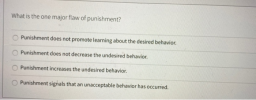 What is the one major flaw of punishment? Punishment does not promote learning about the desired behavior. Punishment does not decrease the undesired behavior. Punishment increases the undesired behavior. Punishment signals that an unacceptable behavior has occurred. Keller and Marian Breland found it was pretty much impossible to train raccoons to drop coins in a slot to receive a food reward. The raccoons spent most of the time rubbing the coins between their paws. This can be explained by the...
 Question 21 1 pts What is a weakness of the deterrence model? It neglects to be proactive. Its primary purpose is to enact revenge. O It is usually more expensive to implement than the other theories of legal punishment. It allows punishments that do not fit the crime.
 QUESTIONS FOR DISCUSSIO 1. What are the purposes of criminal sen- 2. tencing? What sentencing strategies are most closely associated with each sen- tencing purpose?
 What is the one major flaw of punishment? Punishment does not promote learning about the desired behavior. Punishment does not decrease the undesired behavior. Punishment increases the undesired behavior. Punishment signals that an unacceptable behavior has occurred. Keller and Marian Breland found it was pretty much impossible to train raccoons to drop coins in a slot to receive a food reward. The raccoons spent most of the time rubbing the coins between their paws. This can be explained by the...
Most questions answered within 3 hours.
-
Where is the error in this code sequence?
String s1 = "Hello";
String s2 = "ello";...
asked 10 months ago -
Financial data for Joel de Paris, Inc., for last year
follow:
Joel de Paris, Inc.
Balance...
asked 10 months ago -
Consider this reaction:
Al2(SO4)3 (aq)+ BaCl3
(aq) Al2Cl6 (aq)- +
3BaSO4(s) . What is the...
asked 10 months ago -
Suppose that Savneet is considering increasing her
recent random sample from 20 car rentals to 40...
asked 10 months ago -
Trucks arrive at an unloading terminal at an average rate of 120
per hour.
Trucks arrive...
asked 10 months ago -
Why are methanol and ethanol completely soluble in water while
octanol is not very little soluble....
asked 10 months ago -
A facilities manager at a university reads in a research report
that the mean amount of...
asked 10 months ago -
When the CuSO4 is rehydrated by adding water to the anhydrous
compound, is this an endothermic...
asked 10 months ago -
A ray of sunlight is passing from diamond into crown glass; the
angle of incidence is...
asked 10 months ago -
A block of mass 0.249 kg is placed on top of a light, vertical
spring of...
asked 10 months ago -
how do the kidneys compensate in the presences of acidosis
a) trigger hyperventilate
b) reserve acid...
asked 10 months ago -
Question 501 pts
The rental rate of capital to the firm increases. Which of the
following...
asked 10 months ago