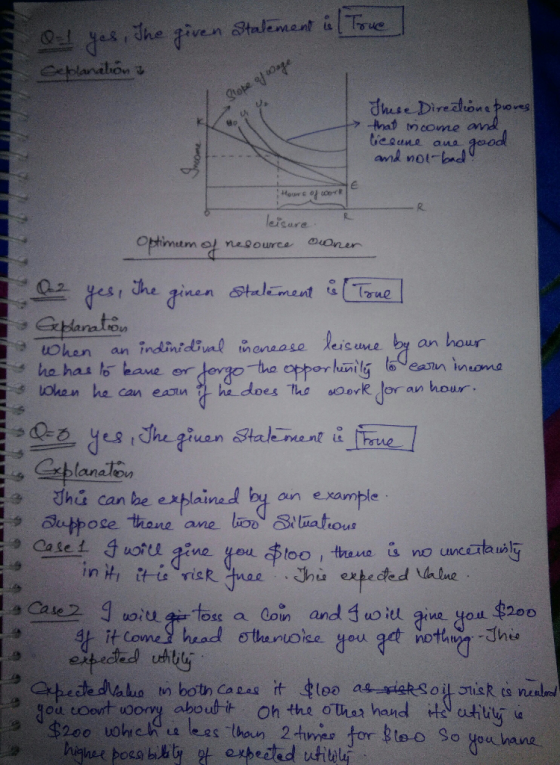
1. Hours of leisure and units of income are both goods, not bads. True or false...
Homework Answers
PLEASE GIVE YOUR VALUABLE REVIEWS ABOUT THE ANSWER IN THE COMMENT BOX AND YOU CAN ALSO GIVE THUMBS UP IF YOU LIKE THE ANSWER.
THANK YOU.
Add Answer to:
1. Hours of leisure and units of income are both goods,
not bads.
True or false...
Assume that a consumer’s satisfaction depends upon leisure (L) and income (Y), so that the utility...
Assume that a consumer’s satisfaction depends upon leisure (L) and income (Y), so that the utility function is: U = 48L + LY – L2 Let N denote the hours of work by the consumer and W the hourly wage rate. Consequently, Y = WN and L + N = 24. If the hourly wage rate is $15 per hour: a) What are the utility maximizing hours of leisure, L*? b) What are the utility maximizing hours of work, N*?
INCOME (Dollars) Kate has 80 hours per week to devote to working or to leisure. She...
 INCOME (Dollars) Kate has 80 hours per week to devote to working or to leisure. She is paid an hourly wage and can work at her job as many hours a week as she likes. The following graph illustrates Kate's weekly income-lelsure tradeoff. The three lines labeled BC, BC, and BC illustrate her time allocation budget at three different wages; points A, B, and C show her optimal time allocation choices along each of these constralints BC 1200 BC 800...
Labor Economics 1. In the leisure-income model, the wage constraint shows a. the points that maximize...
 Labor Economics
1. In the leisure-income model, the wage constraint shows a. the points that maximize a worker's utility b. all points that are equally preferred c. the wage rates that affect work decisions d. the available combinations of leisure and income 2. The slope of a wage constraint reflects the: a. rate at which a person is willing to substitute leisure for income c. income effect b. price of leisure d. substitution effect 3. When a worker maximizes her...
Labor Economics
1. In the leisure-income model, the wage constraint shows a. the points that maximize a worker's utility b. all points that are equally preferred c. the wage rates that affect work decisions d. the available combinations of leisure and income 2. The slope of a wage constraint reflects the: a. rate at which a person is willing to substitute leisure for income c. income effect b. price of leisure d. substitution effect 3. When a worker maximizes her...
A person chooses between leisure and consumption. All of their consumption comes from current income. The...
 A person chooses between leisure and consumption. All of their consumption comes from current income. The utility derived from any combination of leisure and consumption is given by U- YL-88Y where U is utility, L is the hours of leisure per week and Yis the number of dollars of income all of which will be spent on consumption. The person can work as many hours as they wish during the week at a constant wage of $4 per hour. There...
Need as much details as possible. Microeconomics. 2. Vera's utility over consumption (that is, all goods and service...
 Need as much details as possible. Microeconomics.
2. Vera's utility over consumption (that is, all goods and services that she buys), C, and leisure (work- free time), L, is U(CL)-CL. Her hourly wage is w=10 €. Suppose that she can work for 24 hours a day if she wants to and that the price of consumption is p . (a) How many units of consumption can Vera buy in a day if she works non-stop? What if she works 24-L...
Need as much details as possible. Microeconomics.
2. Vera's utility over consumption (that is, all goods and services that she buys), C, and leisure (work- free time), L, is U(CL)-CL. Her hourly wage is w=10 €. Suppose that she can work for 24 hours a day if she wants to and that the price of consumption is p . (a) How many units of consumption can Vera buy in a day if she works non-stop? What if she works 24-L...
Having hours of leisure in the x-axis (24 is the maximum) and Income in the y-axis,...
Having hours of leisure in the x-axis (24 is the maximum) and Income in the y-axis, use indifference curve and constraint analysis to analyze the behavior of employees who are paid: a. An hourly wage rate of $4 per hour (assume workers choose to work 8 hours here). b. A fixed hourly wage of $4 per hour, plus an overtime bonus of $4 for every hour worked in excess of eight hours. c. A fixed salary of $40 per day,...
Clark gains utility from consumption c and leisure l and his preferences for consumption and leisure...
Clark gains utility from consumption c and leisure l and his preferences for consumption and leisure can be expressed as U(c, l) = 2(√ c)(l). This utility function implies that Clark’s marginal utility of leisure is 2√ c and his marginal utility of consumption is l √ c . He has 16 hours per day to allocate between leisure (l) and work (h). His hourly wage is $12 after taxes. Clark also receives a daily check of $30 from the...
Two individuals, Sam and Barb, derive utility from the hours of leisure (L) they consume and...
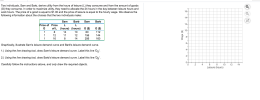 Two individuals, Sam and Barb, derive utility from the hours of leisure (L) they consume and from the amount of goods (G) they consume. In order to maximize utility, they need to allocate the 24 hours in the day between leisure hours and work hours. The price of a good is equal to $1.00 and the price of leisure is equal to the hourly wage. We observe the following information about the choices that the two individuals make: O O...
Labor Economics, multiple choice questions 1. In the leisure-income model, the wage constraint shows a. the...
 Labor Economics, multiple choice questions
1. In the leisure-income model, the wage constraint shows a. the points that maximize a worker's utility b. all points that are equally preferred c. the wage rates that affect work decisions d. the available combinations of leisure and income 2. The slope of a wage constraint reflects the: a. rate at which a person is willing to substitute leisure for income c. income effect b. price of leisure d. substitution effect 3. When a...
Labor Economics, multiple choice questions
1. In the leisure-income model, the wage constraint shows a. the points that maximize a worker's utility b. all points that are equally preferred c. the wage rates that affect work decisions d. the available combinations of leisure and income 2. The slope of a wage constraint reflects the: a. rate at which a person is willing to substitute leisure for income c. income effect b. price of leisure d. substitution effect 3. When a...
1. In the leisure-income model, the wage constraint shows a. the points that maximize a worker’s...
1. In the leisure-income model, the wage constraint shows a. the points that maximize a worker’s utility b. all points that are equally preferred c. the wage rates that affect work decisions d. the available combinations of leisure and income 2. The slope of a wage constraint reflects the: a. rate at which a person is willing to substitute leisure for income b. price of leisure c. income effect d. substitution effect 3. When a worker maximizes her utility, then...
 INCOME (Dollars) Kate has 80 hours per week to devote to working or to leisure. She is paid an hourly wage and can work at her job as many hours a week as she likes. The following graph illustrates Kate's weekly income-lelsure tradeoff. The three lines labeled BC, BC, and BC illustrate her time allocation budget at three different wages; points A, B, and C show her optimal time allocation choices along each of these constralints BC 1200 BC 800...
 Labor Economics
1. In the leisure-income model, the wage constraint shows a. the points that maximize a worker's utility b. all points that are equally preferred c. the wage rates that affect work decisions d. the available combinations of leisure and income 2. The slope of a wage constraint reflects the: a. rate at which a person is willing to substitute leisure for income c. income effect b. price of leisure d. substitution effect 3. When a worker maximizes her...
Labor Economics
1. In the leisure-income model, the wage constraint shows a. the points that maximize a worker's utility b. all points that are equally preferred c. the wage rates that affect work decisions d. the available combinations of leisure and income 2. The slope of a wage constraint reflects the: a. rate at which a person is willing to substitute leisure for income c. income effect b. price of leisure d. substitution effect 3. When a worker maximizes her...
 A person chooses between leisure and consumption. All of their consumption comes from current income. The utility derived from any combination of leisure and consumption is given by U- YL-88Y where U is utility, L is the hours of leisure per week and Yis the number of dollars of income all of which will be spent on consumption. The person can work as many hours as they wish during the week at a constant wage of $4 per hour. There...
 Need as much details as possible. Microeconomics.
2. Vera's utility over consumption (that is, all goods and services that she buys), C, and leisure (work- free time), L, is U(CL)-CL. Her hourly wage is w=10 €. Suppose that she can work for 24 hours a day if she wants to and that the price of consumption is p . (a) How many units of consumption can Vera buy in a day if she works non-stop? What if she works 24-L...
Need as much details as possible. Microeconomics.
2. Vera's utility over consumption (that is, all goods and services that she buys), C, and leisure (work- free time), L, is U(CL)-CL. Her hourly wage is w=10 €. Suppose that she can work for 24 hours a day if she wants to and that the price of consumption is p . (a) How many units of consumption can Vera buy in a day if she works non-stop? What if she works 24-L...
 Two individuals, Sam and Barb, derive utility from the hours of leisure (L) they consume and from the amount of goods (G) they consume. In order to maximize utility, they need to allocate the 24 hours in the day between leisure hours and work hours. The price of a good is equal to $1.00 and the price of leisure is equal to the hourly wage. We observe the following information about the choices that the two individuals make: O O...
 Labor Economics, multiple choice questions
1. In the leisure-income model, the wage constraint shows a. the points that maximize a worker's utility b. all points that are equally preferred c. the wage rates that affect work decisions d. the available combinations of leisure and income 2. The slope of a wage constraint reflects the: a. rate at which a person is willing to substitute leisure for income c. income effect b. price of leisure d. substitution effect 3. When a...
Labor Economics, multiple choice questions
1. In the leisure-income model, the wage constraint shows a. the points that maximize a worker's utility b. all points that are equally preferred c. the wage rates that affect work decisions d. the available combinations of leisure and income 2. The slope of a wage constraint reflects the: a. rate at which a person is willing to substitute leisure for income c. income effect b. price of leisure d. substitution effect 3. When a...
Most questions answered within 3 hours.
-
Where is the error in this code sequence?
String s1 = "Hello";
String s2 = "ello";...
asked 11 months ago -
Financial data for Joel de Paris, Inc., for last year
follow:
Joel de Paris, Inc.
Balance...
asked 11 months ago -
Consider this reaction:
Al2(SO4)3 (aq)+ BaCl3
(aq) Al2Cl6 (aq)- +
3BaSO4(s) . What is the...
asked 11 months ago -
Suppose that Savneet is considering increasing her
recent random sample from 20 car rentals to 40...
asked 11 months ago -
Trucks arrive at an unloading terminal at an average rate of 120
per hour.
Trucks arrive...
asked 11 months ago -
Why are methanol and ethanol completely soluble in water while
octanol is not very little soluble....
asked 11 months ago -
A facilities manager at a university reads in a research report
that the mean amount of...
asked 11 months ago -
When the CuSO4 is rehydrated by adding water to the anhydrous
compound, is this an endothermic...
asked 11 months ago -
A ray of sunlight is passing from diamond into crown glass; the
angle of incidence is...
asked 11 months ago -
A block of mass 0.249 kg is placed on top of a light, vertical
spring of...
asked 11 months ago -
how do the kidneys compensate in the presences of acidosis
a) trigger hyperventilate
b) reserve acid...
asked 11 months ago -
Question 501 pts
The rental rate of capital to the firm increases. Which of the
following...
asked 11 months ago