The rate of heat flow through a slab is H. If the slab thickness is halved,...
The rate of heat flow through a slab is H. If the slab thickness is halved, its cross-sectional area is doubled, and the temperature difference across it is doubled, then the rate of heat flow becomes (please show work)
Homework Answers
Heat flow rate is given by:
H = k*A*dT/dx
k = thermal conductivity of slab
A = Cross-sectional Area of slab
dT = temperature difference across slab
dx = thickness of slab
Since 'k' for slab is constant, So
H2/H1 = (A2/A1)*(dT2/dT1)*(dx1/dx2)
Given that A2/A1 = 2
dT2/dT1 = 2
And dx2/dx1 = 1/2, So dx1/dx2 = 2
So,
H2/H1 = 2*2*2
H2 = 8*H1
So rate of heat flow across slab is increase by a factor of 8
Let me know if you've any query.
Solution: Rate of Heat Flow Under Modified Conditions
Given:
Initial rate of heat flow ():
where:
= thermal conductivity (constant),
= cross-sectional area,
= temperature difference,
= thickness of the slab.
Modified Conditions:
Thickness (): Halved → .
Area (): Doubled → .
Temperature difference (): Doubled → .
New Rate of Heat Flow ():
Answer:
The new rate of heat flow becomes .
Add Answer to:
The rate of heat flow through a slab is H. If the slab thickness
is halved,...
Heat flow by conduction is Select all that apply. Proportional to the temperature difference across the...
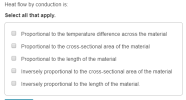 Heat flow by conduction is Select all that apply. Proportional to the temperature difference across the material Proportional to the cross-sectional area of the material Proportional to the length of the material Inversely proportional to the cross-sectional area of the material O O Inversely proportional to the length of the material.
Problem 3 Consider a slab of thickness L as illustrated in the figure below. A fluid...
 Problem 3 Consider a slab of thickness L as illustrated in the figure below. A fluid at a temperature T., with a heat transfer coefficient hi flows over the surface at x = 0, and another fluid at a temperature To2 with heat transfer coefficient h2 flows over the surface at x = L of the plate. (a) Develop an expression for the heat flow O through an area A of the plate. (b) Calculate the heat transfer rate through...
Problem Two slabs are in perfect contact. In slab 1 (thickness Li, thermal conductivity ki) heat...
 Problem Two slabs are in perfect contact. In slab 1 (thickness Li, thermal conductivity ki) heat is generating at a constant rate of S per uni volume. There is no heat generation inside slab 2 (thickness L2, thermal conductivity k2). The temperature at the left face of slab 1 (x-0) is maintained at To and the temperature at the interface between slab 1 and slab 2 (at x L) is found to be T. The right face of slab 2...
PLEASE ANSWER a,b,c Heat Conduction Heat conduction occurs through any material, represented here by a rectangular...
 PLEASE ANSWER a,b,c
Heat Conduction Heat conduction occurs through any material, represented here by a rectangular bar, whether window glass or walrus blubber. The temperature of the material is T2 on the left and T1 on the right, where T2 is greater than T1. The rate of heat transfer by conduction is directly proportional to the surface area A, the temperature difference T2 - T1, and the substance's conductivity k. The rate of heat transfer is inversely proportional to the...
PLEASE ANSWER a,b,c
Heat Conduction Heat conduction occurs through any material, represented here by a rectangular bar, whether window glass or walrus blubber. The temperature of the material is T2 on the left and T1 on the right, where T2 is greater than T1. The rate of heat transfer by conduction is directly proportional to the surface area A, the temperature difference T2 - T1, and the substance's conductivity k. The rate of heat transfer is inversely proportional to the...
If the thickness of a uniform wall is doubled, the rate of heat transfer through the...
 If the thickness of a uniform wall is doubled, the rate of heat
transfer through the wall is
If the thickness of a uniform wall is doubled, the rate of heat
transfer through the wall is
Heat conduction occurs through any material, represented here by a rectangular bar, whether window glass or...
 Heat conduction occurs through any material, represented here by a rectangular bar, whether window glass or walrus blubber. The temperature of the material is T2 on the left and T1 on the right, where T2 is greater than T1. The rate of heat transfer by conduction is directly proportional to the surface area A, the temperature difference T2 - T1, and the substance's conductivity k. The rate of heat transfer is inversely proportional to the thickness d. Q kA (T2-T)...
please do all QUESTION 1 Like 14.3.8 Find the heat flow in 35.61days through a 0.25cm...
 please do all
QUESTION 1 Like 14.3.8 Find the heat flow in 35.61days through a 0.25cm think steel plate with cross section 47 48cm x 76.31cm. Assume a temperature differential of 90.04°C. QUESTION 2 Like 14.3.10 Find the heat flow in 17.25minutes through a 0.17om thick copper plate with cross sectional area 150.07cm if the temperature of the hot side is 971.85°C and the temperature of the cold side is 7.48C QUESTION 1 Like 14.4.8 Find Q for each material:...
please do all
QUESTION 1 Like 14.3.8 Find the heat flow in 35.61days through a 0.25cm think steel plate with cross section 47 48cm x 76.31cm. Assume a temperature differential of 90.04°C. QUESTION 2 Like 14.3.10 Find the heat flow in 17.25minutes through a 0.17om thick copper plate with cross sectional area 150.07cm if the temperature of the hot side is 971.85°C and the temperature of the cold side is 7.48C QUESTION 1 Like 14.4.8 Find Q for each material:...
Heat conduction occurs through any material, represented here by a rectangular bar, whether window glass or...
 Heat conduction occurs through any material, represented here by a rectangular bar, whether window glass or walrus blubber. The temperature of the material is T2 on the left and T1 on the right, where T2 is greater than T1. The rate of heat transfer by conduction is directly proportional to the surface area A, the temperature difference T2 - T1, and the substance's conductivity k. The rate of heat transfer is inversely proportional to the thickness d. Q kA (T2-T)...
Heat flows at a rate of Q/t from a hot object to a cold object through...
Heat flows at a rate of Q/t from a hot object to a cold object through some material that has a thickness of d and a surface area of A. If the surface area of the material is increased to 2A and the thickness is increased to 4d then what rate does the heat flow from the hot object to the cold object now? [You may assume that the hot and cold object are unchanging in temperature.]
Problem 2: Consider a large plane slab of semi-thickness L = 0.3 m, thermal conductivity k...
 Problem 2: Consider a large plane slab of semi-thickness L = 0.3 m, thermal conductivity k = 2.5 W/m K and surface area A = 20.0 m². Both sides of the slab is maintained at a constant wall temperature of 358°K while it is subjected to a uniform but constant heat flux of 950.0 W/m2 Evaluate the temperature distribution/profile within the wall. Calculate the heat flux and temperature at location x = 0.1m. Problem 3: Consider a 10.0 m long...
 Heat flow by conduction is Select all that apply. Proportional to the temperature difference across the material Proportional to the cross-sectional area of the material Proportional to the length of the material Inversely proportional to the cross-sectional area of the material O O Inversely proportional to the length of the material.
 Problem 3 Consider a slab of thickness L as illustrated in the figure below. A fluid at a temperature T., with a heat transfer coefficient hi flows over the surface at x = 0, and another fluid at a temperature To2 with heat transfer coefficient h2 flows over the surface at x = L of the plate. (a) Develop an expression for the heat flow O through an area A of the plate. (b) Calculate the heat transfer rate through...
 Problem Two slabs are in perfect contact. In slab 1 (thickness Li, thermal conductivity ki) heat is generating at a constant rate of S per uni volume. There is no heat generation inside slab 2 (thickness L2, thermal conductivity k2). The temperature at the left face of slab 1 (x-0) is maintained at To and the temperature at the interface between slab 1 and slab 2 (at x L) is found to be T. The right face of slab 2...
 PLEASE ANSWER a,b,c
Heat Conduction Heat conduction occurs through any material, represented here by a rectangular bar, whether window glass or walrus blubber. The temperature of the material is T2 on the left and T1 on the right, where T2 is greater than T1. The rate of heat transfer by conduction is directly proportional to the surface area A, the temperature difference T2 - T1, and the substance's conductivity k. The rate of heat transfer is inversely proportional to the...
PLEASE ANSWER a,b,c
Heat Conduction Heat conduction occurs through any material, represented here by a rectangular bar, whether window glass or walrus blubber. The temperature of the material is T2 on the left and T1 on the right, where T2 is greater than T1. The rate of heat transfer by conduction is directly proportional to the surface area A, the temperature difference T2 - T1, and the substance's conductivity k. The rate of heat transfer is inversely proportional to the...
 If the thickness of a uniform wall is doubled, the rate of heat
transfer through the wall is
If the thickness of a uniform wall is doubled, the rate of heat
transfer through the wall is
 Heat conduction occurs through any material, represented here by a rectangular bar, whether window glass or walrus blubber. The temperature of the material is T2 on the left and T1 on the right, where T2 is greater than T1. The rate of heat transfer by conduction is directly proportional to the surface area A, the temperature difference T2 - T1, and the substance's conductivity k. The rate of heat transfer is inversely proportional to the thickness d. Q kA (T2-T)...
 please do all
QUESTION 1 Like 14.3.8 Find the heat flow in 35.61days through a 0.25cm think steel plate with cross section 47 48cm x 76.31cm. Assume a temperature differential of 90.04°C. QUESTION 2 Like 14.3.10 Find the heat flow in 17.25minutes through a 0.17om thick copper plate with cross sectional area 150.07cm if the temperature of the hot side is 971.85°C and the temperature of the cold side is 7.48C QUESTION 1 Like 14.4.8 Find Q for each material:...
please do all
QUESTION 1 Like 14.3.8 Find the heat flow in 35.61days through a 0.25cm think steel plate with cross section 47 48cm x 76.31cm. Assume a temperature differential of 90.04°C. QUESTION 2 Like 14.3.10 Find the heat flow in 17.25minutes through a 0.17om thick copper plate with cross sectional area 150.07cm if the temperature of the hot side is 971.85°C and the temperature of the cold side is 7.48C QUESTION 1 Like 14.4.8 Find Q for each material:...
 Heat conduction occurs through any material, represented here by a rectangular bar, whether window glass or walrus blubber. The temperature of the material is T2 on the left and T1 on the right, where T2 is greater than T1. The rate of heat transfer by conduction is directly proportional to the surface area A, the temperature difference T2 - T1, and the substance's conductivity k. The rate of heat transfer is inversely proportional to the thickness d. Q kA (T2-T)...
 Problem 2: Consider a large plane slab of semi-thickness L = 0.3 m, thermal conductivity k = 2.5 W/m K and surface area A = 20.0 m². Both sides of the slab is maintained at a constant wall temperature of 358°K while it is subjected to a uniform but constant heat flux of 950.0 W/m2 Evaluate the temperature distribution/profile within the wall. Calculate the heat flux and temperature at location x = 0.1m. Problem 3: Consider a 10.0 m long...
Most questions answered within 3 hours.
-
Where is the error in this code sequence?
String s1 = "Hello";
String s2 = "ello";...
asked 11 months ago -
Financial data for Joel de Paris, Inc., for last year
follow:
Joel de Paris, Inc.
Balance...
asked 11 months ago -
Consider this reaction:
Al2(SO4)3 (aq)+ BaCl3
(aq) Al2Cl6 (aq)- +
3BaSO4(s) . What is the...
asked 11 months ago -
Suppose that Savneet is considering increasing her
recent random sample from 20 car rentals to 40...
asked 11 months ago -
Trucks arrive at an unloading terminal at an average rate of 120
per hour.
Trucks arrive...
asked 11 months ago -
Why are methanol and ethanol completely soluble in water while
octanol is not very little soluble....
asked 11 months ago -
A facilities manager at a university reads in a research report
that the mean amount of...
asked 11 months ago -
When the CuSO4 is rehydrated by adding water to the anhydrous
compound, is this an endothermic...
asked 11 months ago -
A ray of sunlight is passing from diamond into crown glass; the
angle of incidence is...
asked 11 months ago -
A block of mass 0.249 kg is placed on top of a light, vertical
spring of...
asked 11 months ago -
how do the kidneys compensate in the presences of acidosis
a) trigger hyperventilate
b) reserve acid...
asked 11 months ago -
Question 501 pts
The rental rate of capital to the firm increases. Which of the
following...
asked 11 months ago