
Homework Answers

Add Answer to:
Heat flow by conduction is Select all that apply. Proportional to the temperature difference across the...
PLEASE ANSWER a,b,c Heat Conduction Heat conduction occurs through any material, represented here by a rectangular...
 PLEASE ANSWER a,b,c
Heat Conduction Heat conduction occurs through any material, represented here by a rectangular bar, whether window glass or walrus blubber. The temperature of the material is T2 on the left and T1 on the right, where T2 is greater than T1. The rate of heat transfer by conduction is directly proportional to the surface area A, the temperature difference T2 - T1, and the substance's conductivity k. The rate of heat transfer is inversely proportional to the...
PLEASE ANSWER a,b,c
Heat Conduction Heat conduction occurs through any material, represented here by a rectangular bar, whether window glass or walrus blubber. The temperature of the material is T2 on the left and T1 on the right, where T2 is greater than T1. The rate of heat transfer by conduction is directly proportional to the surface area A, the temperature difference T2 - T1, and the substance's conductivity k. The rate of heat transfer is inversely proportional to the...
Heat conduction occurs through any material, represented here by a rectangular bar, whether window glass or...
 Heat conduction occurs through any material, represented here by a rectangular bar, whether window glass or walrus blubber. The temperature of the material is T2 on the left and T1 on the right, where T2 is greater than T1. The rate of heat transfer by conduction is directly proportional to the surface area A, the temperature difference T2 - T1, and the substance's conductivity k. The rate of heat transfer is inversely proportional to the thickness d. Q kA (T2-T)...
The rate of heat flow through a slab is H. If the slab thickness is halved,...
The rate of heat flow through a slab is H. If the slab thickness is halved, its cross-sectional area is doubled, and the temperature difference across it is doubled, then the rate of heat flow becomes (please show work)
Heat conduction occurs through any material, represented here by a rectangular bar, whether window glass or...
 Heat conduction occurs through any material, represented here by a rectangular bar, whether window glass or walrus blubber. The temperature of the material is T2 on the left and T1 on the right, where T2 is greater than T1. The rate of heat transfer by conduction is directly proportional to the surface area A, the temperature difference T2 - T1, and the substance's conductivity k. The rate of heat transfer is inversely proportional to the thickness d. Q kA (T2-T)...
For Following Multiple Choice All Correct Answers Which Applied To Each Question. 1. The hydraulic head,...
For Following Multiple Choice All Correct Answers Which Applied To Each Question. 1. The hydraulic head, h, is equal to the sum of the: pressure, elevation, and velocity heads. fluid pressure and the elevation head. pressure head and elevation head. hydraulic conductivity and intrinsic permeability. 2. Henry Darcy (1865) measured the flow of water through sand-filled columns, and found that the total discharge, Q, through the column was: proportional to the column cross-sectional area, A. inversely proportional to the length,...
Which of the following are true about radiation of heat? Mark all that apply. The rate...
 Which of the following are true about radiation of heat? Mark all that apply. The rate of energy transfer is proportional to the surface area of the object Radiation occurs when mass at one temperature transfers to a different location Radiation can transfer heat through empty space (vacuum) Radiation is a result of the collisions between molecules in two different objects at two different temperatures Which of the following characteristics describe good thermal conductors? Mark all that apply. High thermal...
please do all QUESTION 1 Like 14.3.8 Find the heat flow in 35.61days through a 0.25cm...
 please do all
QUESTION 1 Like 14.3.8 Find the heat flow in 35.61days through a 0.25cm think steel plate with cross section 47 48cm x 76.31cm. Assume a temperature differential of 90.04°C. QUESTION 2 Like 14.3.10 Find the heat flow in 17.25minutes through a 0.17om thick copper plate with cross sectional area 150.07cm if the temperature of the hot side is 971.85°C and the temperature of the cold side is 7.48C QUESTION 1 Like 14.4.8 Find Q for each material:...
please do all
QUESTION 1 Like 14.3.8 Find the heat flow in 35.61days through a 0.25cm think steel plate with cross section 47 48cm x 76.31cm. Assume a temperature differential of 90.04°C. QUESTION 2 Like 14.3.10 Find the heat flow in 17.25minutes through a 0.17om thick copper plate with cross sectional area 150.07cm if the temperature of the hot side is 971.85°C and the temperature of the cold side is 7.48C QUESTION 1 Like 14.4.8 Find Q for each material:...
A block of material with a cross-sectional area of 15 cm2 and length of 8.0 cm...
A block of material with a cross-sectional area of 15 cm2 and length of 8.0 cm is at hand. A temperature difference of 30 ̊C is established and maintained across the block. Find the rate of heat flow through it if: (2 marks) The material is copper (K = 397 Js-1m-1C-1). The material is air (K = 0.0234 Js-1m-1C-1). The material is wood (K = 0.08 Js-1m-1C-1).
1. Consider 1D conduction along connected bars (no heat loss, steady state), with the length and...
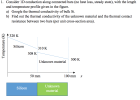 1. Consider 1D conduction along connected bars (no heat loss, steady state), with the length and temperature profile given in the figure. a) Google the thermal conductivity of bulk Si. b) Find out the thermal conductivity of the unknown material and the thermal contact resistance between two bars (per unit cross-section area). A320 K Temperature (K) Silicon - 310 K 308 K 300 K Unknown material 50 mm 100 mm x Silicon Unknown material
Compare the rate of heat conduction through a 12 cm thick wall that has an area...
Compare the rate of heat conduction through a 12 cm thick wall that has an area of 15 m2 and a thermal conductivity twice that of glass wool, k=0.042, with the rate of heat conduction through a window, k=0.84, that is 0.8 cm thick and that has an area of 2.75 m2, assuming a temperature difference of 12 °C across each. (a) What is the heat transfer rate through the wall? QtQt = unit (b) What is the heat transfer rate...
 PLEASE ANSWER a,b,c
Heat Conduction Heat conduction occurs through any material, represented here by a rectangular bar, whether window glass or walrus blubber. The temperature of the material is T2 on the left and T1 on the right, where T2 is greater than T1. The rate of heat transfer by conduction is directly proportional to the surface area A, the temperature difference T2 - T1, and the substance's conductivity k. The rate of heat transfer is inversely proportional to the...
PLEASE ANSWER a,b,c
Heat Conduction Heat conduction occurs through any material, represented here by a rectangular bar, whether window glass or walrus blubber. The temperature of the material is T2 on the left and T1 on the right, where T2 is greater than T1. The rate of heat transfer by conduction is directly proportional to the surface area A, the temperature difference T2 - T1, and the substance's conductivity k. The rate of heat transfer is inversely proportional to the...
 Heat conduction occurs through any material, represented here by a rectangular bar, whether window glass or walrus blubber. The temperature of the material is T2 on the left and T1 on the right, where T2 is greater than T1. The rate of heat transfer by conduction is directly proportional to the surface area A, the temperature difference T2 - T1, and the substance's conductivity k. The rate of heat transfer is inversely proportional to the thickness d. Q kA (T2-T)...
 Heat conduction occurs through any material, represented here by a rectangular bar, whether window glass or walrus blubber. The temperature of the material is T2 on the left and T1 on the right, where T2 is greater than T1. The rate of heat transfer by conduction is directly proportional to the surface area A, the temperature difference T2 - T1, and the substance's conductivity k. The rate of heat transfer is inversely proportional to the thickness d. Q kA (T2-T)...
 Which of the following are true about radiation of heat? Mark all that apply. The rate of energy transfer is proportional to the surface area of the object Radiation occurs when mass at one temperature transfers to a different location Radiation can transfer heat through empty space (vacuum) Radiation is a result of the collisions between molecules in two different objects at two different temperatures Which of the following characteristics describe good thermal conductors? Mark all that apply. High thermal...
 please do all
QUESTION 1 Like 14.3.8 Find the heat flow in 35.61days through a 0.25cm think steel plate with cross section 47 48cm x 76.31cm. Assume a temperature differential of 90.04°C. QUESTION 2 Like 14.3.10 Find the heat flow in 17.25minutes through a 0.17om thick copper plate with cross sectional area 150.07cm if the temperature of the hot side is 971.85°C and the temperature of the cold side is 7.48C QUESTION 1 Like 14.4.8 Find Q for each material:...
please do all
QUESTION 1 Like 14.3.8 Find the heat flow in 35.61days through a 0.25cm think steel plate with cross section 47 48cm x 76.31cm. Assume a temperature differential of 90.04°C. QUESTION 2 Like 14.3.10 Find the heat flow in 17.25minutes through a 0.17om thick copper plate with cross sectional area 150.07cm if the temperature of the hot side is 971.85°C and the temperature of the cold side is 7.48C QUESTION 1 Like 14.4.8 Find Q for each material:...
 1. Consider 1D conduction along connected bars (no heat loss, steady state), with the length and temperature profile given in the figure. a) Google the thermal conductivity of bulk Si. b) Find out the thermal conductivity of the unknown material and the thermal contact resistance between two bars (per unit cross-section area). A320 K Temperature (K) Silicon - 310 K 308 K 300 K Unknown material 50 mm 100 mm x Silicon Unknown material
Most questions answered within 3 hours.
-
Where is the error in this code sequence?
String s1 = "Hello";
String s2 = "ello";...
asked 11 months ago -
Financial data for Joel de Paris, Inc., for last year
follow:
Joel de Paris, Inc.
Balance...
asked 11 months ago -
Consider this reaction:
Al2(SO4)3 (aq)+ BaCl3
(aq) Al2Cl6 (aq)- +
3BaSO4(s) . What is the...
asked 11 months ago -
Suppose that Savneet is considering increasing her
recent random sample from 20 car rentals to 40...
asked 11 months ago -
Trucks arrive at an unloading terminal at an average rate of 120
per hour.
Trucks arrive...
asked 11 months ago -
Why are methanol and ethanol completely soluble in water while
octanol is not very little soluble....
asked 11 months ago -
A facilities manager at a university reads in a research report
that the mean amount of...
asked 11 months ago -
When the CuSO4 is rehydrated by adding water to the anhydrous
compound, is this an endothermic...
asked 11 months ago -
A ray of sunlight is passing from diamond into crown glass; the
angle of incidence is...
asked 11 months ago -
A block of mass 0.249 kg is placed on top of a light, vertical
spring of...
asked 11 months ago -
how do the kidneys compensate in the presences of acidosis
a) trigger hyperventilate
b) reserve acid...
asked 11 months ago -
Question 501 pts
The rental rate of capital to the firm increases. Which of the
following...
asked 11 months ago