Arguably, the central point of metabolism is what enzyme complex which divides anerobic and aerobic metabolism?...
Arguably, the central point of metabolism is what enzyme complex which divides anerobic and aerobic metabolism?
A) G3PDH
B) Hexose Kinase
C) PDC
D) alpha keto dehydrogenase
Homework Answers
Arguably, the central point of metabolism is what enzyme complex which divides anaerobic and aerobic metabolism?
A) G3PDH- It converts glyceraldehyde-3-phosphate to 1,3 bisphosphoglycerate. So it does not divide aerobic and anaerobic metabolism.
B) Hexose Kinase- this phosphorylates hexose. So, it does not divide the metabolism into aerobic and anaerobic.
C) PDC- This converts pyruvate to acetyl CoA. This is required for kreb's cycle. So, it is the one which divides aerobic and anaerobic metabolism.
D) alpha keto dehydrogenase- this is an enzyme of kreb's cycle. This does not divide aerobic and anaerobic metabolism.
So, the correct answer is C.
Add Answer to:
Arguably, the central point of metabolism is what enzyme complex
which divides anerobic and aerobic metabolism?...
Which enzyme that participates in ketoacid metabolism is not present in the liver? a) HMG-CoA synthase...
Which enzyme that participates in ketoacid metabolism is not present in the liver? a) HMG-CoA synthase b)β-ketoacyl CoA transferase c)Thiolase d) β -hydroxybutyrate dehydrogenase
Can someone quick answer/check these questions? Thank you, will rate! (the answers that I have came...
Can someone quick answer/check these questions? Thank you, will rate! (the answers that I have came up with are in bold) Please help 51- Glycogenesis involves the following steps a) isomerisation b) activation c) elongation or coupling d) branching e) all of the above 52 During the breakdown of glycogen, free glucose is formed from A. the reducing end. B. the non-reducing end. C. glucose residues in an a 1-->4 linkage to the chain. D. glucose residues in an...
9. Which of the listed enzymes of the TCA cycle is regulated by phosphorylation/dephosphorylation cycle ?...
 9. Which of the listed enzymes of the TCA cycle is regulated by phosphorylation/dephosphorylation cycle ? :a. isocitrate dehydrogenase b. succinate dehydrogenase c. malate dehydrogenase d. α-ketoglutarate dehydrogenase complex\}c. citrate synthase10. Name the enzyme catalyzing the following reaction:a. PEP carboxykinaseb. pyruvate kinasec. malic enzymed. pyruvate carboxylase11. Name the enzyme that catalyzes the reaction:glyoxylate +CH3CO-SCoA → malate + HSCoAa. malate synthaseb. succinate thiokinasec. aconitased. isocitrate
Which enzyme catalyzes a reversible reaction in the TCA cycle, and produces NADH in the forward...
Which enzyme catalyzes a reversible reaction in the TCA cycle, and produces NADH in the forward direction? a. Alpha-ketoglutarate dehydrogenase b. Malate dehydrogenase c. Isocitrate dehydrogenase d. Succinate dehydrogenase
1) Select the cellular (and subcellular, if relevant) location for each enzyme listed below. (Cytoplasm,Inner membrane...
1) Select the cellular (and subcellular, if relevant) location for each enzyme listed below. (Cytoplasm,Inner membrane of mitochondria, outer membrane of mitochondria, Matrix of mitochondria) Phosphofructokinase: ATP synthase: Hexokinase: Pyruvate dehydrogenase: Aldolase: Citrate synthase: NADH dehydrogenase complex: 2) Based on our discussion in class, which enzyme performs the first committed step in glycolysis? ( i picked hexokinase on this and got it wrong) a. phosphofructokinase b. pyruvate kinase c. hexokinase d. cytochrome e. aldolase
11. Which enzyme is NOT part of the TCA cycle? A. Citrate synthase B. Succinate dehydrogenase...
11. Which enzyme is NOT part of the TCA cycle? A. Citrate synthase B. Succinate dehydrogenase C. alpha-ketoglutarate dehydrogenase D. Aconitase E. Pyruvate dehydrogenase
G 614 04 6 17 What type of enzyme performs this transformation: (OOCH & Co A)...
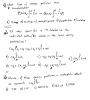 G 614 04 6 17 What type of enzyme performs this transformation: (OOCH & Co A) Kinase B) mutase c) dehydrogenase D) phosphatase 5) oxidase - - - -o(ع) H 4 1o) If this short fat is "e-labeled at the indicated carbon (4) where is the labed during Metabolism? CH₂ Ext₂ CH₂ CH₂ CH₂ CH₂ CHÉS COA G -OC CH ₂ CH C scoa scon * A) CHE E scot 5) -Qc CHCHE SCOA D) -qC CHCH És con *...
Which of the following answers complete the sentence correctly? The pyruvate dehydrogenase complex is activated by:...
Which of the following answers complete the sentence correctly? The pyruvate dehydrogenase complex is activated by: Select one or more: a. decreased levels of insulin b. phosphorylation of the pyruvate dehydrogenase component E1 c. stimulation of a specific phosphatase by Ca2+ d. decrease of the NADH/NAD+ ratio e. inhibition of a specific kinase by pyruvate
1 part A) The branching enzyme of glycogen synthesis _________________. a. couples the formation of glycogen...
1 part A) The branching enzyme of glycogen synthesis _________________. a. couples the formation of glycogen with UDP loss from UDP-glucose b. making α(1,4) linkages with the transfer of seven glucose units c. breaks the α(1,6) branch points and remakes α(1,4) linkages d. catalyzes the cleavage of α(1,4) linkages and the formation of α(1,6) linkages PART b) Which of the following conditions will activate pyruvate dehydrogenase kinase, which catalyzes the phorphorylation and inactivation of E1 in the pyruvate dehydrogenase complex?...
15. Genetic defect in pyruvate dehydrogenase complex lead a. maple syrup urine disease b. phenyike d....
 15. Genetic defect in pyruvate dehydrogenase complex lead a. maple syrup urine disease b. phenyike d. lactic acidemia e. pellagra syrup urine disease b, phenylketonuria c. galactosemia 10. Chemical modification by phosphorylation of pyruvate dehydros a. deactivates the enzyme b. activates the enzyme lation of pyruvate dehydrogenase complex : 17. Pyruvate carboxylase is positively ated through the allosteric mechanism by : a. ATP b. NADH c. Acetyl-SCOA d. TPP e. Biotin 18. Which of the listed coenzymes does not particip...
 9. Which of the listed enzymes of the TCA cycle is regulated by phosphorylation/dephosphorylation cycle ? :a. isocitrate dehydrogenase b. succinate dehydrogenase c. malate dehydrogenase d. α-ketoglutarate dehydrogenase complex\}c. citrate synthase10. Name the enzyme catalyzing the following reaction:a. PEP carboxykinaseb. pyruvate kinasec. malic enzymed. pyruvate carboxylase11. Name the enzyme that catalyzes the reaction:glyoxylate +CH3CO-SCoA → malate + HSCoAa. malate synthaseb. succinate thiokinasec. aconitased. isocitrate
 G 614 04 6 17 What type of enzyme performs this transformation: (OOCH & Co A) Kinase B) mutase c) dehydrogenase D) phosphatase 5) oxidase - - - -o(ع) H 4 1o) If this short fat is "e-labeled at the indicated carbon (4) where is the labed during Metabolism? CH₂ Ext₂ CH₂ CH₂ CH₂ CH₂ CHÉS COA G -OC CH ₂ CH C scoa scon * A) CHE E scot 5) -Qc CHCHE SCOA D) -qC CHCH És con *...
 15. Genetic defect in pyruvate dehydrogenase complex lead a. maple syrup urine disease b. phenyike d. lactic acidemia e. pellagra syrup urine disease b, phenylketonuria c. galactosemia 10. Chemical modification by phosphorylation of pyruvate dehydros a. deactivates the enzyme b. activates the enzyme lation of pyruvate dehydrogenase complex : 17. Pyruvate carboxylase is positively ated through the allosteric mechanism by : a. ATP b. NADH c. Acetyl-SCOA d. TPP e. Biotin 18. Which of the listed coenzymes does not particip...
Most questions answered within 3 hours.
-
Where is the error in this code sequence?
String s1 = "Hello";
String s2 = "ello";...
asked 11 months ago -
Financial data for Joel de Paris, Inc., for last year
follow:
Joel de Paris, Inc.
Balance...
asked 11 months ago -
Consider this reaction:
Al2(SO4)3 (aq)+ BaCl3
(aq) Al2Cl6 (aq)- +
3BaSO4(s) . What is the...
asked 11 months ago -
Suppose that Savneet is considering increasing her
recent random sample from 20 car rentals to 40...
asked 11 months ago -
Trucks arrive at an unloading terminal at an average rate of 120
per hour.
Trucks arrive...
asked 11 months ago -
Why are methanol and ethanol completely soluble in water while
octanol is not very little soluble....
asked 11 months ago -
A facilities manager at a university reads in a research report
that the mean amount of...
asked 11 months ago -
When the CuSO4 is rehydrated by adding water to the anhydrous
compound, is this an endothermic...
asked 11 months ago -
A ray of sunlight is passing from diamond into crown glass; the
angle of incidence is...
asked 11 months ago -
A block of mass 0.249 kg is placed on top of a light, vertical
spring of...
asked 11 months ago -
how do the kidneys compensate in the presences of acidosis
a) trigger hyperventilate
b) reserve acid...
asked 11 months ago -
Question 501 pts
The rental rate of capital to the firm increases. Which of the
following...
asked 11 months ago