what are histones? explain, mentioning their types, structures and most important biological roles.
what are histones? explain, mentioning their types, structures and most important biological roles.
Homework Answers
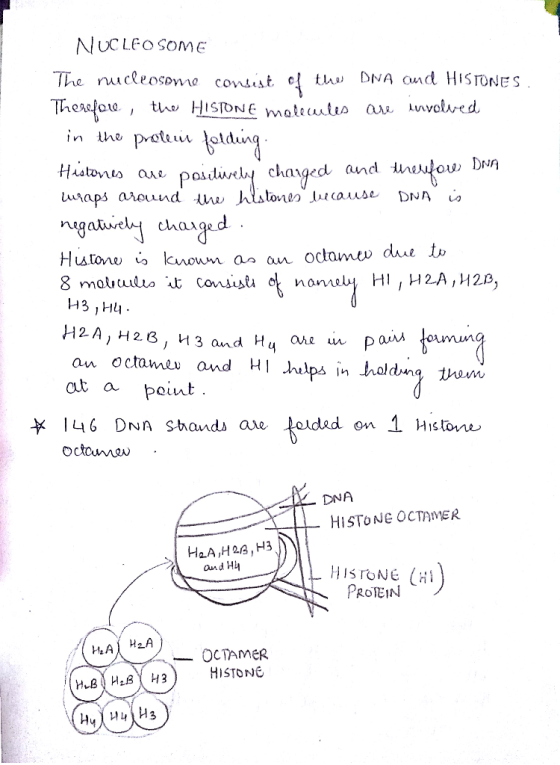
Histones
Histones are proteins which are found in eukaryotic cells in the nuclei which help in packing of the DNA structures which together form the nucleosome.
Important biological role of histones is gene regulation.
Histones are proteins that are rich in the basic amino acid residues suggest lysine and arginine which carry the positive charge in the chains.
H1 histone is the linker region, where is the H2A, H2B, H3 and H4 organise themselves into a histone octamer.
Types of histone proteins
1. canonical replication-dependent histones
they are expressed or seen during the S phase of the cell division cycle, during which the DNA is replicated to prepare itself for cell division.
2. Replication- independent histone variant
They are expressed during the whole cell cycle which is including mitosis and meiosis.
Add Answer to:
what are histones? explain, mentioning their types, structures
and most important biological roles.
1. List and explain the three most important roles brand plays in the marketplace. 2. Why...
1. List and explain the three most important roles brand plays in the marketplace. 2. Why is the concept of service a key source of potential differentiation in a competitive market?
Explain the most important influence on the composition of cliques in terms of different types of...
 Explain the most important influence on the composition of cliques
in terms of different types of segregation
QUEEN SF DOTHAN Grades Assignment Details Cancel Text Entry Submit Assignment 2 (Chapter 5-8) 1. (1) Explain the most important influence on the composition of cliques in terms of different types of segregation and (2) Discuss three important factors in determining adolescent clique membership and friendship patterns. (25 pts)
Explain the most important influence on the composition of cliques
in terms of different types of segregation
QUEEN SF DOTHAN Grades Assignment Details Cancel Text Entry Submit Assignment 2 (Chapter 5-8) 1. (1) Explain the most important influence on the composition of cliques in terms of different types of segregation and (2) Discuss three important factors in determining adolescent clique membership and friendship patterns. (25 pts)
explain the different biological roles of insulin on the podocyte , muscle cell, and neurons include the mesangial cell...
explain the different biological roles of insulin on the podocyte , muscle cell, and neurons include the mesangial cells, glomerular endothelial cells, proximal tubular cell , distal tubular cell
What are the different types of fats ? Briefly explain the different types of fats and...
What are the different types of fats ? Briefly explain the different types of fats and give dietary examples of each types Do not worry about the chemical structures. I do not expect you to focus on the chemical structures. It is important to know that the differences in their structures affect how they function in the body and how they affect health. 2 What are the health effects of consuming excessive fats?
(c) (10 marks) Metal ions are important in biological systems. Using diagrams as appropriate to illustrate...
 (c) (10 marks) Metal ions are important in biological systems. Using diagrams as appropriate to illustrate your answer to explain the following: (i) The roles mono- and divalent-metal ions play in stabilising the secondary and tertiary structure of nucleic acids.
What is a DBMS, and what are its functions (roles)? What are its advantages, and what...
What is a DBMS, and what are its functions (roles)? What are its advantages, and what are its disadvantages (potential cost of implementing a database system)? Explain why database design is important. List and describe the different types of databases. What are the main components of a database system? What are metadata?
(a) define cofactor, coenzyme, and cosubstrate. (b) what are the types of biological polymers? name and...
(a) define cofactor, coenzyme, and cosubstrate. (b) what are the types of biological polymers? name and draw the type of linkage associated with each. (c) describe f-actin explain how it has a + end and a - end.
The list and dictionary object types are two of the most important and often used types...
The list and dictionary object types are two of the most important and often used types in a Python program. Compare the functionalities of those two objects. What are some ways to insert, update, and remove elements from lists and dictionaries? Why would you choose one data type over another? Provide code examples demonstrating the usages of both data types.
What are the 3 most important aspects of emotions and listening? and explain.
What are the 3 most important aspects of emotions and listening? and explain.
What is the first catalyzed step in glycolysis and what are the important metabolic roles this...
What is the first catalyzed step in glycolysis and what are the important metabolic roles this step achieves for the transport of glucose and priming glycolysis?
 Explain the most important influence on the composition of cliques
in terms of different types of segregation
QUEEN SF DOTHAN Grades Assignment Details Cancel Text Entry Submit Assignment 2 (Chapter 5-8) 1. (1) Explain the most important influence on the composition of cliques in terms of different types of segregation and (2) Discuss three important factors in determining adolescent clique membership and friendship patterns. (25 pts)
Explain the most important influence on the composition of cliques
in terms of different types of segregation
QUEEN SF DOTHAN Grades Assignment Details Cancel Text Entry Submit Assignment 2 (Chapter 5-8) 1. (1) Explain the most important influence on the composition of cliques in terms of different types of segregation and (2) Discuss three important factors in determining adolescent clique membership and friendship patterns. (25 pts)
 (c) (10 marks) Metal ions are important in biological systems. Using diagrams as appropriate to illustrate your answer to explain the following: (i) The roles mono- and divalent-metal ions play in stabilising the secondary and tertiary structure of nucleic acids.
Most questions answered within 3 hours.
-
Where is the error in this code sequence?
String s1 = "Hello";
String s2 = "ello";...
asked 10 months ago -
Financial data for Joel de Paris, Inc., for last year
follow:
Joel de Paris, Inc.
Balance...
asked 10 months ago -
Consider this reaction:
Al2(SO4)3 (aq)+ BaCl3
(aq) Al2Cl6 (aq)- +
3BaSO4(s) . What is the...
asked 10 months ago -
Suppose that Savneet is considering increasing her
recent random sample from 20 car rentals to 40...
asked 10 months ago -
Trucks arrive at an unloading terminal at an average rate of 120
per hour.
Trucks arrive...
asked 10 months ago -
Why are methanol and ethanol completely soluble in water while
octanol is not very little soluble....
asked 10 months ago -
A facilities manager at a university reads in a research report
that the mean amount of...
asked 10 months ago -
When the CuSO4 is rehydrated by adding water to the anhydrous
compound, is this an endothermic...
asked 10 months ago -
A ray of sunlight is passing from diamond into crown glass; the
angle of incidence is...
asked 10 months ago -
A block of mass 0.249 kg is placed on top of a light, vertical
spring of...
asked 10 months ago -
how do the kidneys compensate in the presences of acidosis
a) trigger hyperventilate
b) reserve acid...
asked 10 months ago -
Question 501 pts
The rental rate of capital to the firm increases. Which of the
following...
asked 10 months ago