K = 1.3 * 106 for the disproportionation reaction of Cu+ at 298 K. Calculate the...
K = 1.3 * 106 for the disproportionation reaction of Cu+ at 298 K. Calculate the E°cell for this rxn at 298K
The latimer Diagram for Cu+ has:
+0.159 V +0.520 V
Cu2+ ---> Cu+ --> Cu(s)
And then
Cu2+ --> Cu (s) = 0.340 V
So for Ecell would I just do Ecell = (0.520V - (-0.159V))? ... if not how come?
Homework Answers
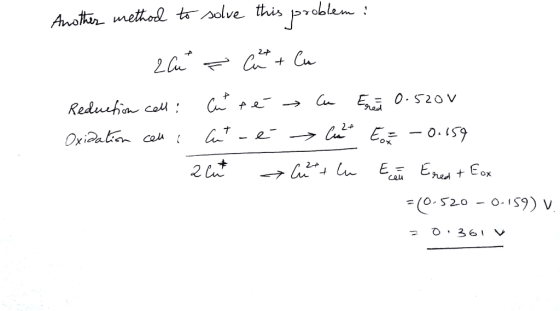
 There is another way to solve
this problem by using the potential of the half cells.
There is another way to solve
this problem by using the potential of the half cells.
Ecell= Ered+Eox
Ered represents reduction half cell(Cu++e- = Cu )and it's value is +0.520 V
Eox represents oxidation half cell (Cu+- e- = Cu2+) and it's value is -0.159V. Potential for the reduction of Cu2+ to Cu+ is +0.159 V, and for oxidation the half cell reaction is reversed and the potential becomes -(+0.159 V) = -0.159 V and it is represented as Eox.
Add Answer to:
K = 1.3 * 106 for the disproportionation reaction of Cu+ at 298
K. Calculate the...
K = 1.3 * 106 for the disproportionation reaction of Cu+ at 298 K. Calculate the...
K = 1.3 * 106 for the disproportionation reaction of Cu+ at 298 K. Calculate the E°cell and ΔG° for this reaction at 298 K So finding delta G is actually pretty easy but for finding Ecell I'm using the equation: DeltaG= -vFE But how do we know v is 1? When would there be a case where v would be 2 or 3...etc? Thank you :)
Calculate the Ecell value at 298 K for the cell based on the reaction: Cu(s) +...
 Calculate the Ecell value at 298 K for the cell based on the reaction: Cu(s) + 2Ag+ (aq) → Cu2+ (aq) + 2Ag(s) where [Ag+] = 0.00350 M and [Cu2+] = 7.00x10⁻⁴ M. The standard reduction potentials are shown below: Ag+(aq) +e → Ag(s) E° = 0.7996 V Cu2+ (aq) + 2e -→ Cu(s) E° = 0.3419 V 2nd attempt Ecell = V
Calculate the Ecell value at 298 K for the cell based on the reaction: Cu(s) +...
Calculate the Ecell value at 298 K for the cell based on the reaction: Cu(s) + 2Ag+(aq) ----> Cu+2 (aq) + 2Ag(s) where [Ag+] = 0.00275 M and [Cu2+] = 8.75×10⁻⁴ M.
Calculate the Ecell value at 298 K for the cell based on the reaction: Cu(s) +...
Calculate the Ecell value at 298 K for the cell based on the reaction: Cu(s) + 2Ag+(aq) ----> Cu+2 (aq) + 2Ag(s) where [Ag+] = 0.00275 M and [Cu2+] = 8.75×10⁻⁴ M.
Calculate Ecell at 298 K for a cell involving Sn and Cu and their ions: Sn(s)...
Calculate Ecell at 298 K for a cell involving Sn and Cu and their ions: Sn(s) I Sn2+(aq, 0.25M) II Cu2=(aq, 0.10M) I Cu(s) A) 0.47 V B) 0.49 V C) 0.50 V
1. Calculate Ecell at 298 K for a cell involving Sn and Cu and their ions:...
1. Calculate Ecell at 298 K for a cell involving Sn and Cu and their ions: Sn(s) I Sn2+(aq,.25 m) II Cu2+(aq,.10 m) I Cu(s) a. .47 V b. .49 V c. .50 V Please explain and use equation. Thank you
IV.CellPotential. The following reaction occurs at 298 K: a. Sketch a diagram that shows how this...
 IV.CellPotential. The following reaction occurs at 298 K: a. Sketch a diagram that shows how this cell could be set up. A voltmeter and two beakers, with some labels are provided to give you a start. Add and label any items you think are necessary for a complete cell. (8 points) b. Calculate Ecell(4 pts) c. Calculate AG for this reaction. (6 pts) d. Calculate the potential of this cell when [Cu2]-0.010M and [Cd2]-1.0M (8 pts) . Cd(s)+Cu2
Calculate the E°cell for the following reaction: Cu2+ (aq) + Ni (s) → Cu (s)...
Calculate the E°cell for the following reaction: Cu2+ (aq) + Ni (s) → Cu (s) + Ni2+ (aq) A) (-0.59 ± 0.01) V B) (-0.09 ± 0.01) V C) (0.59 ± 0.01) V D) (0.09 ± 0.01) V --------------------------------------------------------------------------------------------------------- What is the proper line notation for the following reaction? Cu (s) + 2Ag+ (aq) → Cu2+ (aq) + 2Ag (s) A) Cu2+ | Cu || Ag | Ag+ B) Ag+ | Ag || Cu | Cu2+ C) Cu |...
Consider the balanced redox reaction below. 2Hg(I) + 2 Cu2 + (aq) +2CI-(aq)? Hg2CI2(aq) +2 Cu...
 Consider the balanced redox reaction below. 2Hg(I) + 2 Cu2 + (aq) +2CI-(aq)? Hg2CI2(aq) +2 Cu (s) Standard reduction Potentials are given below. Standard Reduction Potentials Reduction Half Reaction Cu2+ (aq) +2e-? Cu (s) 0.34 27 What is the cell potential, Ecell for the following concentrations at 298 K? Cu2+)-0.02M (CI1-0.3M [Hg2Cl21-0.005M Express your answer in units of Volts. 321
A copper, Cu(s), electrode is immersed in a solution that is 1.00 M in ammonia, NH3,...
 A copper, Cu(s), electrode is immersed in a solution that is 1.00 M in ammonia, NH3, and 1.00 M in tetraamminecopper(I), [Cu(NH). If a standard hydrogen electrode is used as the cathode, the cell potential, Ecell, is found to be 0.074 V at 298 K Constants Periodic Table Use the standard reduction potentials shown here to answer the questions Reduction half-reaction E (V) Cu2+ (aq) 2e Cu(s) 0.337 2H + (aq) + 2e →H, (g) | 0.000 ▼ Part A...
 Calculate the Ecell value at 298 K for the cell based on the reaction: Cu(s) + 2Ag+ (aq) → Cu2+ (aq) + 2Ag(s) where [Ag+] = 0.00350 M and [Cu2+] = 7.00x10⁻⁴ M. The standard reduction potentials are shown below: Ag+(aq) +e → Ag(s) E° = 0.7996 V Cu2+ (aq) + 2e -→ Cu(s) E° = 0.3419 V 2nd attempt Ecell = V
 IV.CellPotential. The following reaction occurs at 298 K: a. Sketch a diagram that shows how this cell could be set up. A voltmeter and two beakers, with some labels are provided to give you a start. Add and label any items you think are necessary for a complete cell. (8 points) b. Calculate Ecell(4 pts) c. Calculate AG for this reaction. (6 pts) d. Calculate the potential of this cell when [Cu2]-0.010M and [Cd2]-1.0M (8 pts) . Cd(s)+Cu2
 Consider the balanced redox reaction below. 2Hg(I) + 2 Cu2 + (aq) +2CI-(aq)? Hg2CI2(aq) +2 Cu (s) Standard reduction Potentials are given below. Standard Reduction Potentials Reduction Half Reaction Cu2+ (aq) +2e-? Cu (s) 0.34 27 What is the cell potential, Ecell for the following concentrations at 298 K? Cu2+)-0.02M (CI1-0.3M [Hg2Cl21-0.005M Express your answer in units of Volts. 321
 A copper, Cu(s), electrode is immersed in a solution that is 1.00 M in ammonia, NH3, and 1.00 M in tetraamminecopper(I), [Cu(NH). If a standard hydrogen electrode is used as the cathode, the cell potential, Ecell, is found to be 0.074 V at 298 K Constants Periodic Table Use the standard reduction potentials shown here to answer the questions Reduction half-reaction E (V) Cu2+ (aq) 2e Cu(s) 0.337 2H + (aq) + 2e →H, (g) | 0.000 ▼ Part A...
Most questions answered within 3 hours.
-
Where is the error in this code sequence?
String s1 = "Hello";
String s2 = "ello";...
asked 10 months ago -
Financial data for Joel de Paris, Inc., for last year
follow:
Joel de Paris, Inc.
Balance...
asked 10 months ago -
Consider this reaction:
Al2(SO4)3 (aq)+ BaCl3
(aq) Al2Cl6 (aq)- +
3BaSO4(s) . What is the...
asked 10 months ago -
Suppose that Savneet is considering increasing her
recent random sample from 20 car rentals to 40...
asked 10 months ago -
Trucks arrive at an unloading terminal at an average rate of 120
per hour.
Trucks arrive...
asked 10 months ago -
Why are methanol and ethanol completely soluble in water while
octanol is not very little soluble....
asked 10 months ago -
A facilities manager at a university reads in a research report
that the mean amount of...
asked 10 months ago -
When the CuSO4 is rehydrated by adding water to the anhydrous
compound, is this an endothermic...
asked 10 months ago -
A ray of sunlight is passing from diamond into crown glass; the
angle of incidence is...
asked 10 months ago -
A block of mass 0.249 kg is placed on top of a light, vertical
spring of...
asked 10 months ago -
how do the kidneys compensate in the presences of acidosis
a) trigger hyperventilate
b) reserve acid...
asked 10 months ago -
Question 501 pts
The rental rate of capital to the firm increases. Which of the
following...
asked 10 months ago