37. Summarize the function of the TCA cycle.
37. Summarize the function of the TCA cycle.
Homework Answers
TCA cycle or Tri carboxylic acid cycle also known as kreb cycle occurs in all eukaryotic cell under aerobic conditions.
In TCA cycle Acetyl CoA is converted into oxaloacetate and cycle continues producing ATP ,NADH2 And FADH2 .
NADH2 and FADH2 enter ETC under aerobic condition and forms ATP. If there is anaerobic condition it will result in accumulation of NADH2 and FADH2 , thus depletion of NAD and FAD , which results TCA cycle to stop.
Function Of TCA
1. It provide energy to cell in form of ATP .
2. It has a Catabolic role :- acetyl CoA serves as common substrate for TCA , which is final product from carbohydrate ,protein & fat metabolism.
3. It has a Anabolic role :- intermediate in TCA cycle are used as substrates for synthesis of different compound essential to cell. eg succinyl CoA for Heame synthesis.
1. Where does the TCA cycle occur in the cell? Identify the products of the TCA...
1. Where does the TCA cycle occur in the cell? Identify the products of the TCA cycle. 2. Summarize how an H+ gradient is used to make ATP in the mitochondria.
1. The main difference in reactions between the TCA cycle and the glyoxylate cycle is that...
1. The main difference in reactions between the TCA cycle and the glyoxylate cycle is that the glyoxylate cycle does not have any oxidative decarboxylation reactions. True or False
Which of the following statements is TRUE about the TCA cycle? a. oxygen is not used...
 Which of the following statements is TRUE about the TCA cycle? a. oxygen is not used and so the TCA cycle can occur in anaerobic conditions b. The TCA cycle produces two water molecules per glucose molecule c. The carbons from a pyruvate are released in one full turn of the TCA cycle d. FAD is a covalently bound coenzyme in the TCA cycle e. More than one of these statements is true In glycolysis, fructose 1, 6-bisphosphate is converted...
What compounds connect TCA cycle (Citric acid cycle) with electron transport and ATP synthesis?
What compounds connect TCA cycle (Citric acid cycle) with electron transport and ATP synthesis?
1) How many CO2 molecules are produced by pyruvate dehydrogenase and the TCA cycle per molecule...
1) How many CO2 molecules are produced by pyruvate dehydrogenase and the TCA cycle per molecule of glyceraldehydes-3-phosphate that goes through glycolysis, pyruvate dehydrogenase, and the TCA cycle? a.1 b.2 c.3 d.4 e.5 f.6 How many NADPH molecules are produced by pyruvate dehydrogenase and the TCA cycle per molecule of phosphoenolpyruvate that goes through glycolysis, pyruvate dehydrogenase, and the TCA cycle? a.3 b.4 c.6 d.8 e.0
1-What are the major TCA cycle regulation sites, and what are the effectors? 2-List the five...
1-What are the major TCA cycle regulation sites, and what are the effectors? 2-List the five coenzymes required by the enzymes of the PDHC . Do they function as prosthetic groups or as cosubstrates?
5. What are some historical experiments that demonstrate how the TCA cycle is not linear and...
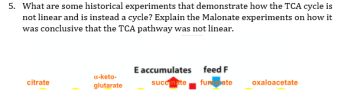 5. What are some historical experiments that demonstrate how the TCA cycle is not linear and is instead a cycle? Explain the Malonate experiments on how it was conclusive that the TCA pathway was not linear. E accumulates succinate a-keto- glutarate feed F furate citrate oxaloacetate
Question #1: In a mitochondrion, the TCA cycle cannot continue on indefinitely without oxygen because the...
Question #1: In a mitochondrion, the TCA cycle cannot continue on indefinitely without oxygen because the electron transport chain will be incapable of reducing NADH and FADH2. a.) True b.) False Question #2:How much energy (in the form of ATP) would one get from oxidation of 1 pyruvate molecule if the pH gradient was destroyed in the mitochondrion? a.) 1 ATP b.) 2 ATP c.) 10 ATP d.) 11.5 ATP e.) 12.5 ATP Question #3: The Fe-S clusters in the...
During the citric acid cycle (TCA) how many times the cycle must turn until an entire...
During the citric acid cycle (TCA) how many times the cycle must turn until an entire GLUCOSE molecule is completely oxidized? A.) 2 B.) 4 C.) 1 D.) 3
What happens to TCA cycle when you have too much of glucose?
What happens to TCA cycle when you have too much of glucose?
 Which of the following statements is TRUE about the TCA cycle? a. oxygen is not used and so the TCA cycle can occur in anaerobic conditions b. The TCA cycle produces two water molecules per glucose molecule c. The carbons from a pyruvate are released in one full turn of the TCA cycle d. FAD is a covalently bound coenzyme in the TCA cycle e. More than one of these statements is true In glycolysis, fructose 1, 6-bisphosphate is converted...
 5. What are some historical experiments that demonstrate how the TCA cycle is not linear and is instead a cycle? Explain the Malonate experiments on how it was conclusive that the TCA pathway was not linear. E accumulates succinate a-keto- glutarate feed F furate citrate oxaloacetate
Most questions answered within 3 hours.
-
Where is the error in this code sequence?
String s1 = "Hello";
String s2 = "ello";...
asked 11 months ago -
Financial data for Joel de Paris, Inc., for last year
follow:
Joel de Paris, Inc.
Balance...
asked 11 months ago -
Consider this reaction:
Al2(SO4)3 (aq)+ BaCl3
(aq) Al2Cl6 (aq)- +
3BaSO4(s) . What is the...
asked 11 months ago -
Suppose that Savneet is considering increasing her
recent random sample from 20 car rentals to 40...
asked 11 months ago -
Trucks arrive at an unloading terminal at an average rate of 120
per hour.
Trucks arrive...
asked 11 months ago -
Why are methanol and ethanol completely soluble in water while
octanol is not very little soluble....
asked 11 months ago -
A facilities manager at a university reads in a research report
that the mean amount of...
asked 11 months ago -
When the CuSO4 is rehydrated by adding water to the anhydrous
compound, is this an endothermic...
asked 11 months ago -
A ray of sunlight is passing from diamond into crown glass; the
angle of incidence is...
asked 11 months ago -
A block of mass 0.249 kg is placed on top of a light, vertical
spring of...
asked 11 months ago -
how do the kidneys compensate in the presences of acidosis
a) trigger hyperventilate
b) reserve acid...
asked 11 months ago -
Question 501 pts
The rental rate of capital to the firm increases. Which of the
following...
asked 11 months ago