If our RAM is full of contents then the CPU use cache and registers otherwise cache...
If our RAM is full of contents then the CPU use cache and registers otherwise cache and registers are free?
Homework Answers
False:
Cache and registers store the instructions which are executed frequently, The sole purpose of the cache memory is to speed up the frequently executed instructions. It is faster than RAM. That doesn't mean these are used only when the RAM is full.
In order to speedup few processes, cache or registers are used.
Add Answer to:
If our RAM is full of contents then the CPU use cache and
registers otherwise cache...
QUESTION 10 The purpose of virtual memory is to use ……… to increase the available address...
QUESTION 10 The purpose of virtual memory is to use ……… to increase the available address space a process can use. A. hard disk as an extension of RAM B. RAM as an extension of CPU C. registers as an extension of arithmetic logic unit (ALU) D. cache as an extension of registers
Given following cache: Show the end result after requesting following data: Read data from RAM address...
 Given following cache: Show the end result after requesting following data: Read data from RAM address 00010 Read data from RAM address 01000 Read data from RAM address 00110 Read data from RAM address 11010 Write data to RAM address 00010 Read data from RAM address 10110 Read data from RAM address 11010 Read data from RAM address 01000 Write data to RAM address 10110 If a read miss request ends up with a RAM load time of 100-ns and...
Module 10 Assignment - Direct-mapped Cache Direct-Mapped Cache In this question you're given a 16-byte memory...
 Module 10 Assignment - Direct-mapped Cache Direct-Mapped Cache In this question you're given a 16-byte memory segment and an 8-byte cache. Given the following series of memory accesses, complete the table below. Use the first Contents/Tag column to insert an item to the cache the first time and use the second Contents/Tag column if a cache entry is overwritten. Note: no index will have more than two blocks mapped to it. The first two examples have been provided. How many...
3. (10) Provide the contents of the registers: RO, R1, R2, and the status flag bits:...
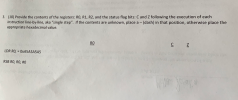 3. (10) Provide the contents of the registers: RO, R1, R2, and the status flag bits: Cand Z following the execution of each instruction line-by-line, aka "single step". If the contents are unknown, place a -(dash) in that position, otherwise place the appropriate hexadecimal value. RO ç z LDR RO, = OxA5A5A5A5 RSB RO, RO, #0
4. Let A =-120 and B = -58. Use 8-bit registers to store the two numbers...
 4. Let A =-120 and B = -58. Use 8-bit registers to store the two numbers (use 2's complement representation). Add now the contents of the two registers and store the result in another 8-bit register. Explain whether the stored result is correct or not.
Programmed in Java, please use inheritance, as that is the part i'm confused on. Thanks! For...
Programmed in Java, please use inheritance, as that is the part i'm confused on. Thanks! For this lab you are creating 4 classes: Main class Has the main method and tests the other classes. Computer We are storing the following information about our computers CPU type CPU speed RAM size Laptop We are storing the following information about our laptops All the information we have in the computer Battery life in hours The current battery level (hours remaining). Charge method...
Vocabulary Exercises is the communication channel that connects all computer system components Cache types that are...
 Vocabulary Exercises is the communication channel that connects all computer system components Cache types that are generally implemented on the same chip as the CPU include 3. thus controlling access to the bus by all other The CPU is always capable of being a(a) devices in the computer system. 4. An) is a reserved area of memory used to resolve differences in data transfer rate or data transfer unit size. 5. A(n) is an area of fast memory where data...
can someone solve this question using registers A, B, and R0.. and using basic coded don't use CMP and LEA. thank yo...
can someone solve this question using registers A, B, and R0.. and using basic coded don't use CMP and LEA. thank you Write an Assembly language program to: A) Store the following text " Welcome to Assembly Language" in the ROM at 200H B) Find how many e letters in this word and store the count in the RAM in location 40H.
Convert the following flowchart into an executable 68000 assembly lanquance program. Use suitable data registers for...
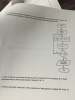 Convert the following flowchart into an executable 68000 assembly lanquance program. Use suitable data registers for SUM and N. Briefly explain what this flowchart does. Write 5 different instructions that will cause the contents of D1 B to cleared to 0. Each instruction that you write should result in making D1.B = 0. Without using MUl instruction. write a sequence of instructions to multiply D1 W by 15.
3. Use any one of the following instructions to explain the steps of the fetch-decode- execute cycle. Your explanation should include what is happening in the related registers. (10 points) Binary...
 3. Use any one of the following instructions to explain the steps of the fetch-decode- execute cycle. Your explanation should include what is happening in the related registers. (10 points) Binary Contents of Hex Contents Memory Address Address Instruction of Memory 100 Load 104 0001000100000100 101 Add 105 102 Store 106 0100000100000110 103 Halt 104 0023 105 FFES 106 0000 1104 0011000100000101 4106 7000 0111000000000000 0000000000100011 0023 FEE9
3. Use any one of the following instructions to explain the steps...
3. Use any one of the following instructions to explain the steps of the fetch-decode- execute cycle. Your explanation should include what is happening in the related registers. (10 points) Binary Contents of Hex Contents Memory Address Address Instruction of Memory 100 Load 104 0001000100000100 101 Add 105 102 Store 106 0100000100000110 103 Halt 104 0023 105 FFES 106 0000 1104 0011000100000101 4106 7000 0111000000000000 0000000000100011 0023 FEE9
3. Use any one of the following instructions to explain the steps...
 Given following cache: Show the end result after requesting following data: Read data from RAM address 00010 Read data from RAM address 01000 Read data from RAM address 00110 Read data from RAM address 11010 Write data to RAM address 00010 Read data from RAM address 10110 Read data from RAM address 11010 Read data from RAM address 01000 Write data to RAM address 10110 If a read miss request ends up with a RAM load time of 100-ns and...
 Module 10 Assignment - Direct-mapped Cache Direct-Mapped Cache In this question you're given a 16-byte memory segment and an 8-byte cache. Given the following series of memory accesses, complete the table below. Use the first Contents/Tag column to insert an item to the cache the first time and use the second Contents/Tag column if a cache entry is overwritten. Note: no index will have more than two blocks mapped to it. The first two examples have been provided. How many...
 3. (10) Provide the contents of the registers: RO, R1, R2, and the status flag bits: Cand Z following the execution of each instruction line-by-line, aka "single step". If the contents are unknown, place a -(dash) in that position, otherwise place the appropriate hexadecimal value. RO ç z LDR RO, = OxA5A5A5A5 RSB RO, RO, #0
 4. Let A =-120 and B = -58. Use 8-bit registers to store the two numbers (use 2's complement representation). Add now the contents of the two registers and store the result in another 8-bit register. Explain whether the stored result is correct or not.
 Vocabulary Exercises is the communication channel that connects all computer system components Cache types that are generally implemented on the same chip as the CPU include 3. thus controlling access to the bus by all other The CPU is always capable of being a(a) devices in the computer system. 4. An) is a reserved area of memory used to resolve differences in data transfer rate or data transfer unit size. 5. A(n) is an area of fast memory where data...
 Convert the following flowchart into an executable 68000 assembly lanquance program. Use suitable data registers for SUM and N. Briefly explain what this flowchart does. Write 5 different instructions that will cause the contents of D1 B to cleared to 0. Each instruction that you write should result in making D1.B = 0. Without using MUl instruction. write a sequence of instructions to multiply D1 W by 15.
 3. Use any one of the following instructions to explain the steps of the fetch-decode- execute cycle. Your explanation should include what is happening in the related registers. (10 points) Binary Contents of Hex Contents Memory Address Address Instruction of Memory 100 Load 104 0001000100000100 101 Add 105 102 Store 106 0100000100000110 103 Halt 104 0023 105 FFES 106 0000 1104 0011000100000101 4106 7000 0111000000000000 0000000000100011 0023 FEE9
3. Use any one of the following instructions to explain the steps...
3. Use any one of the following instructions to explain the steps of the fetch-decode- execute cycle. Your explanation should include what is happening in the related registers. (10 points) Binary Contents of Hex Contents Memory Address Address Instruction of Memory 100 Load 104 0001000100000100 101 Add 105 102 Store 106 0100000100000110 103 Halt 104 0023 105 FFES 106 0000 1104 0011000100000101 4106 7000 0111000000000000 0000000000100011 0023 FEE9
3. Use any one of the following instructions to explain the steps...
Most questions answered within 3 hours.
-
Where is the error in this code sequence?
String s1 = "Hello";
String s2 = "ello";...
asked 11 months ago -
Financial data for Joel de Paris, Inc., for last year
follow:
Joel de Paris, Inc.
Balance...
asked 11 months ago -
Consider this reaction:
Al2(SO4)3 (aq)+ BaCl3
(aq) Al2Cl6 (aq)- +
3BaSO4(s) . What is the...
asked 11 months ago -
Suppose that Savneet is considering increasing her
recent random sample from 20 car rentals to 40...
asked 11 months ago -
Trucks arrive at an unloading terminal at an average rate of 120
per hour.
Trucks arrive...
asked 11 months ago -
Why are methanol and ethanol completely soluble in water while
octanol is not very little soluble....
asked 11 months ago -
A facilities manager at a university reads in a research report
that the mean amount of...
asked 11 months ago -
When the CuSO4 is rehydrated by adding water to the anhydrous
compound, is this an endothermic...
asked 11 months ago -
A ray of sunlight is passing from diamond into crown glass; the
angle of incidence is...
asked 11 months ago -
A block of mass 0.249 kg is placed on top of a light, vertical
spring of...
asked 11 months ago -
how do the kidneys compensate in the presences of acidosis
a) trigger hyperventilate
b) reserve acid...
asked 11 months ago -
Question 501 pts
The rental rate of capital to the firm increases. Which of the
following...
asked 11 months ago