62. Task ID Predecessors Normal Time Maximum Crash Time Normal Cost Crash Cost (Slope) 1 -...
62.
|
Task ID |
Predecessors |
Normal Time |
Maximum Crash Time |
Normal Cost |
Crash Cost (Slope) |
|
1 |
- |
5 |
1 |
50 |
20 |
|
2 |
- |
3 |
2 |
60 |
60 |
|
3 |
1 |
4 |
0 |
70 |
0 |
|
4 |
1 |
2 |
1 |
50 |
10 |
|
5 |
2 |
5 |
3 |
100 |
60 |
|
6 |
3 |
2 |
1 |
90 |
100 |
|
7 |
4 |
5 |
1 |
50 |
30 |
|
8 |
5 |
2 |
0 |
60 |
40 |
|
9 |
6,7,8 |
3 |
1 |
200 |
200 |
Consider the project above. If the indirect costs of the project are: $90 at 15 days, $75 at 14 days, $50 at 13 days, $40 at 12 days, and $30 at 11 days.
Please help crash this project in a manner that minimizes the sum of the total direct and indirect costs. Answer the next 9 questions based on this data.
What is the current estimated project duration in days without any crashing?
|
11 |
||
|
14 |
||
|
13 |
||
|
15 |
63.
What is the current critical path?
|
1-3-6-9 |
||
|
1-4-6-9 |
||
|
2-5-8-9 |
||
|
None of the above |
64.
Currently, which is the cheapest task to crash that can reduce project duration?
|
Task 4 |
||
|
Task 3 |
||
|
Task 1 |
||
|
Task 7 |
65.
After the first iteration of crashing, what is/are the critical path(s)?
|
More than one path is critical |
||
|
1-4-7-9 |
||
|
1-3-6-9 |
||
|
2-5-8-9 |
66.
After the first iteration of crashing, what is the total sum of direct and indirect costs of the project?
|
840 |
||
|
815 |
||
|
830 |
||
|
825 |
67.
Which is the cheapest task to crash for the second iteration that can reduce project duration?
|
Task 2 |
||
|
Task 5 |
||
|
Task 1 |
||
|
Task 6 |
68.
After the second iteration of crashing, what is/are the critical path(s)?
|
1-3-6-9 |
||
|
1-4-7-9 |
||
|
2-5-8-9 |
||
|
All of the above |
69.
After the second iteration of crashing, what is the total sum of direct and indirect costs of the project?
|
810 |
||
|
825 |
||
|
830 |
||
|
840 |
70.
What is the maximum time we can reduce the duration of the project by, for the third iteration of crashing?
|
0 |
||
|
3 |
||
|
1 |
||
|
2 |
Homework Answers


Answer summary: precedence diagram and finding the critical paths, duration, crashing.
Add Answer to:
62.
Task ID
Predecessors
Normal Time
Maximum Crash Time
Normal Cost
Crash Cost (Slope)
1
-...
Assume the network and data that follow: ACTIVITY NORMAL TIME (WEEKS) NORMAL COST CRASH TIME (WEEKS)...
Assume the network and data that follow: ACTIVITY NORMAL TIME (WEEKS) NORMAL COST CRASH TIME (WEEKS) CRASH COST IMMEDIATE PREDECESSORS A 3 $ 60 2 $ 80 — B 5 70 4 110 A C 9 50 6 80 A D 7 100 6 130 A E 8 90 6 100 B F 5 30 3 50 D G 6 110 5 190 C, E, F b. Indicate the critical path when normal activity times are used. A-B-E-G A-C-F-G A-D-E-G...
Normal Time Crash Time Normal with Activity (weeks) (weeks) Cost Crashing Immediate Predecessor(s) $1,400 A 3...
 Normal Time Crash Time Normal with Activity (weeks) (weeks) Cost Crashing Immediate Predecessor(s) $1,400 A 3 2 $2,050 $2,800 B 2 1 $2,100 1 1 $350 $350 7 $1,400 $1,700 A 6 3 $900 $1,200 $5,000 $2,000 F 2 $4,000 $1,500 C 4 G 2 D, E weeks a) Based on the given information regarding the activities for the project, the project completion date b) To reduce the duration of the project to 10 weeks at the least cost, the...
Find the optimal way to achieve a project duration of 27 days? Use the template below...
Find the optimal way to achieve a project duration of 27 days? Use the template below to record your steps InClass – Project Crashing Exercise Project details: Task Predecessor N (days) C (days) D1 ($) D2 ($) A start 7 5 40 80 B A 9 8 60 70 C B 12 10 90 150 D start 10 7 60 120 E D 5 4 50 60 F E 10 6 80 140 Fin C, F Find the optimal way...
1. When finding the approximate probability of project duration, it is necessary to know which of...
1. When finding the approximate probability of project duration, it is necessary to know which of following? a. The mean and variance of each activity b. The mean of each activity on the CP c. The sd of only the activities on the CP d. Each activity's probability of completion e. The distribution of activity times 2. The sd of a path is computed as: a. the sum of the sd of all activities on the path b. the square...
Lecture Exercise #13 Project Crashing Time (weeks) Cost Activity Predecessori s) Normal Crash Normal Crash A...
 Lecture Exercise #13 Project Crashing Time (weeks) Cost Activity Predecessori s) Normal Crash Normal Crash A None 3 2 1000 1600 B None 2 1 2000 2700 C None 1 1 300 300 D A 7 3 1300 1600 E B 6 3 850 1000 F с 2 1 4000 5000 D, E 2000 G 4 2 1500 What's the normal project completion time? Identify the critical path If you'd like to shorten the project by one week, which activity...
Question 18 What are the two principles when crashing a project? Focus on the critical path,...
Question 18 What are the two principles when crashing a project? Focus on the critical path, select the least expensive alternative. Reduce the cost, reduce the duration. Reduce the duration, increase the cost. Reduce the use of resources, reduce the cost 4 points Question 19 The formula for computing the cost/time slope for each activity that can be crashed is . (Crash cost + Normal cost) / (Crash time + Normal time) (Crash cost - Normal cost) / (Crash time...
Given the following information about a small project, Task Duration Immediate Estimates Predecessors A &n
Given the following information about a small project, Task Duration Immediate Estimates Predecessors A 2 days None B 5 days A C 4 days B D 9 days A E 4 days B & D F 12 days E & C Draw a network diagram. Identify the critical path, earliest start and finish and slack for each task. Using MS Excel, produce a Gantt chart for this project. What would happen if a new estimate for task D increases...
Time-Cost Model Exercise Information for the Time-Cost Model ExerciseCrash Task Immediate Normal Crash Predecessors Time Time...
 Time-Cost Model Exercise Information for the Time-Cost Model ExerciseCrash Task Immediate Normal Crash Predecessors Time Time Cost Cost (weeks) (weeks) $5,000 $11,000 $10,000 $20,000 $6,000 $9,000 | $4,000-168,000 NONE B and C 2 4, Crash Project-go back to able in #3
Question 1: I)-What is the normal cost of this project? II)-What is the cost of the...
 Question 1:
I)-What is the normal cost of this project?
II)-What is the cost of the project after 2 days shortening?
III)-What is the crashing cost per day for activity G?
Given the following data and network, find answer the questions 18-20 if you're asked to finish this project 2 days earlier than its normal duration. Indirect cost (overhead) is $200 per day. 9.12 E 3 1.8 12. 19 10,13 B 7 1,8 13.20 0,1 1,7 8.15 20,25 15.20 F...
Question 1:
I)-What is the normal cost of this project?
II)-What is the cost of the project after 2 days shortening?
III)-What is the crashing cost per day for activity G?
Given the following data and network, find answer the questions 18-20 if you're asked to finish this project 2 days earlier than its normal duration. Indirect cost (overhead) is $200 per day. 9.12 E 3 1.8 12. 19 10,13 B 7 1,8 13.20 0,1 1,7 8.15 20,25 15.20 F...
Normal Duration "Crashable" Normal Maximum Crash Cos Activity Predecessor (days) Duration Per Day* Days Cost($000s) 000s...
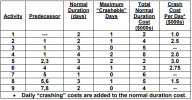 Normal Duration "Crashable" Normal Maximum Crash Cos Activity Predecessor (days) Duration Per Day* Days Cost($000s) 000s 2.5 2.0 3.0 2.75 4 4 2,3 4 2 4 3 5,6 7,8 1.5 4 Daily "crashing" costs are added to the normal duration cost
 Normal Time Crash Time Normal with Activity (weeks) (weeks) Cost Crashing Immediate Predecessor(s) $1,400 A 3 2 $2,050 $2,800 B 2 1 $2,100 1 1 $350 $350 7 $1,400 $1,700 A 6 3 $900 $1,200 $5,000 $2,000 F 2 $4,000 $1,500 C 4 G 2 D, E weeks a) Based on the given information regarding the activities for the project, the project completion date b) To reduce the duration of the project to 10 weeks at the least cost, the...
 Lecture Exercise #13 Project Crashing Time (weeks) Cost Activity Predecessori s) Normal Crash Normal Crash A None 3 2 1000 1600 B None 2 1 2000 2700 C None 1 1 300 300 D A 7 3 1300 1600 E B 6 3 850 1000 F с 2 1 4000 5000 D, E 2000 G 4 2 1500 What's the normal project completion time? Identify the critical path If you'd like to shorten the project by one week, which activity...
 Time-Cost Model Exercise Information for the Time-Cost Model ExerciseCrash Task Immediate Normal Crash Predecessors Time Time Cost Cost (weeks) (weeks) $5,000 $11,000 $10,000 $20,000 $6,000 $9,000 | $4,000-168,000 NONE B and C 2 4, Crash Project-go back to able in #3
 Question 1:
I)-What is the normal cost of this project?
II)-What is the cost of the project after 2 days shortening?
III)-What is the crashing cost per day for activity G?
Given the following data and network, find answer the questions 18-20 if you're asked to finish this project 2 days earlier than its normal duration. Indirect cost (overhead) is $200 per day. 9.12 E 3 1.8 12. 19 10,13 B 7 1,8 13.20 0,1 1,7 8.15 20,25 15.20 F...
Question 1:
I)-What is the normal cost of this project?
II)-What is the cost of the project after 2 days shortening?
III)-What is the crashing cost per day for activity G?
Given the following data and network, find answer the questions 18-20 if you're asked to finish this project 2 days earlier than its normal duration. Indirect cost (overhead) is $200 per day. 9.12 E 3 1.8 12. 19 10,13 B 7 1,8 13.20 0,1 1,7 8.15 20,25 15.20 F...
 Normal Duration "Crashable" Normal Maximum Crash Cos Activity Predecessor (days) Duration Per Day* Days Cost($000s) 000s 2.5 2.0 3.0 2.75 4 4 2,3 4 2 4 3 5,6 7,8 1.5 4 Daily "crashing" costs are added to the normal duration cost
Most questions answered within 3 hours.
-
Where is the error in this code sequence?
String s1 = "Hello";
String s2 = "ello";...
asked 11 months ago -
Financial data for Joel de Paris, Inc., for last year
follow:
Joel de Paris, Inc.
Balance...
asked 11 months ago -
Consider this reaction:
Al2(SO4)3 (aq)+ BaCl3
(aq) Al2Cl6 (aq)- +
3BaSO4(s) . What is the...
asked 11 months ago -
Suppose that Savneet is considering increasing her
recent random sample from 20 car rentals to 40...
asked 11 months ago -
Trucks arrive at an unloading terminal at an average rate of 120
per hour.
Trucks arrive...
asked 11 months ago -
Why are methanol and ethanol completely soluble in water while
octanol is not very little soluble....
asked 11 months ago -
A facilities manager at a university reads in a research report
that the mean amount of...
asked 11 months ago -
When the CuSO4 is rehydrated by adding water to the anhydrous
compound, is this an endothermic...
asked 11 months ago -
A ray of sunlight is passing from diamond into crown glass; the
angle of incidence is...
asked 11 months ago -
A block of mass 0.249 kg is placed on top of a light, vertical
spring of...
asked 11 months ago -
how do the kidneys compensate in the presences of acidosis
a) trigger hyperventilate
b) reserve acid...
asked 11 months ago -
Question 501 pts
The rental rate of capital to the firm increases. Which of the
following...
asked 11 months ago