1. Describe how a major depressive episode is different than feeling sad or in a funk...
1. Describe how a major depressive episode is different than feeling sad or in a funk now and then.
Homework Answers
People often assume being in bad mood as depression. However depression is far much more than a bad mood. Depression is a serious clinical condition. Mood is a relatively temporary condition. However depression is a prolonged condition for weeks (two weeks to be specific as per DSM 5). Major Depressive Disorder is accompanied by a variety of symptoms. These are:
- Depressed mood most of the day or everyday
- Diminished interest and pleasure in almost all activities
- Significant weight loss or gain
- Insomnia or Hypersomnia
- Psychomotor agitation or retardation
- Fatigue or loss of energy
- Feelings of worthlessness or excessive guilt
- Diminished ability to think and concentrate
- Recurrent thoughts of death and suicidal ideation
These symptoms should be present in order to be diagnosed with Depression. Now being in a sad mood now and then doesn't lead to all these symptoms always. Also, all these symptoms must cause clinically significant impairment in areas of social, occupational and interpersonal functioning. Being in sad mood may not lead to impairment in functioning. Thus being in a sad mood is normal as long as it doesn't turn into depression. One should be able to recognize when these symptoms start becoming prominent.
Hope this answer helps! If it did, kindly rate a thumbs up. For further clarification on the answer please mention in the comments section.
Add Answer to:
1. Describe how a major depressive episode is different than
feeling sad or in a funk...
How do you describe major depressive disorder? .
How do you describe major depressive disorder? .
Define and describe the features of mood disorders such as: Major Depressive Disorder, Persistent Depressive Disorder,...
Define and describe the features of mood disorders such as: Major Depressive Disorder, Persistent Depressive Disorder, Premenstrual Dysphoric Disorder, Cyclothymic, Bipolar I and Bipolar II and out of these disorders which do you believe to be the most severe? Explain your answer. please cite where you get your info from
24. Bipolar I Disorder requires a. Hypomanic symptoms b. At least one hypomanic episode c. At...
 24. Bipolar I Disorder requires a. Hypomanic symptoms b. At least one hypomanic episode c. At least one manic episode d. At least one manic episode and one majo r depressive episode 25. How is Major Depressive Disord er (MDD) different from Persistent Depressive Disorder (PDD)? a. The depression in MDD is not significant b. The depression in PDD is strikingly different from non-depressed mood, while thsho c. d. necessarily true for MDD The depression in PDD is more chronic...
1.Consider the assessment and diagnosis of major depressive disorder and bipolar disorder in adults (two of...
1.Consider the assessment and diagnosis of major depressive disorder and bipolar disorder in adults (two of the most common psychiatric disorder seen in acute and outpatient settings) a. Discuss how treatment for the two disorder is different and why it is different. What are some examples of specific pharmacological and non-pharmacological interventions? b. When performing a psychiatric evaluation why is it critical to have access to an immediate family or close friend to confirm information?
Discussion Topics, Mohr Chapter 27, Depressive Disorders Discussion Topics Learning Objective 1. Depression is...
Discussion Topics, Mohr Chapter 27, Depressive Disorders Discussion Topics Learning Objective 1. Depression is often referred to as the common cold of mental illness because it affects so many individuals at some point in their lives. When was the last time you felt “down” or sad? What were the circumstances? Did you consciously do anything about this feeling, or did the feeling just “go away”? Have you noticed any particular events or circumstances in your life that are related to...
Steph has been feeling blue lately. Ever since her boyfriend broke-up with her last month, she...
Steph has been feeling blue lately. Ever since her boyfriend broke-up with her last month, she doesn’t enjoy things like she used to and is frequently sad. She is concerned that she might be developing depression. She calls her mom to ask her what she thinks, as her mom has experienced several major depressive episodes in her lifetime. Explain how the diathesis-stress model of mental illness would apply to this situation. Be sure to define the diathesis-stress model overall, identify...
Summarize how to look for Depressive Syndromes. Describe the Relationship between Depression and Substance Abuse.
Summarize how to look for Depressive Syndromes. Describe the Relationship between Depression and Substance Abuse.
As a guy, describe a personal experience of feeling different, or not “fitting in” with a...
As a guy, describe a personal experience of feeling different, or not “fitting in” with a larger group. Been a guy could these experiences relate to not fitting in because of gender, ethnicity, sexuality, nationality, language, religion (or irreligion), age, or any other reason. Then, in each situation identify the “in-group” from which you felt excluded, and the “out-group” that you felt you were being assigned to by others. Then briefly describe whether or not you changed something about yourself...
Describe, in your own words, how the story in the NOVA episode is a good example...
Describe, in your own words, how the story in the NOVA episode is a good example of the scientific method working properly.
Question 10 (1 point) Kolya recently started college in a new city far away from her...
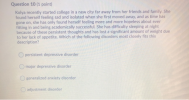 Question 10 (1 point) Kolya recently started college in a new city far away from her friends and family. She found herself feeling sad and isolated when she first moved away, and as time has gone on, she has only found herself feeling more and more hopeless about ever fitting in and being academically successful. She has difficulty sleeping at night because of these persistent thoughts and has lost a significant amount of weight due to her lack of appetite....
 24. Bipolar I Disorder requires a. Hypomanic symptoms b. At least one hypomanic episode c. At least one manic episode d. At least one manic episode and one majo r depressive episode 25. How is Major Depressive Disord er (MDD) different from Persistent Depressive Disorder (PDD)? a. The depression in MDD is not significant b. The depression in PDD is strikingly different from non-depressed mood, while thsho c. d. necessarily true for MDD The depression in PDD is more chronic...
 Question 10 (1 point) Kolya recently started college in a new city far away from her friends and family. She found herself feeling sad and isolated when she first moved away, and as time has gone on, she has only found herself feeling more and more hopeless about ever fitting in and being academically successful. She has difficulty sleeping at night because of these persistent thoughts and has lost a significant amount of weight due to her lack of appetite....
Most questions answered within 3 hours.
-
Where is the error in this code sequence?
String s1 = "Hello";
String s2 = "ello";...
asked 10 months ago -
Financial data for Joel de Paris, Inc., for last year
follow:
Joel de Paris, Inc.
Balance...
asked 10 months ago -
Consider this reaction:
Al2(SO4)3 (aq)+ BaCl3
(aq) Al2Cl6 (aq)- +
3BaSO4(s) . What is the...
asked 10 months ago -
Suppose that Savneet is considering increasing her
recent random sample from 20 car rentals to 40...
asked 10 months ago -
Trucks arrive at an unloading terminal at an average rate of 120
per hour.
Trucks arrive...
asked 10 months ago -
Why are methanol and ethanol completely soluble in water while
octanol is not very little soluble....
asked 10 months ago -
A facilities manager at a university reads in a research report
that the mean amount of...
asked 10 months ago -
When the CuSO4 is rehydrated by adding water to the anhydrous
compound, is this an endothermic...
asked 10 months ago -
A ray of sunlight is passing from diamond into crown glass; the
angle of incidence is...
asked 10 months ago -
A block of mass 0.249 kg is placed on top of a light, vertical
spring of...
asked 10 months ago -
how do the kidneys compensate in the presences of acidosis
a) trigger hyperventilate
b) reserve acid...
asked 10 months ago -
Question 501 pts
The rental rate of capital to the firm increases. Which of the
following...
asked 10 months ago